
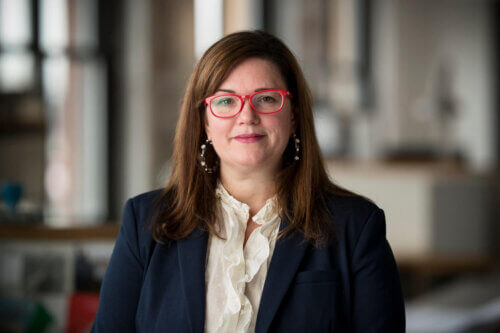
A Science + Technology Design Principal at HGA, Breana Werner is dedicated to finding elegant architectural solutions to complex and highly functional buildings. She is a talented designer who understands that at the heart of great design, there is empathy. Breana’s knowledge transcends the exterior of a building, as she is extensively involved in the detailing of laboratory, community, and office spaces, which is evident in her work.
Reflected in Breana’s work is her aptitude for creating spaces that are open, engaging, and inclusive—along with a strong understanding of color, material, and scale. Breana is currently the design principal on the Institute for Integrative & Innovative Design at the University of Arkansas, and her portfolio includes award-winning projects such as MIT.nano at the Massachusetts Institute of Technology, the Graduate School of Public Health at the University of Pittsburgh, and the transformative Hult House at Hult International Business School.
Continue reading as Breana shares her thoughts ranging from her approach to designing technically complex spaces that generate research innovation and interdisciplinary collaboration, to mentoring and guiding the next generation of design professionals at HGA.
Growing up, did anything or someone influence or inspire you to pursue a career in architectural design?
I come from a family of engineers, and teachers. My mother was a teacher and school administrator and my father a mechanical and plastics engineer working in Research & Development. He had a workshop and drafting table in the basement, and I would often see him prototyping projects in the basement. At one time, he drew up plans for a renovation to our house. The renovation included ripping off the roof of the entire second floor while we lived in the basement during construction, so I saw how the process works, at least from a residential perspective. That started my interest in architecture. Solving challenges was the interesting part for me. Architecture is like a puzzle, fitting the different pieces together. The idea that there are many possible solutions is intriguing to me.
If you had chosen a different career path, what would you be doing?
I’m interested in all things medical. My brother is a gastroenterologist and, in many ways, I’m living vicariously through him. So, I would have been a doctor if not an architect.
What is your approach to design and what inspires you?
For me, it is always the emotional response to space and how architecture and space can change the way people live, act, and relate to each other. I think that is part of the reason I ended up designing for higher education.
Yet I feel the most satisfied when everyone on a team is operating as powerfully and effectively as possible, when everyone’s working in an integrated approach, and everyone feels a sense of ownership on the project. Architecture is a collaborative process and some of the best ideas come from that experience.
Can you share a couple of challenges and opportunities you see the architectural profession is faced with today?
We are seeing changes in pedagogy and how students learn. Education is becoming much more interdisciplinary. Academic spaces are becoming more flexible and open to accommodate a range of learning styles and programming needs. Rather designing a single-purpose building to accommodate a specific discipline, campuses are creating learning spaces and labs where researchers and students can work across disciplines. This interdisciplinary approach is blurring the lines between traditional departmental silos.
As architects, we need to be good shepherds of different learning styles and understand diverse voices to create equitable spaces that work for all, not just one type of person. We also must consider what is a healthy building, a well building, a sustainable building that is responsible and welcoming not only to the occupants but to the ecosystem.
What do you find most rewarding about your job?
One thing we did during COVID was form a mentorship program with Girls, Inc., that focuses on high school girls in underserved communities in the greater Boston area. Girls, Inc., offers a range of after-school programs that provide career resources and learning opportunities in STEM and other fields. This gives the students a window into different opportunities that they might not otherwise have been aware of. In one instance, we helped a young girl develop and tailor her portfolio for architecture school. We later found out she got accepted to the school of her choice.
That was probably the most satisfying part of my job during the pandemic—helping someone achieve her goals.
Do you have a definition of a successful project?
Success is not only about the finished product but the process of getting there. The client needs a beautiful, functional building and we achieve that goal together through a strong team process.
Where would we find you if you were to take a month off from work?
South India. My husband and I received a grant after college to study Dravidian Hindu temples in South India for about five weeks. We immersed ourselves in the culture and history of the temples. It was one of those purely wonderful trips, everything about it just resonated with us. It was a full-bodied experience that I loved.
If you were to give one piece of advice to this year’s architectural design graduates, what would it be?
Be open and nimble in your thinking about what it means to be an architect. Find your passion and find where that passion fits into architecture. There are so many paths within the broad stroke of architecture. If you’re passionate about data science or sustainability, or cultural anthropologists—or another area—you can easily parlay that passion within the architecture field and tie it into making space.
At the same time, don’t be afraid to be the classic architect. Sometimes people feel that they must specialize, but there’s the other side where you know a lot about a variety of things—the classic model of the architect. There’s space for both of those career visions, so I encourage young designers not to be myopic about what the field is.
Are there any HGA initiatives or projects you’re currently involved with that you’d like to highlight?
I’m fortunate to work across different market sectors and be involved in a range of innovative projects.
For instance, I’m currently working on the Institute for Integrative & Innovative Research (I3R) at the University of Arkansas, which will serve as a hub between the Institute and the entire campus to accommodate cross-disciplinary research. This is a satisfying project because it is an integrated HGA team process with experts and disciplines working across different offices. It’s also a mass timber project that has an entrepreneurial aspect from the local economy.
I’m also working on a developer-led project in San Diego that includes tenant fit-out of nine existing buildings and new construction.