
Many research institutions exist to improve human health by moving knowledge from the laboratory into care. Their buildings are often understood as instruments of that purpose, supplying the space, equipment, and technical conditions the work requires. They also create the environment in which that purpose is lived, day after day, by everyone whose labor makes the work possible.
A building enters that purpose through choices that can look almost incidental. A laboratory benchtop, a wall finish, or a can of primer may seem far removed from the ambition to cure disease. Each choice still determines what substances workers handle, what researchers live with, and what manufacturers are asked to produce. Materials place the building inside a chain of human consequence that begins before construction and continues long after occupancy
The Materials Inside the Mission
The Living Building Challenge Red List gives institutions one way to follow that chain. It identifies building-product chemicals associated with serious harm to human health and the environment. Some are linked to cancer, reproductive toxicity, or damage to organs and endocrine systems. Their effects can be borne by people who manufacture a product, those who install it, and those who eventually occupy the building. Choosing materials with greater care extends an institution’s concern for health to people who may never appear in its research reports, but whose bodies are implicated in the work all the same.
In a laboratory, that concern for health must also meet the conditions of science. A surface has to withstand harsh chemicals and years of cleaning and use. A coating may have to satisfy fire and life-safety requirements. Public projects must preserve competitive bidding, and schedules leave little room for products that exist only in theory. A commitment to healthier materials matters only if it can guide choices under those conditions.
Carrying the Goal into Construction
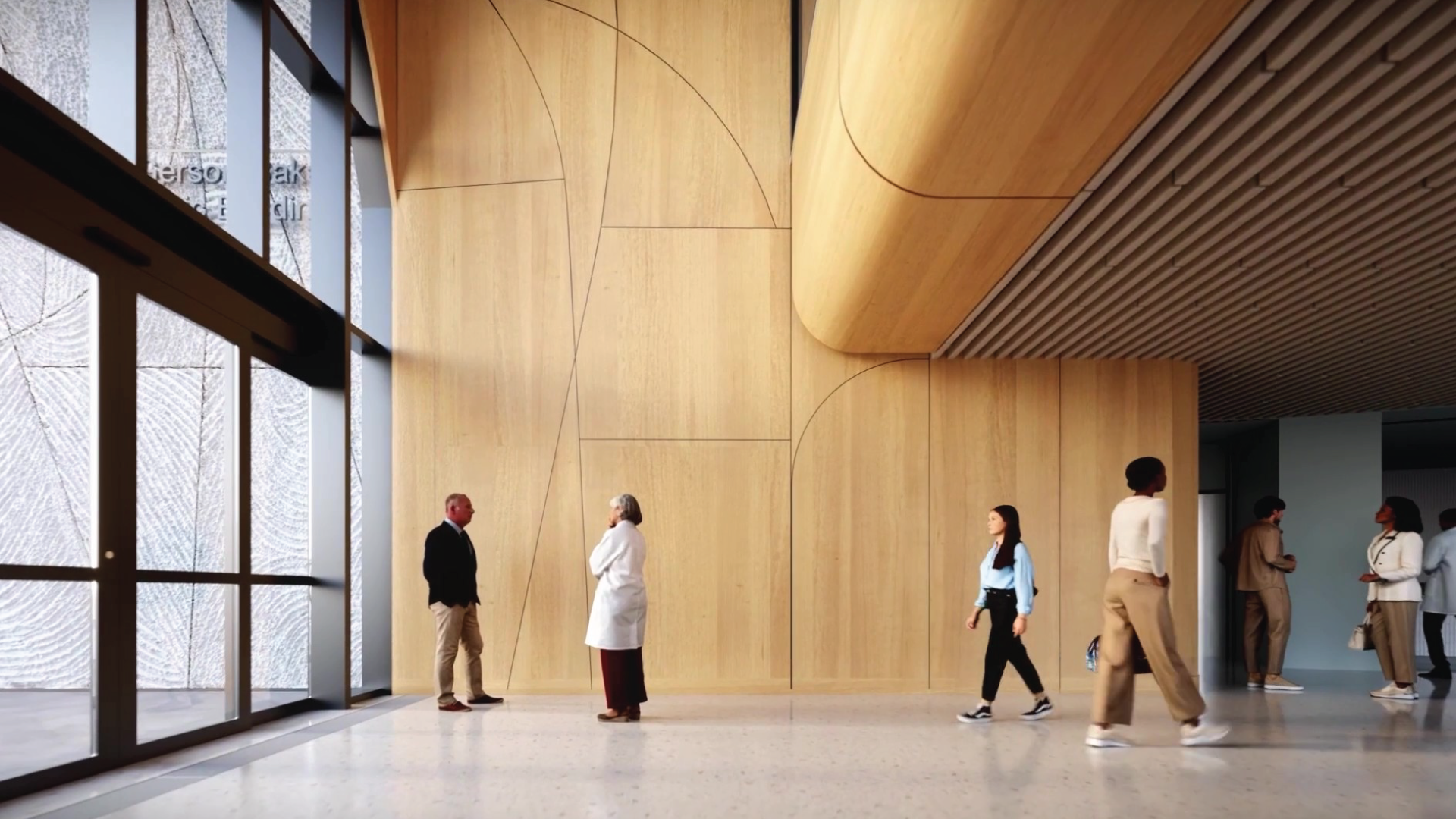
The University of California, San Francisco (UCSF) took up that challenge early in planning the Barbara and Gerson Bakar Research and Academic Building (BRAB). BRAB will bring together 15 academic departments, clinical research spaces, and the School of Nursing. UCSF’s mission is to advance health worldwide. The institution decided that the materials surrounding that work should reflect the same concern for health, setting a target of avoiding Red List chemicals in 90 percent of interior finish materials by cost.
That ambition then had to survive the long distance between an early intention and a finished building. Products change. Contractors propose substitutions. A material that appeared acceptable during design may arrive with new ingredients or outdated documentation. We helped UCSF turn its goal into instructions that could govern those moments. We identified which materials would count, what proof manufacturers needed to provide, and when an exception could be considered. We placed those requirements in the documents used to purchase and build the project, then reviewed the actual products proposed during construction. The original question stayed attached to each decision. Does this material meet UCSF’s standard for health, and how do we know?
Two Products and Two Answers
The laboratory benchtops are a good example of how a project can alter the choices the market offers. Fundermax made a laboratory-grade compact laminate capable of withstanding constant use and exposure to strong chemicals, but the company had not disclosed enough about its ingredients for us to verify the product against UCSF’s standard. When we explained the scale of BRAB and the importance of ingredient transparency to UCSF, Fundermax pursued a Declare label that publicly reported the product’s contents and its relationship to the Red List. UCSF gained a competitively priced option that met the project criteria without a premium, while other institutions gained information they could use to evaluate the same product. A requirement that began with one building had made that product more transparent to the wider market.
But the market did not answer every request so readily. For the primer used on BRAB’s steel stairs, we identified an alternative whose ingredients aligned more closely with UCSF’s goal, and the project team purchased samples and tested it in a full-scale installation. The alternative could not meet the demands of the application, and the project returned to the standard primer. By then, however, the choice carried a record of what had been tried, what the test revealed, and why the project had changed course. The compromise remained visible, along with the gap between the materials UCSF wanted and those the project could use.
The Influence of a Single Project
Together, these decisions show what it means for a value to govern the creation of a building. In one case, the demand for healthier materials prompted a manufacturer to provide greater transparency. In the other, the same demand exposed a limit and made the reason for an exception clear. Both outcomes were more deliberate because health had become an established criterion for making the choice.
Research institutions exercise purchasing power with every building they commission. Each specification tells manufacturers what a buyer will accept, and each purchase rewards what the market already supplies. When an institution asks for ingredient transparency and safer formulations, then follows that expectation through construction, it gives manufacturers a commercial reason to respond. A single project can give an emerging demand enough weight for manufacturers to answer it.
This is how mission passes from language into matter. It begins with ordinary questions asked consistently. What is this product made of? Who encounters it before it reaches the building? Does its performance require the substances it contains? What could become available if enough institutions asked for something better?
For institutions devoted to health, these questions belong inside their missions. At BRAB, they changed what we asked of products, what we required from manufacturers, and how the project team weighed difficult choices. The place where science happens is part of the human world the science hopes to improve. Its materials, and the lives attached to them, already lie within the institution’s field of care.