
The development of ambulatory surgery centers (ASC) is one of the fastest growing segments of the healthcare industry, offering specialized care for a demographically expanding patient base.
Multiple factors are driving this growth, yet common considerations guide the planning and design process. As you look for a design partner, it’s important to start with the basic questions: Why, How, What and When. The right team with the right balance of expertise—interdisciplinary research, planning and design supported with measurable results—can provide the answers.


 Why
Why
The reason to develop an ASC is usually driven by one or more market challenges and opportunities, such as inadequate capacity at the main hospital. This could mean not enough procedure rooms to accommodate services, or not enough space within existing rooms to function well—or both. Shifting hospital-based volumes to an ASC can increase system-wide capacity, often for less cost than a hospital renovation.
Bellin Memorial Hospital solved its capacity challenges with a new right-sized Ambulatory Surgery & Specialty Center that includes imaging, lab services, and operating room suites. The facility increases accessibility and services for the local community and region while decompressing Bellin’s main hospital for new strategic planning.

 What and When
While many ASCs begin as single-specialty surgery centers, identifying what services to expand and when to build can provide long-term advantages for the healthcare system and community. Your design partners can help apply data analytics and research tools to assess space needs in context of workflows, medical equipment, service lines, and projected patient volume within your market.
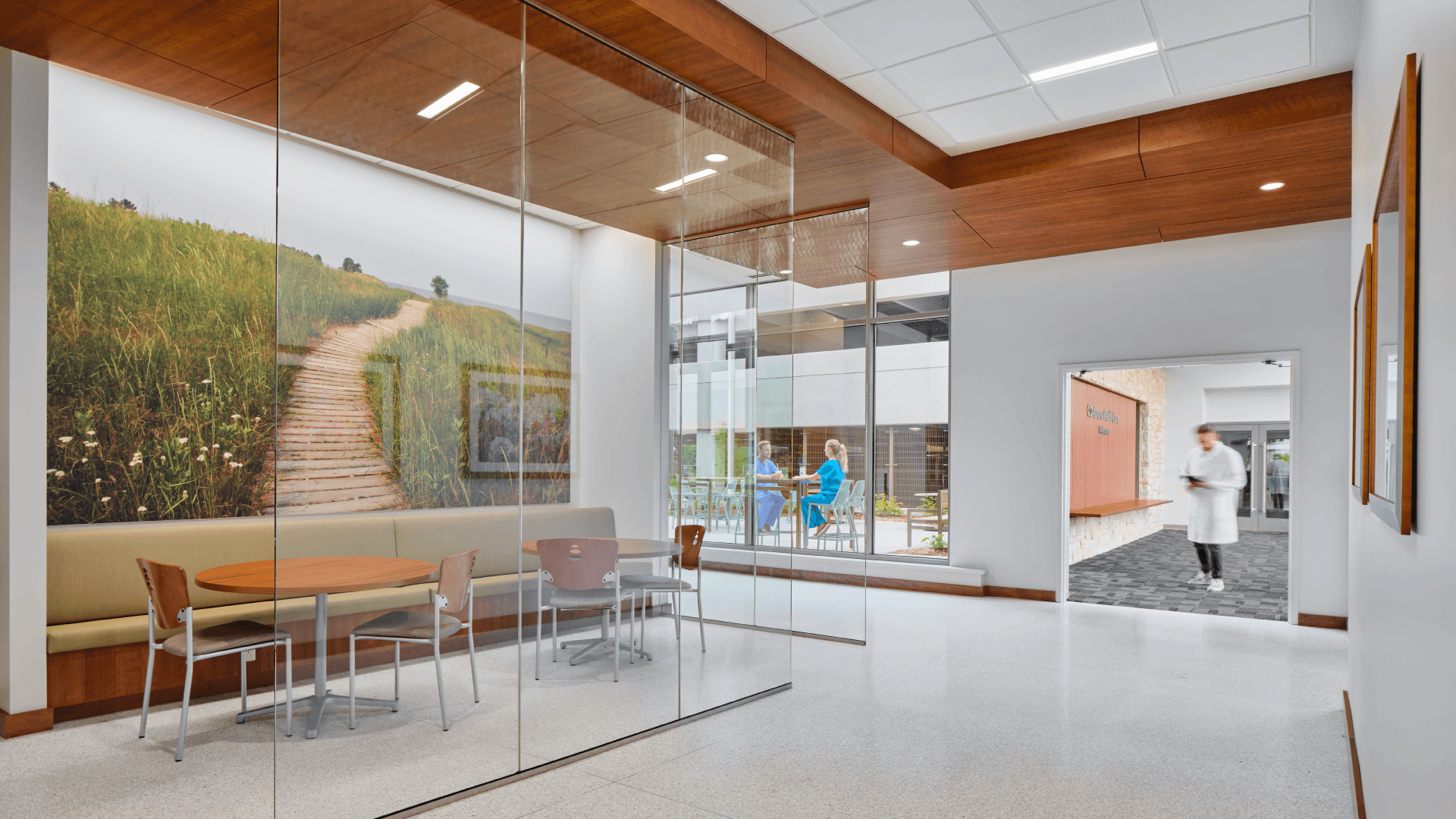
To that end, Advocate Aurora Health Center consolidated its outpatient facilities with the opening of 84 South Ambulatory Surgery and Health Center, part of a mixed-use development. Following a speed-to-market timeline, the design team structured its process around AAH’s core values, focused on Lean project delivery, safety, and diversity—enabling the healthcare system to direct savings toward expanding patient services.
 How
How
You also need to decide how to optimize space planning to flexibly accommodate different procedures. For instance, should ORs be universally sized so any case can be done in any room? Planning a flexible, universal care platform may be optimal since the acuity level of cases in ambulatory facilities is projected to increase, taking on more procedures previously performed in hospitals.
ThedaCare’s Orthopedic, Spine and Pain Center focuses on a flexible process neutral platform that accommodates a range of surgical procedures. Additionally, operationally efficient staff work zones support collaboration between caregivers, drawing on earlier post-occupancy research from ThedaCare’s Regional Cancer Center.

Moving Forward
Ambulatory surgery centers are an investment in the community—an integral part of a wider network of care that enables communities to thrive. Planning an ASC is a partnership between the healthcare system, caregivers, developers, architects, and community members. To dive deeper into why, what, when and how to plan ambulatory surgery centers as a strategic advantage, read our full whitepaper.
About the Authors

Andrew Zimmer
With extensive experience leading Lean planning engagements at all scales, regionally and nationally, Andrew combines open-minded curiosity with a rigorous attention to detail.

Paul Widlarz
Paul is committed to supporting his clients’ business strategies. As principal and project manager, he combines his background in medical planning and project management to direct the programming, planning, and design process.