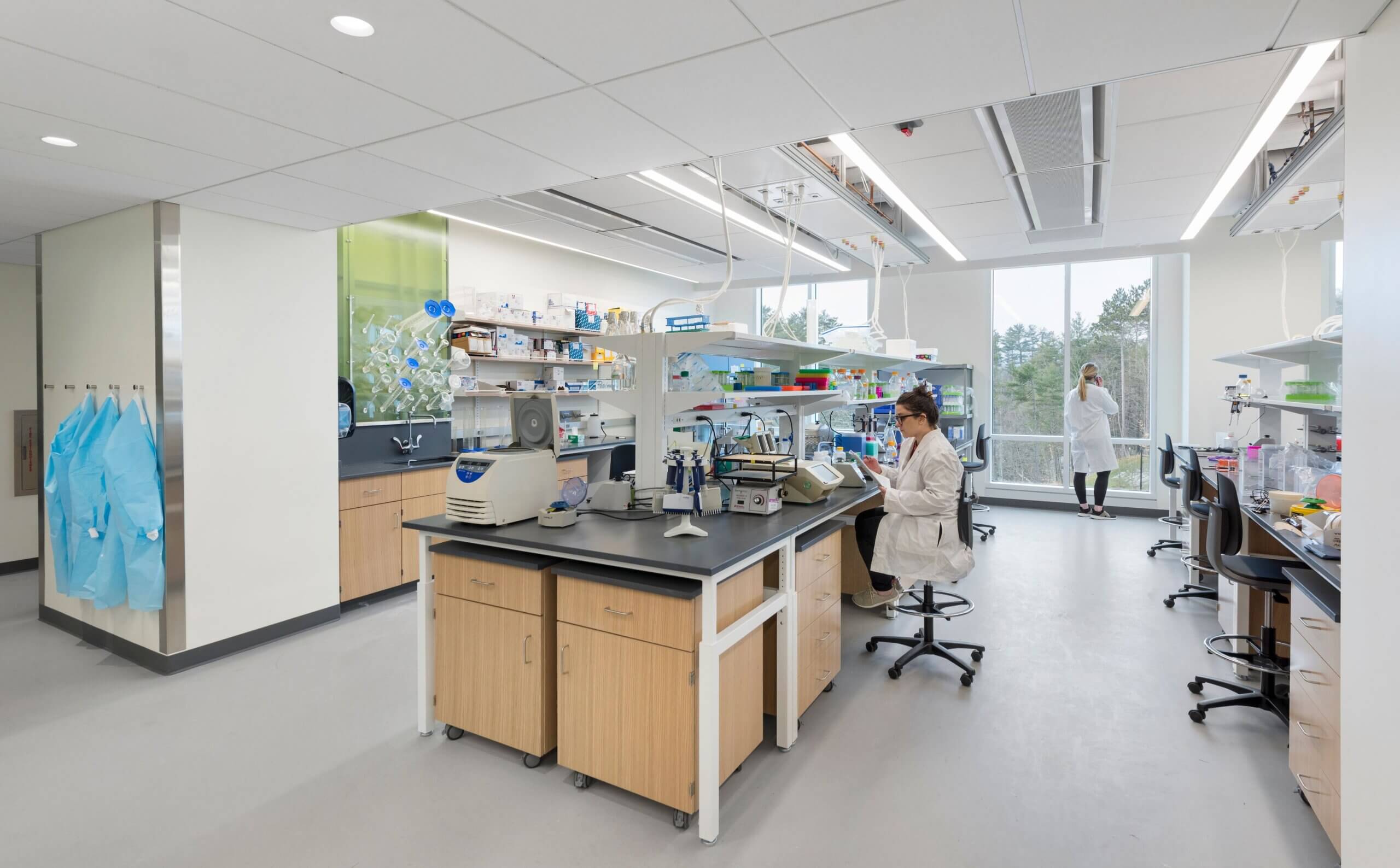

Architect and Planning Principal Arlen Li is a national leader in HGA’s Science + Technology market sector. Recognized for his holistic approach to lab planning and design, Arlen leads initiatives to develop teaching and research buildings that set new standards in energy efficiency and significantly reduce fossil fuel reliance.
In the following, Arlen highlights his early experiences and influences that have shaped his dedication to environmental design and discusses some of the strategies our teams employ to deliver sustainable research buildings for leading academic and corporate life sciences clients throughout the United States. Arlen discusses the implementation of passive design elements such as access to natural lighting and ventilation, alongside water conservation measures, and optimized energy efficiencies. He also emphasizes the importance of prioritizing responsible use of materials and opting for eco-friendly, recycled, and locally sourced options to create healthier interior environments.

What inspires and motivates your professional commitment to environmental stewardship?
I remember my first real connection with sustainability was about 30 years ago, attending a small group course on environmental design for buildings. I wouldn’t have been able to articulate it in a detailed manner, but my takeaway from the course was that there was some essential connection between what we build and how much impact, positive or negative, that can have on our greater ecosystems. It resonated with my own view that no resources are unlimited and keeping a balance between built and natural environments is both an individual and collective responsibility.
At that time, most clients were either not aware of sustainable design or just learning about it. Now, clients are generally much more knowledgeable about potential strategies and more inclined to incorporate sustainability into their overall project vision, and that has motivated me to continually increase my knowledge and advocacy for environmental stewardship.
How do these influences shape your philosophy and approach to integrating sustainability into the architectural planning and design process?
More and more, I see how our building activities, among the most resource-intensive and carbon-emitting, influence our surrounding environment as evidenced by climate change, which in turn affects living conditions. It is the direct link between our built structures and daily quality of life that leads me to the view that sustainable thinking should be part of the basic planning and design approach to any project. For example, performance targets should be treated like programmatic requirements for the building, not optional items.
Why focus on sustainable laboratories?
I did not go into the architectural profession with the aim of focusing on lab buildings, but by circumstance, my early work was all on science facilities. I soon learned that labs, particularly because of their high energy demands, pose a greater challenge than almost any other building to reduce their environmental impact. At the same time, there is much greater potential for real energy savings through implementation of targeted strategies.
Although energy conservation was the key focus for sustainable labs early on, more attention has been given recently to other components, such as water conservation and healthy materials, which are also significant contributors to sustainability.
How is it achievable to minimize the environmental impact of research environment requirements such as fume hoods, cleanrooms, and other high intensity equipment cooling loads?
There are many factors in the establishment of design loads for research labs. One of the challenges is that lab needs will change as discoveries are made, so the facilities must provide an allowance of infrastructure capability to accommodate yet-to-be-defined utility loads and equipment. This often encourages the design of building systems to meet capacities far exceeding typical use levels, with the goal of maintaining maximum flexibility. Finding the right level that is a realistic target is key, and requires coordination with researchers, and comparison to actual usage data where possible.
New ultra-efficient heat recovery units and decoupled space conditioning systems are examples of technologies now available to reduce energy use. Programs for efficient lab operations also contribute to reduced consumption.
What do you consider the most significant challenges when it comes to designing sustainable laboratory spaces? Conversely, where do you see the greatest opportunities?
One major challenge is that designing a sustainable lab often requires a persistent effort to optimize design loads and research new technologies for implementation, as the building needs are defined and revised. There is no one magic bullet for sustainability—individual products and building systems have both upsides and downsides to them environmentally, so it is a matter of working to achieve a mix that on balance is the most sustainable for the specific building, program, and site.
The opportunities come with a broader perspective of sustainability. A holistic design framework, embraced by HGA, considers the wide range of aspects that make sustainable and good design the same. For labs, impactful strategies include heat recovery, heat pumps, low-flow fume hoods, water reclaim from pure water systems, zoning of lab and non-lab spaces, demand response ventilation, water-cooled equipment, daylighting, and selection of healthy finish materials. Resiliency measures to address changing climate conditions also improve the life of building systems.
Is there a different way of thinking when implementing sustainability, particularly in science and technology buildings?
Goal setting for sustainability remains an important step in establishing the priorities of a project. However, I feel the approach to implementing sustainable science and technology buildings requires a shift in thinking on how base assumptions are set. Benchmarks such as indoor temperature and humidity ranges, power density, and ventilation rates in labs might be appropriate as a general standard, but labs vary widely in type and intensity, so the standards should be aligned to the use. This shift also embraces a process of establishing more ambitious performance targets than would be set by standard practice, and then exploring the possible strategies to achieve those targets.
What is in the future?
As climate change becomes more visible through extreme weather events, there is a growing awareness among many of our clients that reducing carbon emissions is a necessary mitigating action. There is increased attention on net zero carbon labs using only fossil fuel-free energy. The use of mass timber, suitable for certain types of labs, is growing. Many existing buildings have the potential to be revitalized to modern research and teaching facilities, with associated significant savings in embodied carbon over building new. Resiliency will continue to be a pressing concern, with careful consideration of location, maintenance, and durability of major mechanical and electrical equipment.
Labs have evolved to be more than just highly technical work boxes. They are social buildings in much the same way as other building types, needing collaborative spaces for scientific interaction and healthy indoor work environments. And they can be more sustainable than ever. ∎