
Editor’s Note: This is the first in a series on workplace design in television and film. Find more lessons learned in Part 2.
Now more than ever, business leaders are eager to imagine the office of the future. Hybrid working, employee wellness, and enhanced collaboration may feel like new concepts, but these needs have existed for some time, documented both directly and indirectly in pop culture for decades. Read ahead to learn how TV and movies have portrayed workplace design—and how HGA’s current work is incorporating these insights.

Natural Light is a Human Need

Amid all the TPS reports and pieces of flair, Mike Judge’s message about dignity in work is as applicable now as it was a generation ago. With a new outlook on life, courtesy of a hypnosis session cut short, one of Peter’s most memorable responses is to take down a workstation panel and take in the natural light that had been blocked for so long. There are undeniable health advantages to working in a place with access to quality daylight and outdoor views. One study has shown a 51% decrease in eye strain, 56% decrease in drowsiness and 63% decrease in headaches when working in a daylit office. 1
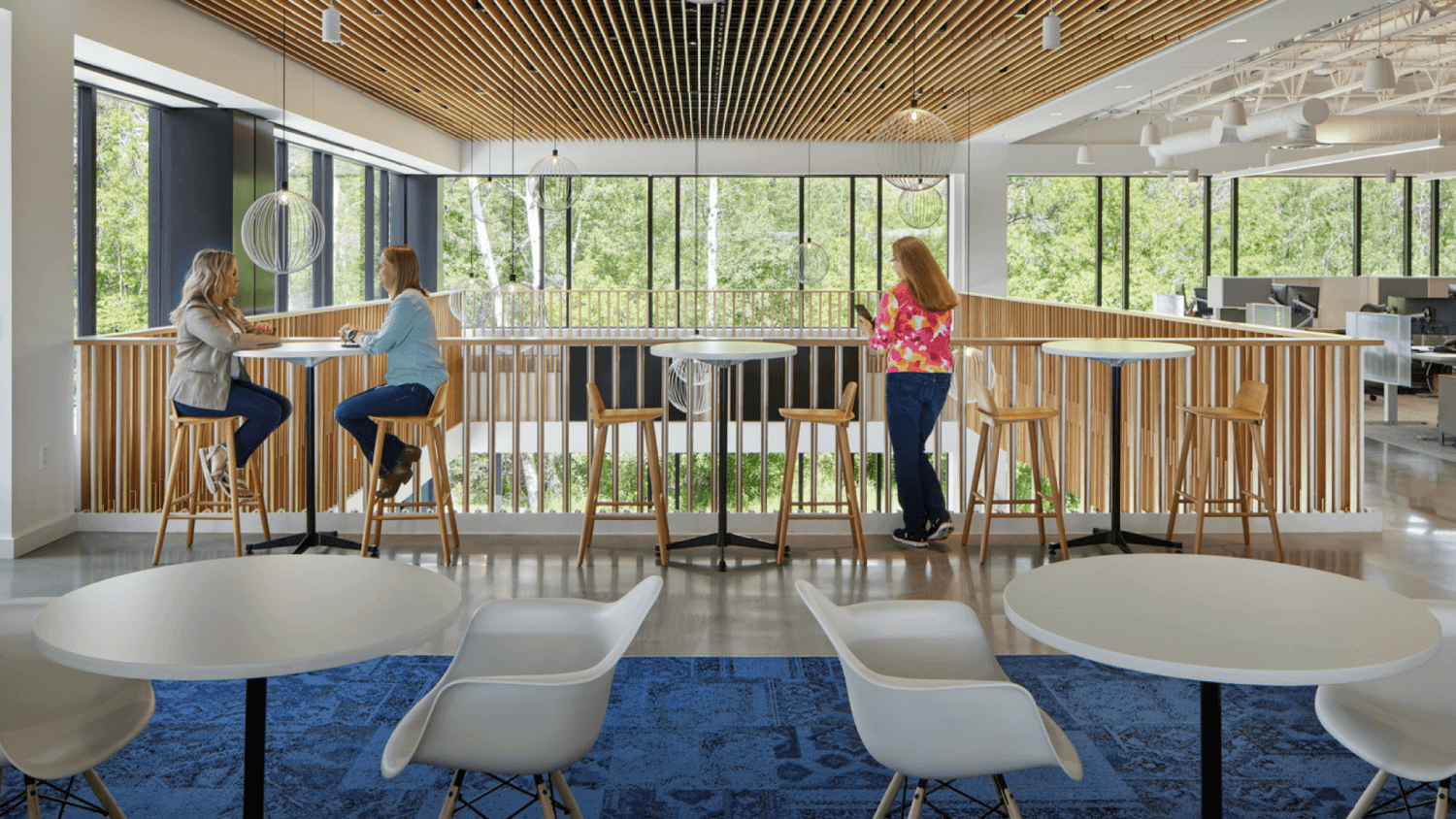
While issues of workplace privacy and acoustics are real, any office design worth its salt will also maximize outdoor views for all employees — and include at least one red Swingline stapler.
Restorative Spaces Improve Health and Productivity
Veiled from the prying eyes of Steinbrenner and the rest of the Yankees organization, the space beneath George’s desk is cozy, calming, and quiet.

Working from home during the COVID Pandemic provided opportunities throughout the day for many of us to seek relief from mental fatigue and stress. While there is clearly a distinction between avoiding work and taking a break, employers are studying the productivity impact that restorative spaces bring to the workplace 2 — not to mention how such amenities encourage a return to the office.

The International WELL Building Institute, who measure and certify healthy indoor environments, provide credit for relaxation or restorative spaces, separate from workspaces, that are calming, comfortable, and include at least five of the following:
- Adjustable lighting
- Sound interventions and effects
- Temperature control
- Varied seating options
- Natural elements
- Subdued colors
- Textures and forms
- Visual privacy
By this definition, George’s desk doesn’t quite meet the WELL standard, but it’s much closer than “just a Lucite table and four legs.”
There is Such a Thing as Being Too Accessible

It was equal access to department personnel that inspired Ron Swanson’s circular desk, but it was a desire to break down corporate hierarchy that inspired Post-War Germany to pioneer open office planning.3 In the decades since, open office designs have become more widely adopted while their benefits and shortcomings have been increasingly scrutinized.
Designing to treat all office users equally is commendable. Designing to treat all office tasks equally is foolish. Open office areas have been shown to improve innovation, which requires collaboration and serendipity. But those same spaces can be a hindrance to implementation and other tasks requiring greater privacy and focus.4

Being an expert woodworker, Ron Swanson knows to use the right tool for the right job. A properly designed workplace should be like a toolchest, providing a variety of implements such as open office desking, hotel offices, focus rooms, restorative spaces, and an array of formal and informal meeting rooms; each space tailored to a different type of user and task. When workplace designs don’t provide enough privacy and focus space to supplement the open office areas, it is like a toolchest with multiple hammers and not enough screw drivers.
Creative Lounges Are a Catalyst for Innovation
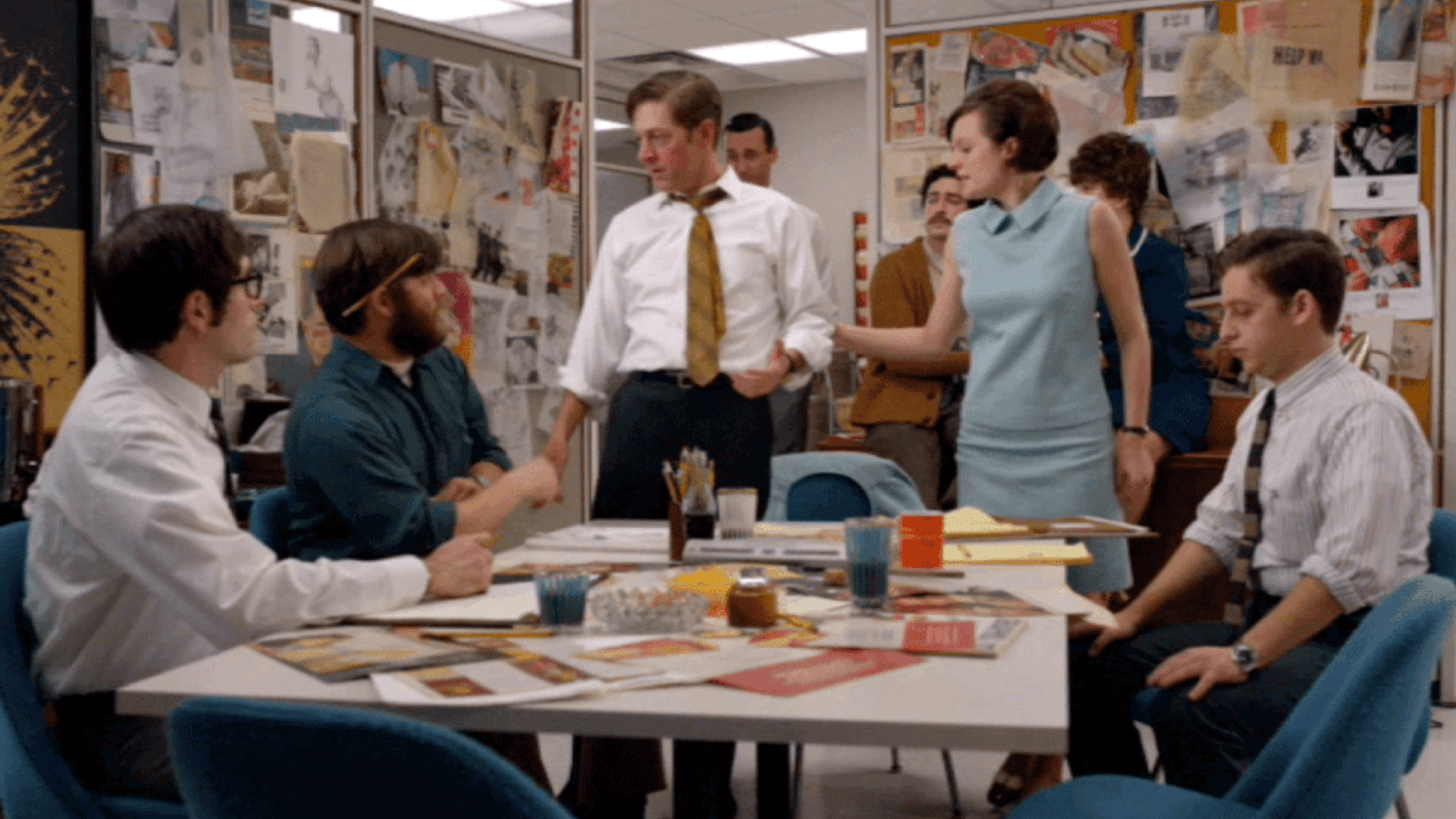
Charting the course of the 1960’s over seven seasons, Sterling Cooper’s workspace design changed with the times. Creative meetings that were held in Don Draper’s corner office during Season 1 find a new home in a shared Creative Lounge beginning in Season 4. More than a shift in aesthetics, this collaboration space marked a transition in the agency’s process:
- Meeting outside of one individual’s personal workspace gave a greater voice to the group (and Peggy in particular)
- Movable tables were conducive to creating, while sitting at the foot of Don’s desk was better suited for taking notes
- Tackable wall surfaces facilitated a collective train of thought
Perhaps less noticeable, but nevertheless important, is the lounge’s centralized location. Findings from an MIT study of its research facilities support this and “empirically demonstrate a persistent relationship between physical proximity and intensity of collaboration.” 5

In other words, the closer teammates work to one another and a shared project room, the more successfully they will innovate.
Lower Overhead Does Not Require a Lower Overhead

While the 7 ½ Floor of the Mertin-Flemmer Building may hold a secret portal into the mind of actor John Malkovich, other office buildings are seeing tenants enter a different headspace. According to a recent survey of over 1,200 organizations, remote work and rising costs are leading 51% of office tenants to reduce square footage going forward.6
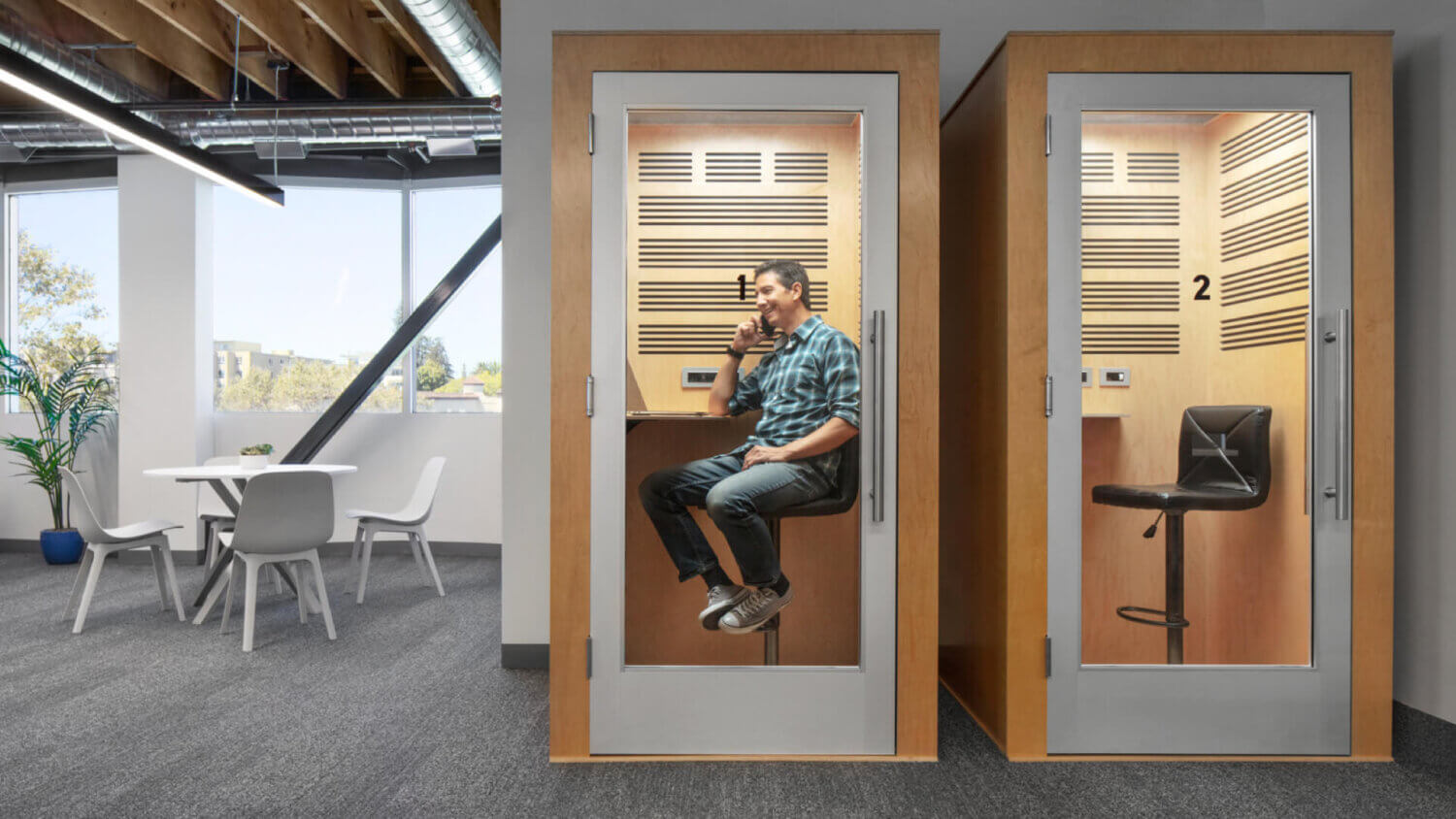
Downsizing a new or existing workplace often includes several of the following design strategies:
- Incorporating some form of shared desking
- Reducing the size of personal workspace while providing more shared resource spaces, such as phone rooms
- Leveraging shared building amenity spaces such as larger meeting rooms as well as collaborative and restorative spaces
- Forgoing formal reception/lobby spaces and moving café break rooms towards the primary entrance
- Shrinking file and storage spaces
- Designing flexible spaces and furniture that can accommodate multiple uses
As office downsizing becomes the new normal, remember that focused strategies prioritizing shared resources, flexible spaces, and efficient use of square footage can effectively reduce overhead costs without compromising productivity or employee satisfaction.
Learn more about workplace design through the lens of TV and movies.
About the Author
 As Workplace Principal, David Little, AIA,CID,LEED AP, focuses on partnering with corporate clients to transform under-performing work spaces into collaborative, inspiring environments. He has been with HGA for 10 years and has worked with organizations like International Dairy Queen, Marvin Windows, and Trane Technologies.
References
1. Jeanne C. Meister, ‘The #1 Office Perk? Natural Light’, Harvard Business Review, https://hbr.org/2018/09/the-1-office-perk-natural-light, September 3, 2018.
2. Albulescu, P., Macsinga, I., Rusu, A., Sulea, C., Bodnaru, A., & Tulbure, B. T. (2022). “Give me a break!” A systematic review and meta-analysis on the efficacy of micro-breaks for increasing well-being and performance. PLOS ONE, 17(8), e0272460. https://doi.org/10.1371/journal.pone.0272460
3. The Open Office Concept: What Went Wrong and Can It Be Fixed
4. Building and Environment 205 (2021) 108270. Journal Homepage: https://www.sciencedirect.com/journal/building-and-environment
5. Claudel M, Massaro E, Santi P, Murray F, Ratti C (2017) An exploration of collaborative scientific production at MIT through spatial organization and institutional affiliation. PLoS ONE 12(6): e0179334. https://doi.org/10.1371/journal.pone.0179334
6. The Building Owners and Managers Association International COVID-19 Commercial Real Estate Impact Study.
October 6, 2022.