
A transformational project within the Jackson Hole community, the HGA-designed history museum campus is a new cultural destination that strengthens the region’s connections between the past, present and future while engaging diverse audiences locally and nationally.


National interdisciplinary design firm HGA, with Jackson Hole-based Prospect Studio, today announced the completion of the reimagined Jackson Hole History Museum. History Jackson Hole (HJH), previously known as Jackson Hole Historical Society and Museum, establishes its new site as a cultural destination and an important local fixture for history education as well as community gathering and conversation. The new, comprehensive campus effectively houses and puts on display HJH’s collection of 7,200 objects, 19,200 photographs, 8,200 records and 460 oral histories, so that locals and visitors alike can form a meaningful connection to the region and those who have inhabited it for millennia.
Located at 175 East Broadway Avenue in downtown Jackson, Wyoming, the new campus establishes a permanent home for the museum and is now the primary destination for the museum’s interactive exhibits, educational programming and special events, in addition to offering flexible space for community use by members and partners. The quarter-acre site features three structures centered around a three-story museum with two stories above ground and a basement level. In total, the campus comprises the 13,200-square-foot new museum, two historic cabins and integrated outdoor space within a design framework that highlights the natural, cultural and architectural past of the region while leveraging modern-day building performance and technology.
The new museum campus is situated within a prominent, historic downtown Jackson block, partially protected by conservation easements and revered for its deep history, public green space and thriving local businesses. With funding for the project stemming from a public-private partnership, HGA worked closely with the HJH team to conduct a robust community engagement process to communicate design and sustainability strategies early and often in order to build consensus across Jackson residents, indigenous communities and others. This stakeholder engagement, in turn, informed various aspects of the design, particularly as it tells the comprehensive narrative of the history of Jackson.
“Jackson Hole is a community brought together, enriched and strengthened by compelling connections to the history of the region and the preservation of its resources, and now the newly designed history museum campus furthers this vision by expanding its capacity and reach,” said Morgan Jaouen, History Jackson Hole’s executive director.
History Jackson Hole’s goal of preservation through sustainable design was also achieved as museum stakeholders and the design team considered ecological concerns throughout the course of the project. This started with the selection of a vibrant urban parcel connected to shared transit, reducing the required parking footprint. The design optimizes a prime parcel in the city center with existing, mature trees on the site, while bringing in drought-resistant native plantings to limit irrigation needs and low-flow fixtures to minimize water use. The exterior design also minimized water-impervious surfaces with a wooden boardwalk public entry plaza and, as a result, stormwater runoff and release has improved from pre-development rates. The selection of timber columns, wood siding and a simple material palette results in a lower embodied carbon than common building materials, while the thick insulation, VRF mechanical systems and triple-pane windows increase energy efficiency.
Creating a Sense of Time and Place
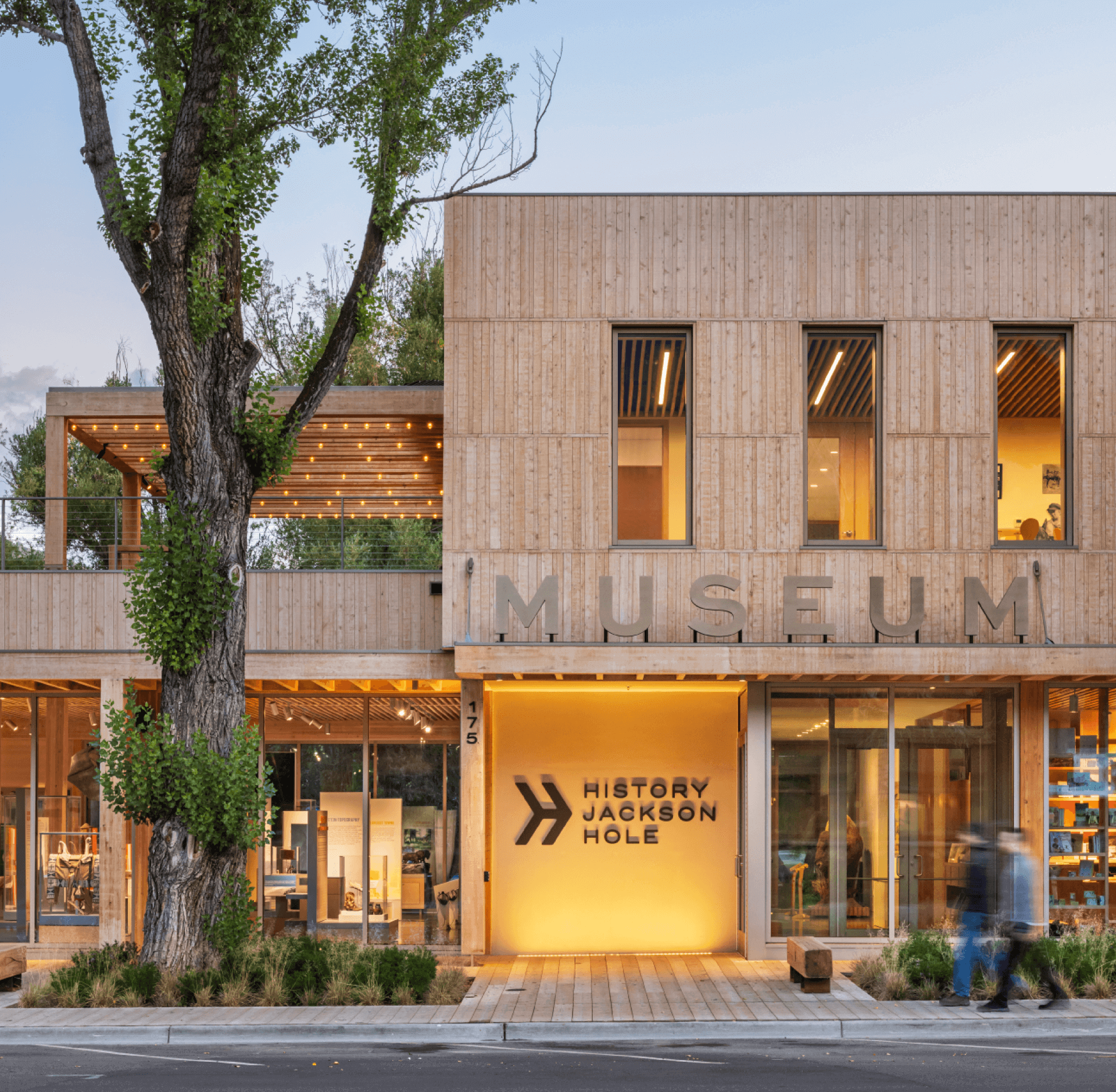
The collaborative design effort, led by HGA as the design architect and architect of record, struck a delicate balance between contextual and contemporary design, integrating both the Western character and historic relevance of downtown Jackson alongside a modern museum reflecting Jackson Hole’s present and future. The architectural language of Jackson, preserved by design guidelines for the town square area, is marked by distinctive storefront façades with natural wood finishes, all connected by boardwalks and design elements that highlight the uniqueness of the town’s cowboy roots. The resulting design ethos of the Jackson Hole History Museum campus is compatible with this characteristic style.
Drawing from Jackson’s signature Western aesthetic, the overall design of the new museum building mirrors typologies of legacy stores on the block with glassy ground floor frontage and punched windows on the second level. The museum’s footprint appropriately holds its scale with both a two-story town building across the street and shifts down to match more intimately scaled properties on its other side, including a local one-story cafe. The design also features a covered boardwalk in sync with other town boardwalks, seamlessly connecting the museum to the rest of the central square.
A rustic materiality is achieved through warmth and character in materials, even down to rougher finishes on wood, where appropriate, warmer metals, woven textures and more. There is a nod to the Jackson “Old West” style, but through an authentic approach that feels both modern and timeless. Other natural materials that reflect the Jackson style include formed, natural stone stepping stones and river rock and metal paneling in a variety of expressions as well as authentic Western expressions of timber, such as chinked logs.
“This collaboration required a delicate balance of design languages to honor the full history of Jackson Hole. We sought to distill this character within a modern museum design that reflects Jackson Hole’s present and future,” said Joan Soranno, FAIA, design principal at HGA and the project’s lead.
Preserving and Elevating Rich Histories
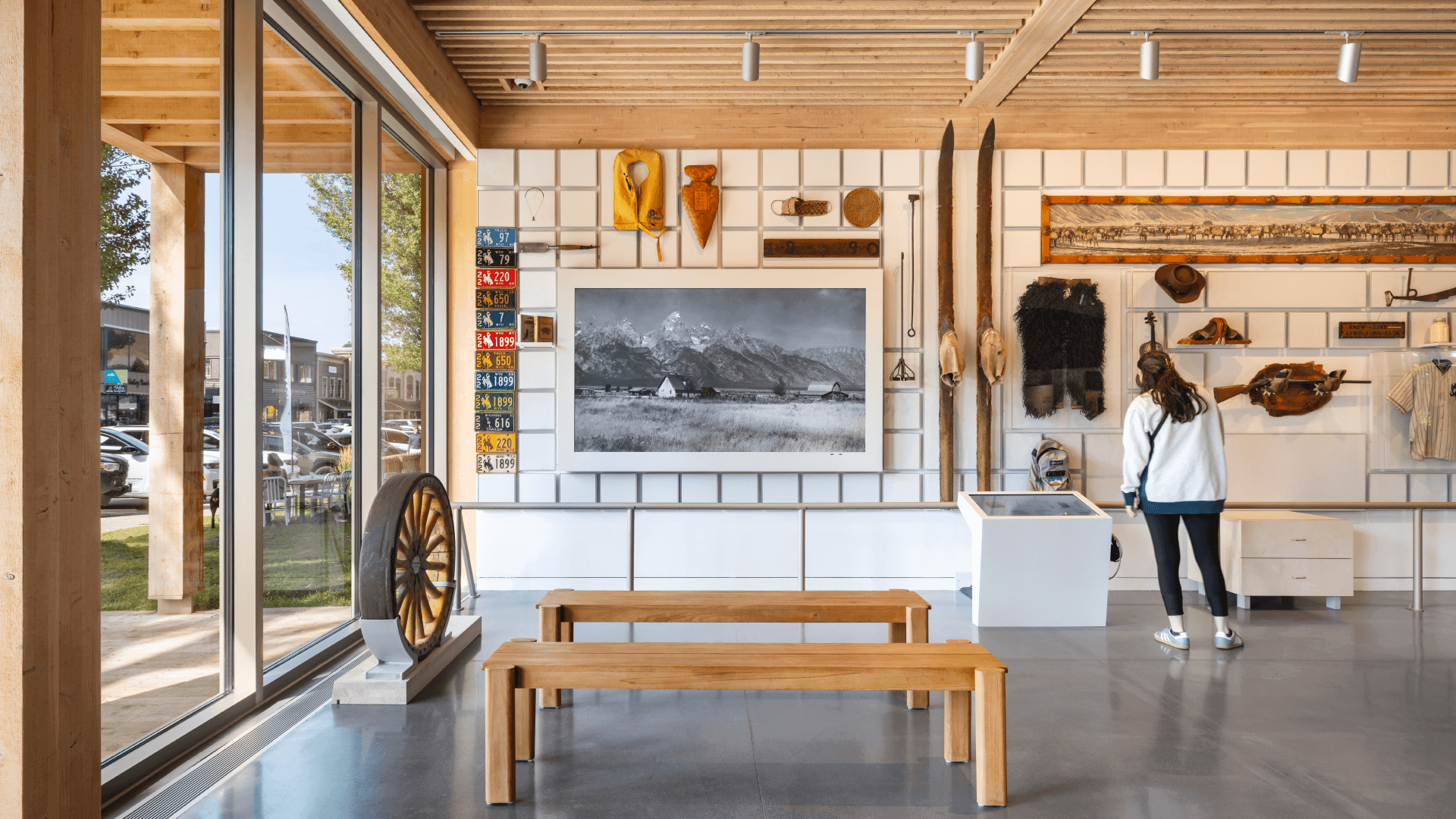
G&A (Gallagher & Associates) led the exhibition design throughout the Jackson Hole History Museum campus with museum staff. Exhibits within the new museum were designed in support of HJH’s mission to collect the stories, objects and images that connect people to the history of Jackson Hole and bring this history to life through the preservation, curation and interpretation of that collection. Inside, layered stories are told through evocative and lasting experiences, presented in a state-of-the-art format on par with some of the nation’s top museums that seamlessly integrate important cultural ties and storylines throughout the fabric of the design. Initial concept sessions that focused on the messaging of exhibits were extremely collaborative and engaged external stakeholders with the intention of elevating the Native American voice alongside the Western.
For example, the interactive photo wall “Windows on Jackson,” is a featured exhibit with faces of Jackson that, much like the objects throughout the museum, is meant to create moments of human connection to the history of Jackson. It moves beyond myths and initial impressions to reflect the true diversity of who has made Jackson Hole home over time, sparking curiosity within all who visit. In the rotating exhibition space, an exhibit gathers the work of six contemporary Wind River artists whose artworks explore the relationships between earth, animals, humans and homelands.
The new museum also features Native American art and exhibits. To highlight this connection, a mural on the west side of the museum will be installed in late October by Native American artist, Nanibah Chacon working in collaboration with the Eastern Shoshone Tribe and Jackson Hole Public Art.
. The concept brings attention to Shoshone language, Newe Daygwap, and recognizes its importance as a cultural knowledge essential to Shoshone peoples and their preservation of life and culture. The mural is a design of Shoshone beadwork pattern and text woven together with rose bead patterns scattered through the design, illustrating a popular Shoshone beading motif and reminding visitors of hope, rebirth and the ability and tenacity to nurture and witness growth.
The museum not only preserves histories through exhibits and other major spaces, but before construction began, the team worked to relocate and refurbish an existing house on the property. Then they brought the Karns and Shane historic cabins onto the new campus for visitors to enjoy and experience.
“The campus provides unparalleled access to and opportunities for engagement with ideas, topics and concepts from Jackson Hole’s history that foster curiosity, illuminate connections and inform a robust 21st century dialogue; all with an emphasis on historical accuracy, integrity, collaboration and inclusivity in support of our goals and vision,” said Kirsten Corbett, History Jackson Hole’s exhibits and communications director.

Enhancing the Visitor Experience
The design of the museum prioritizes and maximizes interactivity for HJH and its visitors, with multiple spaces for dynamic programs, events, conversations and presentations. Flexibility was achieved using a variety of design strategies, including the integration of several nimble spaces and a rotating exhibit space that can be used by the HJH organization to accommodate multiple uses and enhance the user experience. The main gallery can flex for large public gatherings, and the multipurpose classroom adapts for both youth and adult programming. The rooftop terrace connects to mountain views and overlooks downtown, and a back patio helps to activate the park.
HGA’s design of the reimagined campus started with an evaluation of the existing museum that was dark, opaque and relatively closed off to the town. The final design achieves HJH’s goal of opening up the campus to the broader community with an inviting and transparent museum building. Exhibit areas have two glass walls—one linking to the Greenspace and one linking to the rest of downtown—so that passersby can see inside toward living history. Visitors can also see through museum exhibits to the historic cabins located on the patio. A connection to the outdoors is further achieved via a ground floor patio that houses both relocated log cabins that have been integrated into the overall circulation path as well as a second-floor rooftop terrace for visitors to enjoy views of Snow King Mountain Resort and the surrounding rolling hillside. There are also expressions of whimsy and playfulness infused throughout the design to keep learning exciting for visitors of all generations.
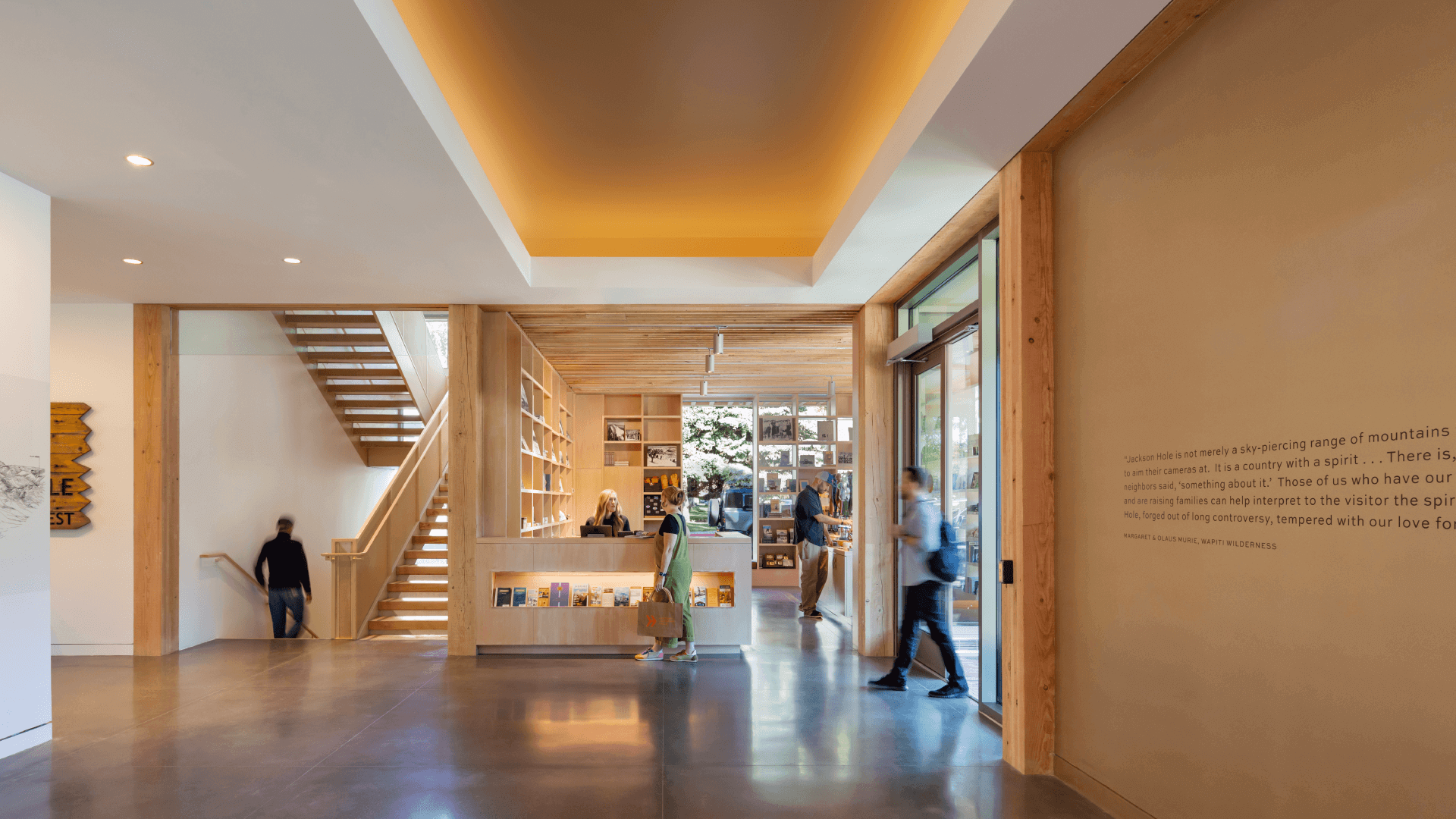
“During design, there was a recognition that there was an opportunity for History Jackson Hole to be an open and welcoming community hub, expanding upon how the museum formerly functioned,” said HGA senior project designer, David Wilson. He continued, “It’s a space where you want to spend time before and after viewing the exhibits, whether it’s an educational program on the rooftop terrace or grabbing lunch from one of the neighboring cafes and having a picnic on the front plaza or back patio overlooking Cache Creek and the Greenspace.”
The History Jackson Hole Archives and Research center sits in the lower basement level where the archives are now kept appropriately secure and preserved. With a dedicated Research room, the archives and collection are more accessible to engage with and explore in an effort to help serve the nearly 200 requests a year from researchers accessing HJH’s databases, books and collections for use in their work.
In addition to award-winning architect, Soranno, and senior project designer David Wilson, AIA, the HGA design team included senior project architect and museum technical specialist, John Cook, FAIA; principal serving as project manager, Roxanne Nelson, AIA, LEED AP; and senior interior designer, Natalie Pullen, NCIDQ.
HGA’s scope of work encompassed full design, architectural, landscape and engineering services, with civil engineering managed by Nelson Engineering. ACM served as the general contractor and Jason Berning Project Management served as owner’s rep. The firm worked in close partnership with local architecture firm Prospect Studio and exhibit designer G&A, both of which contributed their expertise in community-based design and visitor experience to the project respectively.
About HGA
HGA is a national interdisciplinary design firm committed to making a positive, lasting impact for our clients and communities through research-based, holistic solutions. We believe that great design requires a sense of curiosity—forming deep insight into our clients, their contexts, and the human condition. We are a collective of more than 1,000 architects, engineers, interior designers, planners, researchers, and strategists. Our practice spans multiple markets, including science and technology, corporate, cultural, education, local and federal government, and healthcare. Visit hga.com or follow us on LinkedIn and Instagram.
About History Jackson Hole
History Jackson Hole is a nonprofit whose mission is to tell the stories of Jackson Hole that connect people to the history of the valley and region. HJH stewards and shares artifacts and ideas that foster curiosity and continual learning, forge connections, and inform our 21st-century dialogue. We envision a community brought together, enriched, and strengthened by compelling connections to the history and legacy of Jackson Hole. To learn more or to get involved visit Jacksonholehistory.org or follow us on Instagram, Facebook, and LinkedIn.