
Healthcare systems are seeing an increasing number of people with neurodiversity in their patients, staff, and the larger community. To address this, many healthcare providers are designing specialized spaces that can take the form of quiet rooms, wellness rooms, or sensory rooms.
Designers play a critical role in shaping healthcare environments that not only address clinical needs, but also promote accessibility, dignity, and wellbeing.
Prioritizing Neurodiversity in the Population
According to the National Library of Medicine, neurodiversity describes the idea that people experience and interact with the world around them in many ways, with no one “right” way of thinking, learning, and behaving, and differences are not deficits. Although the term refers to the diversity of all people, neurodiversity is often used in the context of autism spectrum disorder, attention-deficit/hyperactivity disorder, dyslexia, dysgraphia, dyspraxia, and Tourette Syndrome. Referring to someone as neurodiverse or neurodivergent is a way to focus on the positive aspects of their differences and what that can bring to the group setting.
Individuals with neurodivergent conditions often have more intense responses to sensory stimuli including hypersensitivity such as being overwhelmed by noise, lighting, and various sensory cues or a diminished response to environmental stimuli. This is where neuro-inclusion design strategies come in.
Starting with Design Research
Designing for people with neurodiversity starts with a shift in programming and planning towards a neurodivergence lens. Inviting people with neurodiversity to join advisory committees to provide input at key planning stages can help to address users’ needs in different spaces. The use of engagement methods—from journey-mapping and on-site observations to focus groups—can help to identify specific needs and requirements and offer valuable insight into the patient’s experience.
Neuro-inclusion design strategies then consider key environmental features that can reduce anxiety while increasing comfort. Strategies include calming spaces with appropriate color selections and ease of wayfinding, windows with views or access to the outdoors, acoustic considerations to reduce background noise and echoes, sensory spaces for relaxation, and a range of flexible spaces that accommodate diverse needs and preferences.
Improving Wayfinding Through the Familiar
People with neurodivergent conditions can become overwhelmed quickly while searching for sensory cues to confidently reach a destination. Artwork, signage with legible text and realistic images, distinct architectural elements, and exterior views of landmarks are examples of how sensory cues can make the journey more intuitive. Offering unobstructed vistas of upcoming spaces and integrating “peek holes” into corridors and transition areas can have a calming effect by allowing people to see into spaces and better anticipate what to expect.
To that point, Children’s National Hospital in Washington, D.C., initially lacked an architecturally clear entrance as it was tucked in an underground garage. To improve wayfinding, the hospital and HGA facilitated a multi-method research study that analyzed how visitors currently accessed the entrance. The goal was to improve wayfinding, keeping in mind how design can emotionally impact different patient types, from young children to concerned parents. The result is an entry full of light, easy-to-follow wayfinding, and bright colors that lead to a highly visible two-story entry and elevator bank with large windows that increase visibility from the garage approach.
Elevating Calming Spaces
Designing for the human experience in healthcare prioritizes the needs and perspectives of all users to create a more effective and positive healthcare environment. Increasingly more healthcare providers are prioritizing various non-clinical spaces, such as sensory rooms, meditation rooms, and connection with nature and the outdoors.
These spaces give patients, families, and caregivers options for respite and calm in stressful situations. One space in particular that is gaining momentum are sensory rooms. These spaces specifically address neurodivergent patients, frequently integrated into behavioral health facilities but now finding their way into other healthcare facilities. Sensory rooms give patients control over their environment, often featuring colors, lighting, auditory, and seating options that can be adjusted for individual patients.
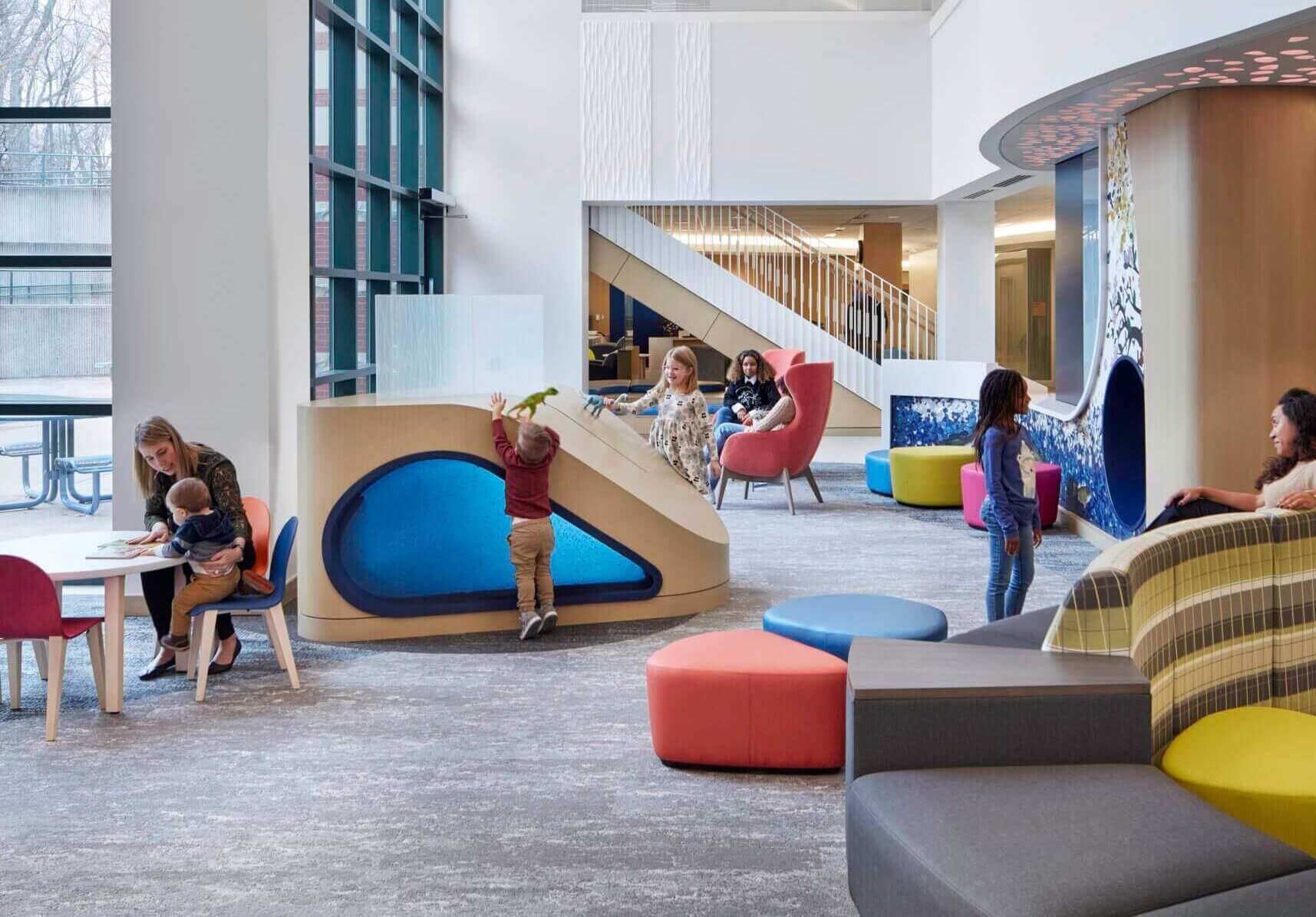
The Masonic Institute for the Developing Brain at the University of Minnesota advances healthy brain function for children throughout their lifespan. Through research and user engagement strategies, HGA transformed a former Shriners Children’s Hospital into a 117,000-square-foot home for the institute, creating spaces that support the diverse sensory needs of participants, patients, and their families. A variety of sensory spaces and visual imagery provide moments of adjustment, ease of wayfinding, appropriate levels of privacy, and positive distraction through graphics and texture.
Connecting to Nature
Research cites the benefits of biophilia (a connection to nature) in healing environments. Natural light, plant life, nature-inspired patterns and materials, and easy access to outdoor spaces and healing gardens all contribute to wellbeing.
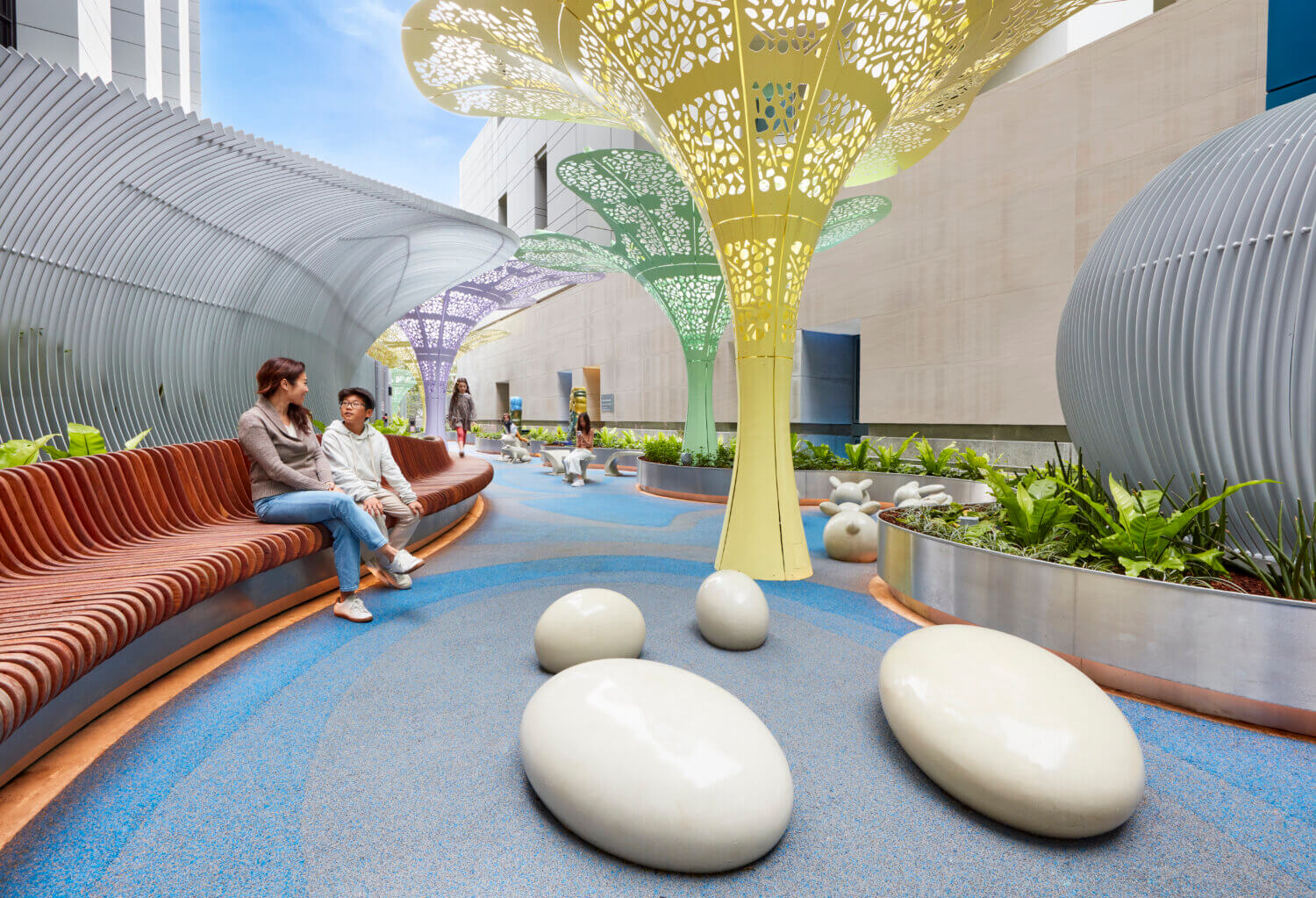
At Cedars-Sinai Medical Center Guerin Children’s inpatient unit in Los Angeles, the design transports patients and families to another world using technology, play, color, and biophilic elements. Notably, an outdoor healing garden evokes a fantastical feeling with artist-designed sculptural elements, such as frogs and rabbits, patterned walkway surfaces, and a canopy of pastel-colored large steel flower sculptures. The intent is to engage the senses and spirit, and for people with neurodiversity, these elements provide a variety of spaces and design features to support their choice of positive distractions and engagement.
Onward: Designing for All
Designing healthcare spaces for people with neurodiversity starts with understanding how all people perceive and experience the world differently. It’s a matter of bringing empathy to the design process. When designing for neurodiversity, ask the following questions:
- What design features and elements can be incorporated to make the space more welcoming for all?
- Which lighting and acoustical design guidelines are most effective for addressing the needs of people with neurodivergent conditions?
- How can access to nature, outdoor spaces, and natural light improve wellbeing?
- What visual cues—from artwork to signage—can enhance ease of wayfinding?
- How can providing more choices and control of their environment improve patient and staff satisfaction?
- How can designing for neurodiversity benefit all?
Designing for those with the greatest challenges elevates the experience for all, contributing to healthier, more inclusive communities that help advance health equity and empathy. ∎
Acknowledgement
“Mindful Selections: An Empathetic Approach to Neurodiverse Healthcare Design” was originally published in the May/June 2025 issue of Medical Construction & Design.
About The Authors
Tracy Randall
Tracy Randall, CID, CHID, NCIDQ, EDAC, IIDA brings more than 25 years of expertise to her work. She coordinates interior finishes, materials, detailing, and furnishings, paying particular note to sustainable products that add lasting, cost effective value.
Terri Zborowsky
As an Evidence-based Design Researcher, Terri focuses on the intersection of user experience and human interaction within the built environment. Beginning her career as a registered nurse, she then obtained a PhD and master’s degree in interior design.