
The multi-building complex advances the University’s vision for the future of arts education, provides new spaces for a growing student population and establishes a cultural destination for the region.
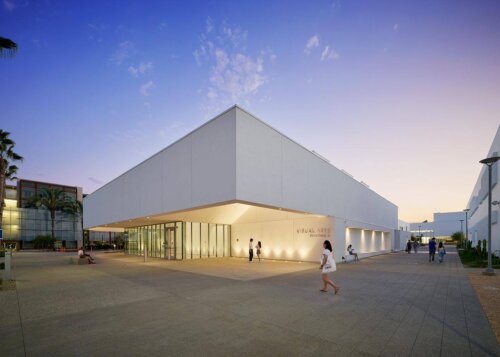
The new Visual Arts Complex at California State University, Fullerton (CSUF) is now open, providing a state-of-the-art hub for creation and creativity on campus and positioning the University to more holistically serve students in their pursuit of the arts in addition to offering a forum for the regional creative community to come together. Designed by national interdisciplinary design firm HGA and delivered through a design-build partnership with general contractor, C.W. Driver, the $65 million campus transformation houses a constellation of specialized facilities that encompasses the renovation of existing buildings and the construction of two new buildings—all set within a landscape of connective outdoor areas to enhance interaction across both old and new educational environments. The complex was inaugurated during a ribbon cutting ceremony on October 19, 2024.
The comprehensive Visual Arts Complex modernization project included the complete renovation and seismic upgrade of a two-story classroom building and the interior renovation of an existing one-story building to house new offices and graduate studios. A new, single-story gallery, a curatorial education building, and a two-story Digital Arts Building were also added to fully outfit the complex for the next generation of students and faculty. The overall complex of seven buildings—two renovated, two new and three existing—are integrated via a comprehensive new landscape strategy spanning 191,000 square feet, with 92,745 square feet of total building area comprising 52,315 square feet of new construction and 40,430 square feet of renovated building space.

Within the new Visual Arts Complex, students, faculty and the community can experience new and revitalized spaces including:
- The Gallery Building – A 15,288-square-foot, one-story, exhibition-focused building with four new galleries defined by expansive, north-facing clerestories. Three of the galleries were designed to focus on presenting the work of CSUF’s permanent collection as well as the work of emerging and underrepresented artists, while the fourth gallery is dedicated to presenting student work. The building also houses the Arts Research Library, a bespoke curatorial classroom, permanent collections storage and exhibition support spaces. The lobby—designed to double as another exhibition and events space—is flanked by two outdoor galleries and punctuated by open air skylights with strategic positioning along the heart of the University’s Arts Mall, directly across from the existing Clayes Performing Arts Hall.
- The Digital Arts Building – A 37,027-square-foot, two-story educational building that includes digital arts-focused classrooms as well as illustration and animation classrooms in addition to a maker space, a green screen motion capture stage, open transparent crit and review spaces and a computer commons room. Its unique three-story central entry is defined by a social stair under skylights and a north-facing clerestory with integrated digital projection to facilitate the continual presentation of student work. The building also centrally locates the offices of the dean of the College of the Arts within the Visual Arts Complex.
- A completely renovated and seismically reinforced 25,028-square-foot, two-story Administrative and Classroom Building that integrates faculty offices alongside drawing and painting rooms, 2D foundation classrooms and a new photography suite including two studios, a room for large-scale printing, a darkroom and a photo computer lab.
- A partially renovated Administration and Studio Building, totaling 15,176 square feet with 6,770 square feet of renovations focused on graduate students including individual studio and critique spaces, painting and drawing areas, a maker space for graduate projects and additional offices for the Department of Visual Art.
The Visual Arts Complex project was spurred by the decades-long shift in CSUF’s student body, representative of the region’s increasingly diverse population. The school serves predominantly first-generation students, commuter students and non-traditional students, including adults returning to school, part-time, transfer and online students. Furthermore, the Visual Arts Department, particularly the Digital Arts disciplines, have a high matriculation rate to the regional creative economy, making the project a priority for the University.
HGA’s resulting design solutions prioritize making the arts education process more accessible by creating visibility and connections throughout the project to draw in and expose the entire CSUF student population to experience the arts in formal and informal ways. Public spaces and shared facilities are configured to foster interdisciplinary engagement between visual and performing arts, so all disciplines can come together in novel ways to create more opportunities for understanding and inspiration.

“Working on the Visual Arts Modernization Project has been a rewarding experience, aligning with the College’s vision for arts education by providing future-proofed spaces that promote collaboration, creativity, and community engagement,” said Arnold Holland, Ed.D., dean of the College of the Arts at CSU Fullerton. “These new buildings help meet the needs of CSUF’s diverse College of the Arts students while cementing this college as a cultural destination. Collaborating with HGA and C.W. Driver was instrumental in blending contemporary design and the College’s rich history, showcasing our commitment to comprehensive educational and artistic excellence.”
Designing a Hub for Arts Creation and Presentation
The design vision for both the new and renovated buildings within the Visual Arts Complex was conceived to honor the modernist essence of CSUF’s campus, creating a respectful bridge to the past while also building on the modernist legacy of thoughtful innovation and site specificity.
As a programmatic whole, the facilities support a student population of 2,100 undergraduate and graduate students, faculty and administration. The completed project unifies the department’s full range of visual arts programs including ceramics, photography, graphic and interactive design, illustration, glass, drawing and painting, art history, art education and museum studies.
The design is also driven by the University’s goal to more holistically integrate and connect the arts with the broader community and region as a welcoming and engaging space for members of the outside arts community, other campus departments and the greater public to gather and exchange ideas. Accordingly, the new Digital Arts Building is defined by an expansive front porch and a transparent ground floor that invites the community in to see the educational process. A large projection wall above the porch was designed to continually present the work of artists and students to the community.
The new Gallery Building is also positioned near a primary drop-off area across from the main parking structure, working in tandem with the adjacent Clayes Performing Arts Hall to create an entry portal to the campus and frame CSUF’s iconic Arts Mall. The fully glazed building lobby and surrounding outdoor galleries create an open, accessible entry for the Visual Arts Complex that invites curiosity and participation with full-height windows that offer clear views from the outside into the main exhibition space. The Gallery Building’s interiors are designed to present the work of established, emerging and student artists and double as creative learning labs, giving students direct engagement with the format and processes of practice. This is further bolstered in the curatorial education and research spaces and supports the University’s overarching goal to become a cultural hub for Orange County and the entire Southern California region.

Modernizing Arts Education for Generations to Come
The Visual Arts Complex modernization prioritized the upgrading of technology throughout the new and existing buildings for a technologically rich experience on par with the professional arts creation and exhibition environments of today. The new Digital Arts Building is outfitted with a variety of advanced tools for the creation of digital art such as film, animation, digital illustration and other computer-based artwork. Furthermore, three permanently installed projectors to continuously share the work of the students are augmented by seven additional mobile projectors to support the activation of all surfaces of the Visual Arts Complex buildings, indoor and out.
The complete transparency of the Digital Arts Building’s ground level reframes engagement and participation, with maker spaces, computer labs and meetings room also on full display. Critic spaces and flexible classrooms also offer visibility internally and externally to demystify the creative process. The second-floor digital classrooms balance the need for extreme light control with a continuous slot window that allows students to look out and refocus, a critical wellness practice to maintain retina health. Long-term flexibility is built into the core DNA of the building with the structure intentionally designed for future flexibility with few fixed structural walls, allowing long term modularity for new education pathways and the promotion of cross-disciplinary collaboration.
The new Gallery Building continues the practice of education on display. Windows not only provide views into the main gallery and lobby, but also offer views into the research library, fabrication shop and curatorial classroom, allowing visual access for everyone on campus. Internally, the curatorial classroom parallels the aspect of the galleries in terms of volumes, lighting control and natural light, providing one to one fidelity between the spaces for education and implementation.
“The new Visual Arts Complex is an unparalleled environment for advanced arts education and presentation within Orange County, and we’re excited that the Department of Visual Arts will be able to use it as their home for years to come,” said John Frane, design principal at HGA and the project lead designer. “CSUF’s students already have access to the robust Southern California arts community, and this new complex will provide them with the spaces and the tools they need to thrive in their pursuit of arts education and better connect with the surrounding community as they prepare for future careers in arts and entertainment.”

Leveraging the Outdoors to Facilitate Connection and Learning
The Visual Arts Complex’s outdoor spaces are designed to accommodate groups at a range of scales and uses. A central common area for large gatherings and installations—anchored by an outdoor stage—defines the heart of the campus, providing opportunities for formal and impromptu performances. Smaller spaces for more intimate groups and individual moments are interspersed throughout the complex, leveraging shade, views and proximity to specific programs to enhance indoor/outdoor opportunities. New pedestrian walkways stitch the various buildings together and create connections to the larger campus. Along these pathways, a variety of opportunities have been created to provide views into various spaces including classrooms, galleries, maker spaces and meeting rooms, bridging connections to the larger campus by allowing transparency to the activities within the buildings themselves.
The collection of new outdoor spaces completes and upgrades the overall identity of the complex, unifying the internal campus experience for the community through an integrated sequence of landscapes. Embracing the Southern California climate, the design expands the programmatic and informal academic activities beyond the prescriptive needs of the required programs to create zones for production and presentation outside. These open spaces blend with the historic campus core, drawing students and visitors into and through the campus arts hub. As a result, the overall design invites and fosters engagement, interaction and visibility with the greater community.
The project was completed under a collaborative design-build model with HGA leading the architectural efforts and C.W. Driver leading the construction process. Additional partners included Luminesce Design, lighting design; Landlab, landscape design; M-E Engineers, mechanical, electrical and plumbing engineering; Saiful Bouquet, structural engineering; KPFF Inc., civil engineering; Acentech, acoustic/vibration consulting; Vantage Technology Consulting Group, AVIT; and Gerald Stamm Design, wayfinding/signage.
In addition to Frane as design lead, the HGA project team included Christina Delgado, project manager; Kevin Donaghey, managing principal; Matt Austin, project designer; Evan Rubel, project designer; Gustavo Alvarado, project architect; and Haley Nelson, program verification.
About HGA
HGA is a national interdisciplinary design firm committed to making a positive, lasting impact for our clients and communities through research-based, holistic solutions. We believe that great design requires a sense of curiosity—forming deep insight into our clients, their contexts, and the human condition. We are a collective of more than 1,000 architects, engineers, interior designers, planners, researchers, and strategists. Our practice spans multiple markets, including science and technology, corporate, cultural, education, local and federal government, and healthcare. Visit HGA.com or follow us on LinkedIn and Instagram.
HGA Media Contact
Michelle Nelsen, Public Relations Director
mnelsen@hga.com