
Equipped with simulation spaces that accurately mimic real-world healthcare scenarios, the building completes the college’s new campus hub for the sciences.
National interdisciplinary design firm HGA announced the completion of the new Health Sciences Building at Santa Ana College. Located on the perimeter of campus at 1530 West 17th Street in Santa Ana, California, the 55,563 square-foot building is a three-story structure that houses healthcare-related educational programs—including nursing, medical assistant, occupational therapy assistant, emergency medical technician (EMT) and pharmacy technology—complemented by general classrooms and support spaces.
The new facility creates a designated home for health sciences on Santa Ana College’s campus, developed in large part due to the emphasized need for healthcare professionals as a result of Orange County’s aging population. In addition to providing top-of-the-line spaces for today’s students, the new classrooms within the Health Sciences building also address future needs for the growth of the college’s health sciences programs. HGA’s flexible design prioritizes spaces that can be changed to fit the needs of Santa Ana College over time as well as simulation labs that replicate the real-world scenarios students will encounter after graduation.
The new Health Sciences building was designed to serve as the companion to the College’s new Science Center building located next door (also designed by HGA), with both buildings sharing an architectural language to create a visually and functionally cohesive sciences district for the campus. Together, the buildings create a new, modernized quad that creates a gateway for those entering the campus through its southeast corner.
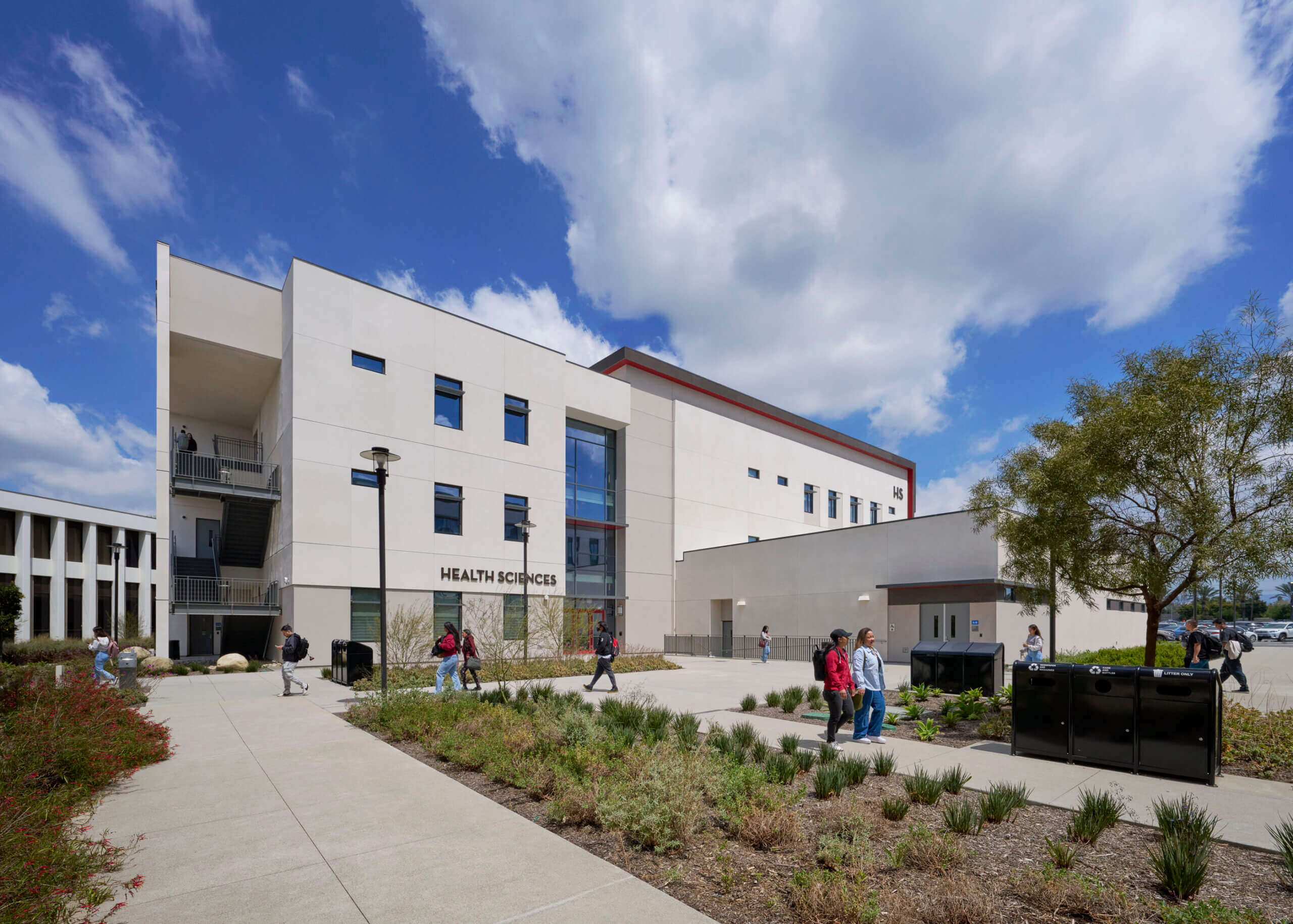
The new sciences district creates a hub of consolidated academic resources for Santa Ana College students, as well as increased opportunities for cross-disciplinary collaboration and informal gatherings and chance encounters. Informal gathering and study areas are found on each floor to provide students with spaces to collaborate and learn independently from their academic schedules. In addition to instructional spaces, students and faculty alike can make use of the building’s computer labs, offices, library, study spaces and meeting rooms.
“We are proud to provide new spaces for our outstanding health sciences programs, particularly as career opportunities in healthcare continue to grow throughout Orange County,” said Joe Melendez, Director of Facility Planning, Construction & District Support Services at Rancho Santiago Community College District. “At Santa Ana College, we train first responders and health professionals to help our local residents and boost our local economy, and the new Health Sciences building will offer us a platform to do so for decades to come with HGA’s flexible design that has been built to weather technological and practical advancements in the field as well as our campus community’s changing needs.”
Flexibility at the Forefront
In alignment with the college’s goals, HGA’s design of the new Health Sciences building seeks to respond to and consider changes in teaching modalities and learning environments by offering spaces that are flexible and adaptable to different learning models, thereby encouraging shared learning, interaction and multidisciplinary collaboration.
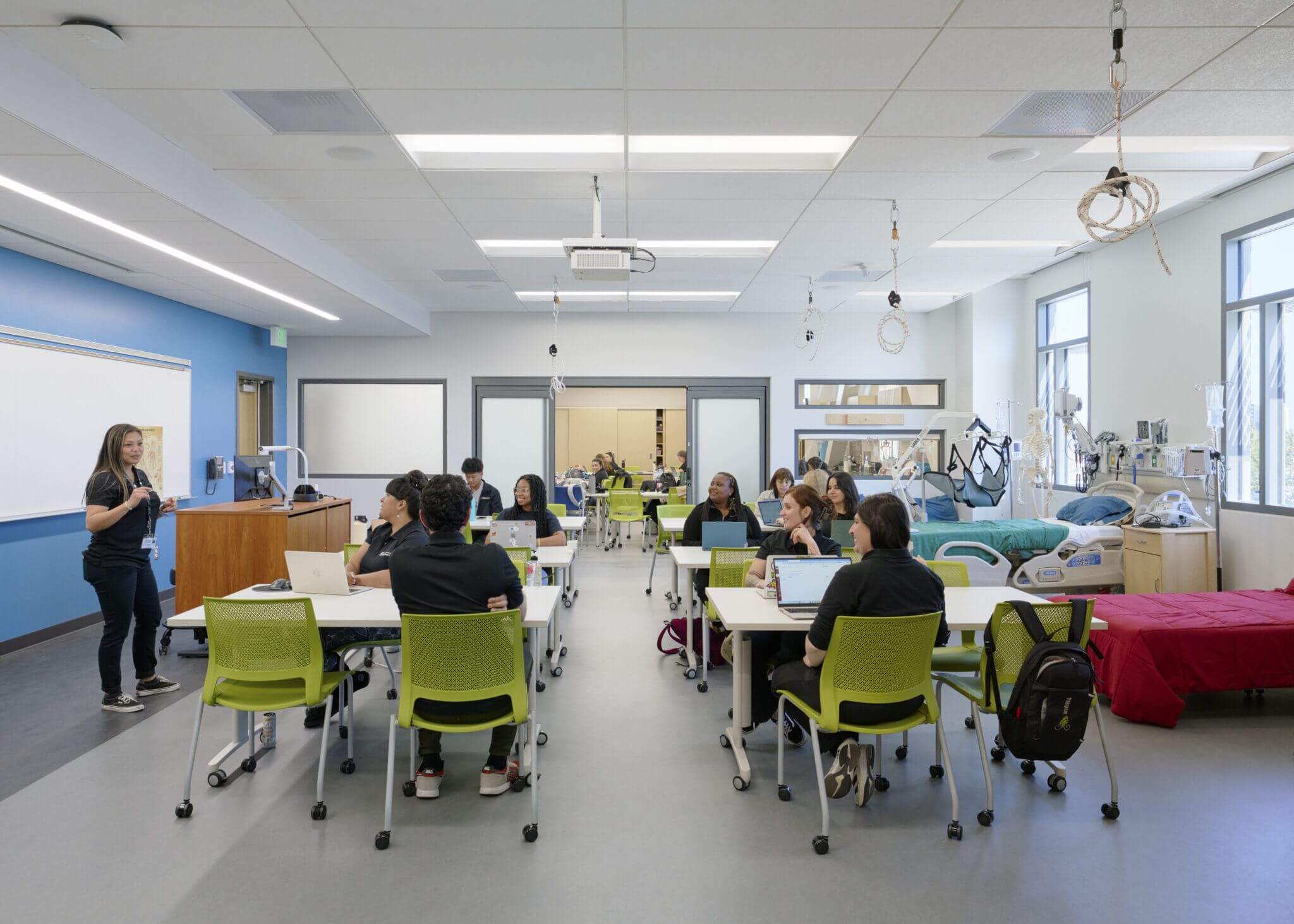
Classrooms and teaching labs throughout the building were designed with optionality for multiple future uses with mobile, modular furniture and fixtures and operable partitions to accommodate a variety of disciplines and uses. With open layouts and flexible furniture selections, both lectures and practical teaching can easily take place within the same spaces depending on the needs of students and faculty at any given time. Open collaboration zones are embedded throughout the new Health Sciences building where students can pursue their studies outside of classrooms with supportive features such as white boards, enclosed meeting rooms, technological integrations and more.
As a public community college, Santa Ana College received state-funding for the new Health Sciences building and, as such, the HGA design team was mindful of the financial implications of the resulting design and made decisions that were mutually beneficial for the school, student body and budget. Accordingly, the design prioritizes simple materials that serve dual purposes, in that they support any modality and layout while providing functional benefits. For example, textured acoustic paneling provides subtle design interest while also dampening distracting sounds to support better learning outcomes. HGA’s design similarly makes the most of other finishes including carpeting and paint selections that support an engaging learning experience while seamlessly blending with any variety of layouts required by the college over time.
“It’s exciting to see the new Health Sciences building at Santa Ana College come to fruition after years of design work,” said Joseph Sion, project manager with HGA. “HGA has enjoyed working with the college and district creating this important facility that will help support and advance health sciences education and prepare students for their professional careers in this field.”
Health Sciences on Display
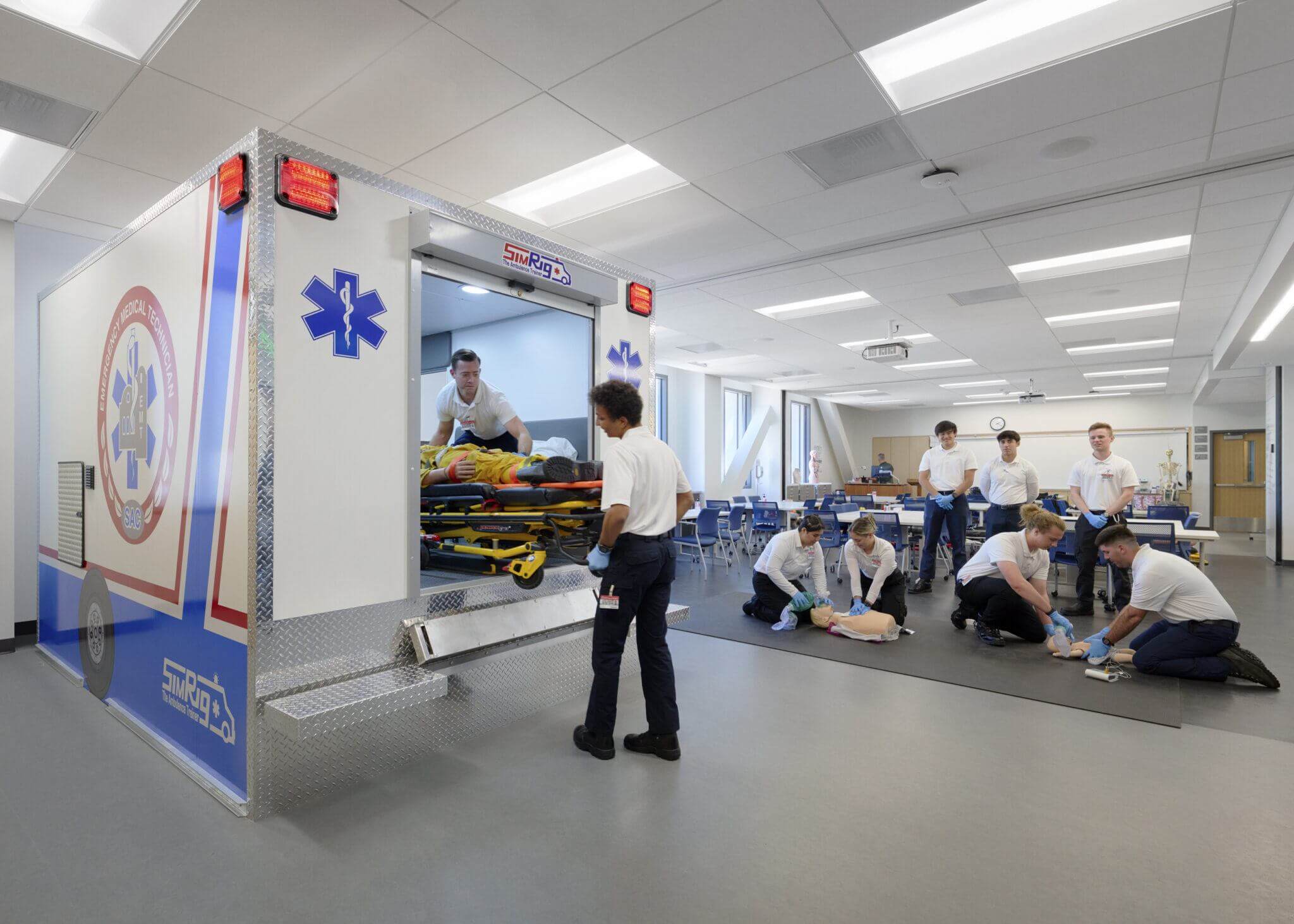
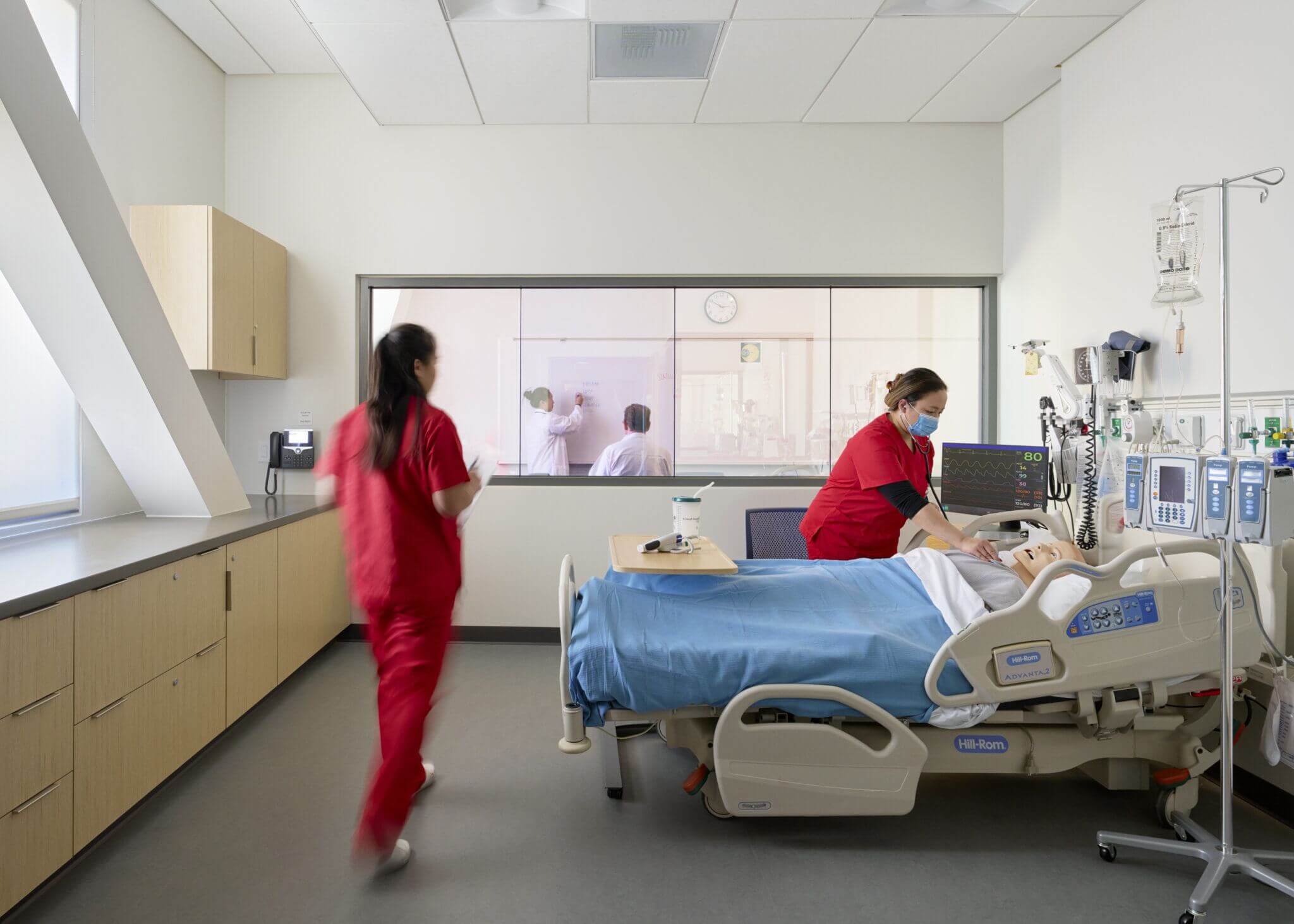
The design of the Health Sciences building also integrates opportunities for simulation as an educational tool with spaces equipped to mirror everything from hospital rooms to pharmacies and high-tech mannequins for technical practice. High fidelity simulation labs include one-way glass and audio-visual technology where students can be observed by faculty and other classmates as they improve their techniques so that real-time feedback can be offered. Additionally, control rooms that offer recording capabilities and debrief rooms where those recordings can be reviewed and discussed are also integrated across floors.
Within the nursing and medical assistant programs, students will interact with patient beds with headwalls just like they would find in hospital settings. For the occupational therapy assistant program, students will have the opportunity to simulate working with patients as they reintegrate into home life with washers, dryers and kitchen sinks for doing dishes as well as hooks on ceilings where therapy swings can be attached. The building also includes a fully functioning outpatient simulation pharmacy with everything from fume hoods to support formulating medicines in class to a cleanroom and pharmacy storage. In the designated EMT lab, students will find a full-scale simulation ambulance.
Building Program Stats
Floor One
- Three single-occupancy and two double-occupancy faculty offices with supportive faculty work rooms and meeting rooms
- Two large lecture classrooms, one with tiered seating for symposia-type lectures
- Three standard computer labs and three additional classrooms
Floor Two
- Seven double-occupancy faculty offices and three meeting rooms
- Medical assistant labs with 20 hospital-grade beds and headwalls, including exam rooms and front office simulation stations
- Pharmacy technology labs including an IV prep room and anteroom as well as inpatient and outpatient pharmacy counters
- A variety of study collaboration spaces right off high-volume space and near circulation paths
Floor Three
- Two enclosed spaces for group work (study carrels) that can be converted to future offices
- Four nursing simulation labs, including one NICU, with control rooms and observation/debrief rooms
- A physical therapy and occupational therapy lab and clinic
- EMT Labs, including a fully functioning ambulance simulator
- A variety of study collaboration spaces right off high-volume space and near circulation paths
Project partners included Balfour Beatty, general contractor; Bernards, construction manager; KPFF, civil engineering; Saiful Bouquet, structural engineering; Lynn Capouya, landscape design; PAL id Studio, furniture; Criterion, medical equipment; Stantec, mechanical and plumbing engineering; FBA Engineering, electrical, telecom and fire alarms; Jensen Hughes, fire protection and code review; Davies Associates, signage; Guidepost Solutions, security; Veneklasen, audio-visual and acoustics; and Finish Hardware, door hardware.
The HGA project team included Kylie Wong, project architect; Joseph Sion, project manager; Stacy Kwok, project architect; Gustavo Alvarado, senior project architect; Kevin Donaghey, principal; Jennifer Ries, medical planner; Satoshi Teshima, project designer; and Miguel Simental, project designer.
The college celebrated the completion of the Health Sciences Building with a ribbon-cutting ceremony. Learn more, here.
About HGA
HGA is a national interdisciplinary design firm committed to making a positive, lasting impact for our clients and communities through research-based, holistic solutions. We believe that great design requires a sense of curiosity—forming deep insight into our clients, their contexts, and the human condition. We are a collective of more than 1,000 architects, engineers, interior designers, planners, researchers, and strategists. Our practice spans multiple markets, including science and technology, corporate, cultural, education, local and federal government, and healthcare. Visit HGA.com or follow us on LinkedIn and Instagram.
HGA Media Contact
Michelle Nelsen, Public Relations Director
mnelsen@hga.com