
Today’s colleges and universities need every competitive advantage they can get as the demand for student housing has remained strong, but supply is struggling to keep up. Increasingly, schools are investing in upgrades and new construction that can wow prospective students.
Before breaking ground on a new residence hall, however, school officials need to consider several questions:
- What do students need to be successful?
- How will we build an inclusive community?
- What benefits the bottom line?
- How will we support the diverse needs of students?
- What’s good for the planet?
The answers to these questions vary by institution. To help administrators sort out the best solutions, HGA recently embarked on a study of residence hall design. Leveraging our expertise in higher education, research capabilities, and other engagement tools, and outcomes from a survey we conducted with students, design industry experts, and college and university housing officers, we created a blueprint for the residence hall of the future. This exercise led to multiple design insights and resulted in a concept that demonstrates how residence halls can be fine-tuned to serve both today’s students and future generations.

 Common areas, like this recreational space at the Hult International Business School, help foster diverse interactions.
Our research yielded five key lessons that will drive future success of residence halls.
Residence Halls of the Future Must…
1) Boost Student Success
Living on campus is often viewed as fundamental to the college experience, a marker of maturity and adulthood. What’s more, our research found that residence halls are a crucial factor in student success. Data shows that students who live on campus are more likely to engage in campus activities, have higher GPAs, and graduate on time compared to off-campus peers.
2) Build Community
Residence halls are immersive environments where students can form supportive and inclusive communities. Research studies show that friendships and social connections are key to retention. Strong community ties keep students engaged and contribute to stronger retention.
While more than 60 percent of the students we surveyed expressed a preference for single rooms, a considerable amount of research shows that students in suites and doubles perform better academically than those in singles.
HGA’s research showed that designing residence hall communities totaling roughly 50 people can also boost equity, contributing to diverse experiences and increased resident interaction. Spaces that are smaller or larger provide fewer benefits in this regard.
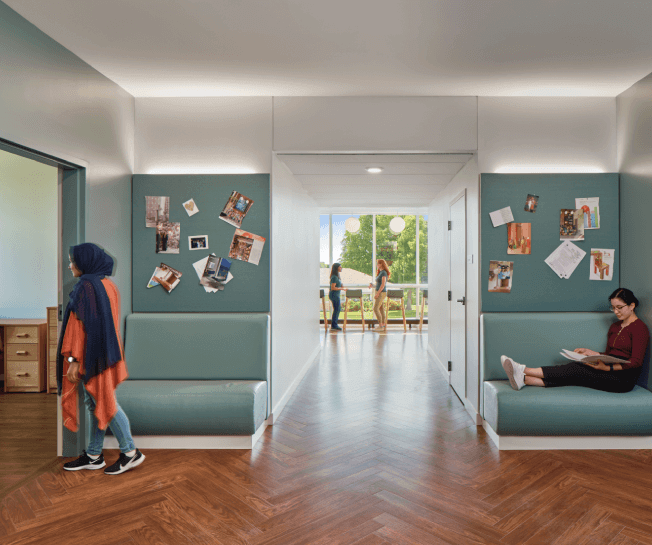
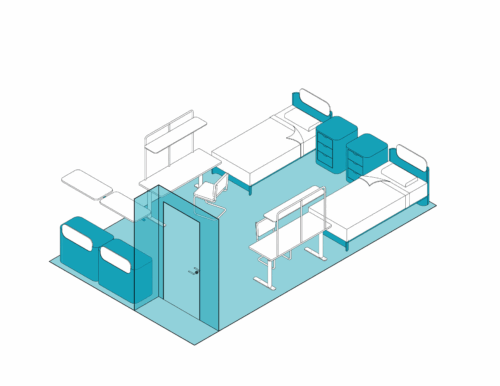
Semi-private transitional spaces, like the one shown above, serve as extensions to private spaces in residence halls. In the diagram, flexible furniture allows residents to create different layers of privacy within a typical double room.
In designing the residence hall of the future, HGA looked for ways to provide privacy while still promoting community. Partitions are a potential solution in double rooms, offering the option to close off spaces temporarily or even semi-permanently. We also focused on creating centrally located shared spaces that invite gathering. These can vary in size, from cafes and maker spaces to outdoor terraces and health and wellness rooms. Shared resources located in hubs and nodes help minimize those required in private spaces such as kitchens, dining, lounging, or recreation areas. The more resources people share, the more opportunities for interaction, collaboration, empathy, and social equity.
3) Promote Equity
The students we surveyed said inclusivity was one of the first words that came to mind when they imagined the residence hall of the future. Designing for diverse populations means creating spaces that allow everyone to feel welcome and seen.
Many universities in the U.S. have recognized the importance of supporting religious needs and have provided dedicated spiritual areas for students within residence halls. Beyond accommodating different spiritual rituals and practices, multifaith spaces can also facilitate intercultural or interfaith understanding and exchange by exposing users to the faith traditions and practices of others.
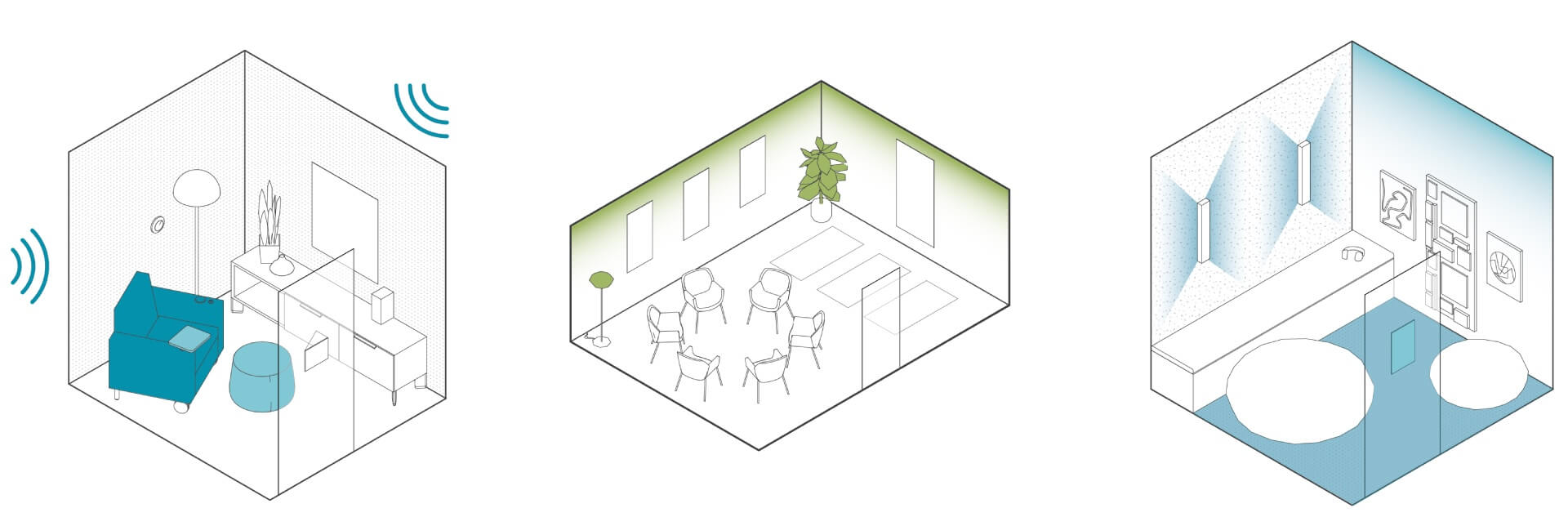

Wellness room, prayer room, and sensory room.
For neurodiverse individuals, colleges and universities have begun to incorporate spaces where they can manage their environment and calm or stimulate their senses based on personal needs. With broadening understanding of diversity to include neurodiversity and a growing recognition of neurodivergent needs, higher education institutions, community organizations, and corporations are incorporating sensory-friendly design strategies and introducing sensory rooms into the built environment.
4) Be Affordable
Not surprisingly, students prioritize affordability in housing. According to our surveys, it is their top concern regarding residence halls. Housing is a major expense for students and families.
Smart design, thoughtful amenity selection, and appropriate leveraging of other campus resources can reduce both construction and maintenance costs, resulting in savings that may be passed along to students. HGA has found that using modular designs, in particular, can reduce construction time and complexity—lowering costs.
5) Further Sustainability Efforts
Finally, designs for future residence halls should incorporate sustainability. Students expect this, and as energy costs rise and the United States transitions to non-fossil-fuel-based energy sources, colleges and universities will reap future benefits from today’s investments in sustainable design.
New residence halls should be designed with energy efficiency and water conservation in mind. Daylighting, lighting controls, and solar gain are important considerations in the design of such facilities, as are outdoor spaces and rainwater capture. Increasingly, organizations are interested in the benefits of mass timber and other carbon capture methods. The future residence hall not only seeks to serve the next wave of college and university students but also generations to come. ∎
Learn more about how we are creating inclusive and vibrant student life environments.
About the Authors

Corey Andrus
Corey is a designer and planner with experience in architectural and interior design, research, and strategy. He believes centering equity in design is a powerful way to create a sense of belonging. Empathy is the cornerstone of his design process, and he works closely with clients to bring their vision to life.

Kevin Allebach
Kevin is a Principal and Practice Group Leader for the Arts, Community, and Education Group in the HGA Milwaukee office. His expertise lies in elevating the experience of those who live, work, learn, and play in the spaces HGA designs.

Kim Workman
As a Project Architect, Kim’s passion for design is elevated by her technical acumen. She believes both beauty and functionality are necessary components in design that solves client problems and improves the human experience. Through close coordination with the client, Kim seeks to find out what’s most important to the success of the project.