
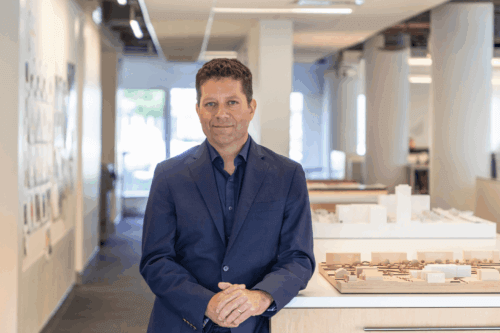
Peter Cook, FAIA, NOMA, is a Design Principal with HGA. With nearly 30 years of experience designing arts, community, cultural, and educational projects, his work touches core values tied to history and a sense of place. Among his current projects are the Contemplative Site at Monticello, the Northern Virginia Science Center in Loudoun County, Virginia, the recently completed Burial Ground for Enslaved People at Monticello, and the Lamond Riggs / Lillian J. Huff Library in Washington, D.C. He was appointed a member of the U.S. Commission of Fine Arts in 2021 and was recently elevated to the College of Fellows of the American Institute of Architects.
In this interview, Cook discusses his design inspirations and opportunities for creating shared community experiences through architecture.
What inspired you to become an architect?
I consider myself fortunate to find that inspiration within my family. I’m speaking about two people in particular.
My grandfather, Julian Abele Cook, Sr., was the Building Coordinator, akin to deputy campus architect, at Howard University his entire career. He was incredibly talented but as an African-American architect, he just didn’t have the opportunities that he so deserved. I remember visiting him as a kid here in Washington, D.C. He took me to the University to tour the campus architecture. It was inspirational just to have that talent right at my fingertips.
My second greatest influence is my grandfather’s uncle, Julian Francis Abele, who practiced architecture from 1904 to 1950 in Philadelphia at the renowned firm of Horace Trumbauer. As the firm’s chief designer, he led the designs for some of the most iconic buildings of that era: the Philadelphia Museum of Art, the Free Library of Philadelphia, Widener Library at Harvard University, several buildings in D.C., and the Duke University campus.
So, you are continuing the family tradition?
Yes, some people have joked that I didn’t have much of a chance to escape architecture. As a teenager, I vividly recall going to the Philadelphia Museum of Art and climbing those front steps. I remember getting a bit emotional walking around recognizing that a family member was the visionary behind such an extraordinary building.
Do they continue to inspire your career?
Yes, they influenced my career choice and particularly the type of architecture I practice—arts, community, cultural, and educational projects—projects that have a lasting, positive influence on our cities and our communities. Projects such as these, in many ways, help bring people together.
Are cultural and community projects important to our national experience?
I think it’s important to have these shared national experiences, whether it’s going to a museum, a college campus, a downtown green, or some other community space. We live in a precarious time right now. I’m just old enough to have vague recollections growing up in the city of Detroit and witnessing the unrest—and the lasting aftereffects—following the assassination of Dr. Martin Luther King. Those were challenging times that tested our faith in the American ideal.
And yet all these years later, we’re still wrestling with those very same issues, compounded by many more issues. We seem to focus on things that make us different from one another. Instead, we need to focus on common ground that unites us—and celebrate our shared experiences.
Empathy for each other?
Yes, an empathy that allows us to see through the lens of another’s life experiences. Frankly, community and cultural projects ought to be a growth industry, because we need a lot more of these shared experiences these days, not less.
With that in mind, how do you research a project through the lens of empathy?
Research can take different forms, but my research always begins with listening to the community, engaging with them to understand their aspirations. You can’t go wrong starting there.
I also encourage team members to research using multiple sources: literature, poetry, archival newspaper articles and documents. Personally, I love researching the physical history of a place by looking at old maps and discovering stories that almost literally can be unearthed.
Through this process of listening and learning, we hope to build trust with the community, something that I think is critical to the ultimate success of a project.
The Monticello Contemplative Site has personal resonance for you. Tell us about that.
I first visited Monticello decades ago as a teenager. I noticed how the tour guides glossed over important information as they referred to the people whom Jefferson enslaved as “his servants.” I asked, “why do you refer to them as ‘servants’ when in fact they were enslaved?” My question clearly made them uncomfortable, and they dismissively responded this was the term “Mr. Jefferson preferred.”
Then as now, Monticello resonated with me because our family passed down an oral history that one of our direct ancestors, Alethia “Lethe” Tanner, had a direct connection to Jefferson but we didn’t have the proof. As the story was told, she secured her freedom by selling vegetables in Lafayette Square in D.C. and one of her customers was President Thomas Jefferson.
It was only during our research for the projects at Monticello that I was shown a doctor’s bill addressed to Jefferson listing medical services provided to his “servants.” There were about 12 names on the bill and right there was Lethe herself. With this, we now had documented evidence that our family’s oral history was indeed correct.
Discovering this must be very satisfying.
It is interesting to come full circle 40 years later after my first visit to work on the Contemplative Site and Burial Ground. It’s really fulfilling professionally and personally to work with the Thomas Jefferson Foundation, which is dedicated to telling a much fuller, more complex story of Monticello and the over 600 people enslaved there.
How does your experience at Monticello influence your other work?
It certainly has confirmed the importance of utilizing different research methods. In so doing, you can arrive at unexpected solutions. We did a lot of engagement with descendants of the enslaved people at Monticello to understand what was important to them, because this is sacred ground for them.
Working out of D.C., do you have a favorite building or monument?
There are so many, but one that stands out to me is the Vietnam Veterans Memorial. It’s such a simple gesture, but it can bring tears to people’s eyes. As you enter, you’re essentially at grade and you hear the city around you. But as you slowly move along the wall, the city fades away, the number of names on the wall continues to grow and grow and you are left to contemplate your reflection among all of those who sacrificed. The immense power of the Memorial is remarkable.
What advice do you have for young designers entering the profession?
I often lean on the advice from my parents who said, “find something that you love. If you love it, you’ll probably be good at it and the rest will fall into place.”
Architecture offers many possibilities for creative expression. So, find what you’re most passionate about and the experiences that bring you joy. I would also say, stand up for yourself, speak up for yourself. The only way you are going to grow is to ask questions of yourself and the people around you. Architects like to mentor others, so don’t be shy about asking questions and exploring your options.
What would you be if not an architect?
A jazz pianist, but I’d first have to actually learn to play the piano a lot better! I would aspire to be like Kenny Barron or McCoy Tyner or Bill Evans. I can easily get lost in the music of a talented musician or singer and let the sounds just wash over me. It goes back to what I said earlier about letting the experience of listening inspire you creatively.