
By embracing an inclusive, data-driven planning process, the University of Wisconsin-Milwaukee placed student input at the center of its Student Union renovation.

Student wellbeing and equity are integral drivers in campus planning today. Recent shifts in demographics are informing how colleges and universities prepare for a more diverse student body. Today’s campuses are now serving students with a broader range of life experiences and are refocusing their approach to campus planning. Rather than take a top-down approach, colleges and universities are inverting the paradigm to place students at the forefront of the planning process.
The University of Wisconsin-Milwaukee (UWM) did just that when it hired HGA to renovate its Student Union. Partnering with UWM, the State of Wisconsin, and a diverse group of stakeholders, HGA customized an inclusive, student-centered strategy to drive the design vision and create consensus.
A Student-Centered Process
Student-centered design involves engaging all stakeholders while centering decisions toward students’ success. The UWM Student Union faced many challenges over the years, including completing several planning studies that considered building new vs. renovation before deciding to renovate to maximize budget limits for the aging building.
UWM and HGA prioritized strategies that involve a wide range of students within the context of this diverse urban campus. Our goal was to foster a strong sense of ownership among students and relevant stakeholders.
To actualize this vision, our integrated team of researchers, engagement designers, planners, architects, and interior experts employed a comprehensive six-step engagement design and data-driven research process from planning to occupancy evaluation to promote a holistic design experience.
Following the Six-Step Process
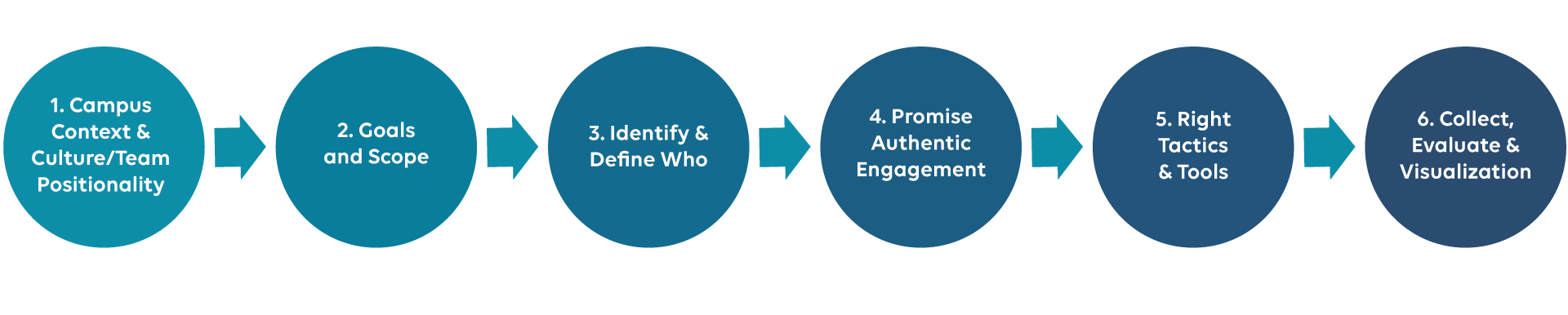
Building off the International Association of Public Participation (IAP2) and NAACP Guidelines for Equitable Community Involvement in Building & Development Projects and Policies, this six-step process ensures both higher education leadership and design teams take due diligence for an authentic and transparent process.
Let’s take a closer look at each step.
Step 1: Campus Context, Culture, and Team Positionality
Before jumping into a project kick-off, it is important to understand existing context by conducting secondary research and fact-gathering ahead of time to understand existing campus strategies, mission, demographics, Diversity, Equity, and Inclusion (DEI) initiatives, and sustainability goals. Also, consider the lenses and assumptions individual team members bring to the program based on their own social and cultural context.
With UWM, we re-grounded in the university’s vision, strategic plan, and demographic data integrated with their campus DEI goals as a foundation for framing our engagement scope. This included:
- Equitable access to opportunities
- Welcoming campus climate
- Amplifying diverse voices and experiences
- Creating a sense of belonging for all members of the campus community
This background research provided the necessary context for us to move forward.
Step 2: Engagement Goals & Scope

With this contextual grounding, we then initiated discussion within our team about how to engage students and stakeholders. Questions included: What relationships do you want to build or strengthen through this process? Why do you want to bring people together, and around what?
Through this discussion, we co-developed five engagement goals:
- Collaborate with and value student time throughout the design process and decision-making milestones
- Prioritize inclusive design—outreach with student communities with limited or missing voices
- Partner with existing networks as connectors—cultural brokers, Directors of DEI
- Acknowledge and strengthen students’ relationships with the Student Union
- Understand students’ values and sense of inclusivity within the Centers for Advocacy and Student Engagement (CASE) resources: Women’s Resource Center, Inclusive Excellence Resource Center, Veteran’s Resource Center, and LGBTQ+ Resource Center
Step 3: Identify & Define Who
The goal in step 3 was to understand the different stakeholders. One activity included mapping out specific stakeholders by “stake” (high and low) and “at the table” (already at the table or missing from the table).
A group of 15 campus and project leaders participated in a stakeholder matrix activity. We prioritized inclusive engagement to partner with first-generation, BIPOC (Black, Indigenous, Persons of Color), and commuter students, as well as staff and student employees working at the Union and CASE communities.
Step 4: Promise Authentic Engagement
This is an essential step before you start talking about tools and methods for engagement. When you bring people together, you need to define their role in the project—what influence do they have in shaping the project or decision-making? The IAP2 and NAACP Toolkit spectrums are great references for the discussion on stakeholders’ role and influence: ignore, inform, consult, involve, empower, defer.
With UWM, the authentic engagement selected was INVOLVE as the final decision making will be at Campus and System Facilities. It was essential to be transparent on how input and feedback will inform final decision making.
Step 5: Engagement Strategy: Right Tactics & Tools
Usually, this is where engagement discussions start. Should we have a town hall, open house, focus group, or other methods? Teams must apply due diligence from the previous steps when building an inclusive process. Key questions to ask include: What are barriers to participation? How do we meet stakeholders where they are? What does the value of time and involvement mean to stakeholders?
With UWM, we created an engagement strategy grid that organized different engagement groups (steering committee with student and CASE leaders, core committee, staff + student staff, inclusive student communities, students at large) with successive design phases (predesign, schematic design, design development). This enabled us to identify when to employ a specific research tool with a specific group to be most effective.
Step 6: Collect, Evaluate & Visualization

This is where research ethics, methods, and evaluation are key to ensure the data analysis is rigorous as you share with stakeholders during feedback loops to confirm design decisions.
With UWM, we used a mixed-method approach. In pre- and schematic design, we focused on qualitative data to understand the context and stories through thematic narrative analysis. This led to data-driven success criteria (above) that informed all decision-making. During the design development feedback loop, we distributed a questionnaire that included visual listening to confirm that the success criteria were translated into design.
Research Tools
Our mixed-method research tools included online surveys, pop-up stations to meet students, inclusive workshops, walking interviews, observational studies, and data visualization tools such as Power BI and Space Syntax to identify opportunities that support social connection.
Let’s look at two tools as examples of quantitative and qualitative data.
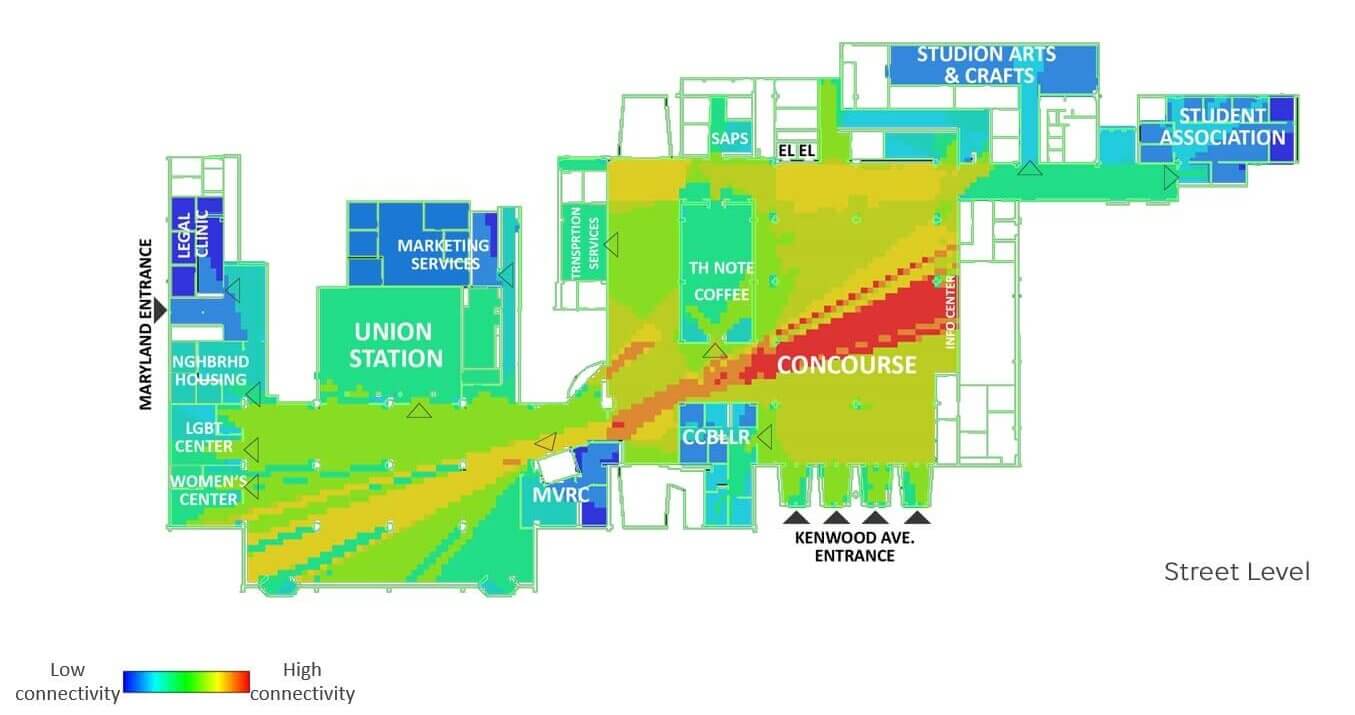
Space syntax analysis involved quantitatively analyzing the spatial configuration of the built environment of the Union by converting architectural layouts into network graphs, where spaces are nodes and connections are edges (see graph below). By measuring metrics like connectivity, the analysis provided insights into how spatial layouts could influence movement and accessibility, yielding valuable quantitative data on spatial relationships and their impact on student interactions within a given environment.
Inclusive workshops also facilitated the collection of qualitative data by bringing together a diverse group of students and faculty to engage in open discussions, activities, and exercises about what an inclusive space looks and feels like. These workshops created a supportive environment where stakeholders could share their perspectives, experiences, and insights, generating rich qualitative data that captured a wide range of viewpoints and promoted a deeper understanding of use patterns and perceptions of the Union.
Looking Forward

While this six-step process informed our design strategy through project completion in spring 2023, we are not done. On the roster, we are planning a post-occupancy evaluation based on our pre-occupancy research that established a baseline for success. We also will continue to work with UWM to educate staff and students to maximize opportunities in the renovated building and help co-create programming to further build a welcoming community.
Lessons learned from UWM are particularly relevant to urban campuses that serve economically and demographically diverse student populations, but also apply to campuses across the higher education spectrum. More than ever, students need—and expect—to be involved in campus planning. By following customized variations on this six-step process, administrators can engage student voices to create more inclusive learning environments.
More . . .
Kevin Allebach, Adaheid Mestad, and Mahshid Jalalian recently presented “Creating Community Through an Inclusive Engagement Design Process” with Eric Jessup-Anger of UWM at SCUP 2023 Annual Conference. This blog highlights takeaways from their presentation.
For more information about our research, visit HGA Research & Innovation.
About the Authors

Adaheid Mestad is a Design Anthropologist who utilizes social and scientific approaches to translate human behavior, culture, and social context to inform the built environment.

Kevin Allebach, RA, is a Principal and Practice Group Leader focused on arts, community, and education work.

Mahshid Jalalian, PhD, is a Design Researcher and Environmental Designer specializing in the relationship between built environments and the user experience.