
Editor’s Note: This is the second in a series on strategies to reduce embodied carbon of our interior materials selections. Find more in Part 1.
HGA is committed to lowering both embodied and operational carbon on our projects, and we have reinforced this promise as signatories to AIA 2030, SE 2050, MEP 2040, and the AIA Materials Pledge. As architects, interior designers, and engineers, we are charged with protecting the health, safety, and wellness of those who use the spaces we design. Therefore, it is paramount that this protection also extends to the health of our climate and planet.
As we navigate through the iterative and often fast-paced design phases, it is crucial to plan for embodied carbon research and reduction. This commitment ensures the spaces we create are truly sustainable and support a healthy future for our communities.
In the following examples, we highlight three ways that our designers are incorporating embodied carbon assessment into the design process: A structural analysis that informs the materials palette, evidence-based research that provides benchmark data to design teams, and internal tracking tools to assess individual material selections.

Structural Analysis to Inform Materials Approach

Research to Establish Benchmarks

Individual Material Assessment
Case Study: The Blake School Early Learning Center, Hopkins, MN
Our industry has invested significant research into the embodied carbon associated with a building’s core and shell, as this is where most of a project’s carbon emissions are generated during initial construction. Our design teams have tapped into these industry-wide tools and resources to holistically assess structural system options—balancing the project budget, program needs, and sustainability goals. The Blake School Early Learning Center made this assessment a priority.


The Blake School design team utilized Revit and Tally for Global Warming Potential (GWP) analysis of typical commercial construction (concrete slab + steel structure + steel roof decking) compared to various timber construction and hybrid scenarios. This guided the team to select a glulam structure to significantly reduce embodied carbon emissions within the building’s core structure.
By leaving glulam columns and beams exposed, the design team reduced unnecessary carbon emissions associated with column wraps and wall board that often cover up typical steel construction. The wood detailing extends to the facade, tying interior and exterior together.


The glulams were sourced from the northeast coast of the United States and Canada, supporting regional industry rather than relying on popular European glulam sources, further reducing the project’s embodied carbon. The decision on the building’s structural system also influenced the rest of the interior materials.

Case Study: HGA + University of Minnesota Consortium for Applied Research in Practice, Minneapolis, MN
While information about embodied carbon in structural and exterior architectural materials has typically been the focus of carbon conversations, the impact of interior building finishes is often overlooked. Recognizing this gap in industry knowledge, HGA has begun exploring how these interior design components contribute to a project’s overall carbon emissions. Ongoing research with the University of Minnesota has calculated the interior embodied carbon for “typical” healthcare, performing arts, and corporate office projects.
Together with our student researcher, Joon Ta, the quantity of each interior material was multiplied by its associated GWP sourced from a corresponding Environmental Product Declaration (EPD). These calculations, in combination with client interviews, identified key interior materials with high embodied carbon and frequent replacement cycles.
Embodied carbon “heavy hitters” vary by project type. With data gleaned from our ongoing research, designers know that the first areas of carbon focus in material selection is based on the project’s program requirements.

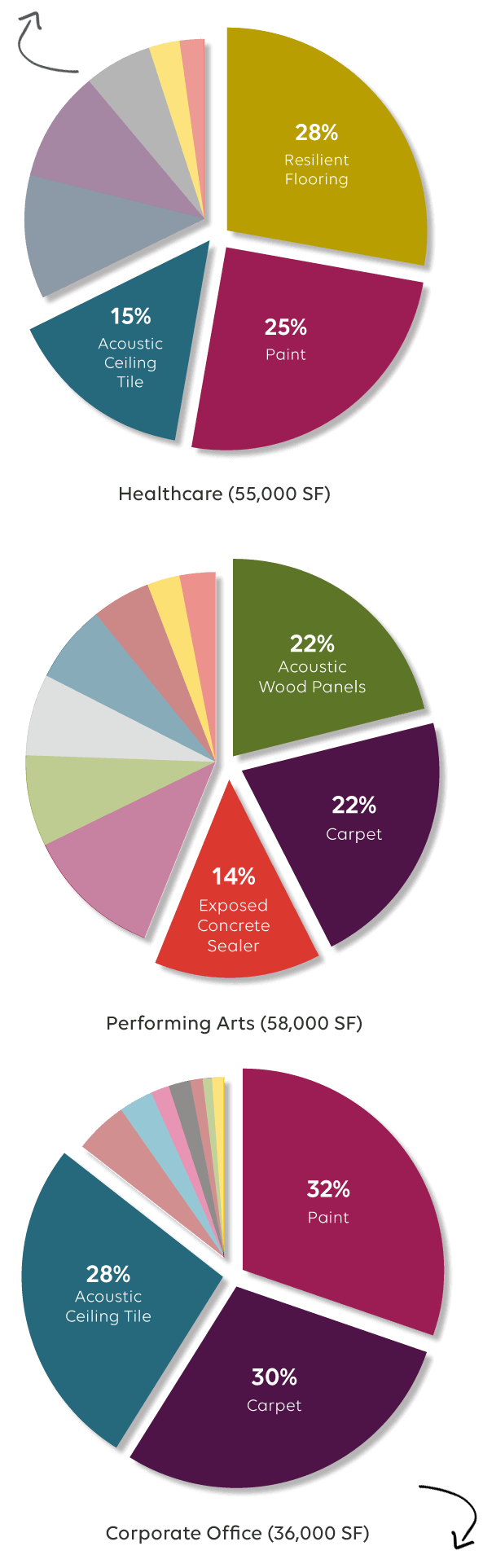
This data reflects the critical factor of repeated replacement of interior finishes, highlighting how the carbon impact of finishes starts to outweigh initial core & shell carbon because tenant improvement projects often have shorter lifespans with frequent tenant turnover.

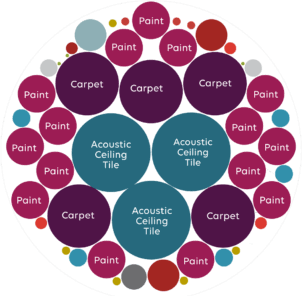
Proportional Carbon Impact of Corporate Office Material Replacements over 75 years


Based on findings from the European Environment Agency in 2012, a single mature tree can absorb approximately 22 kilograms of carbon dioxide annually. To fully counterbalance the cumulative GWP over a span of 75 years through replacements, a total of 5,580 trees would be required.
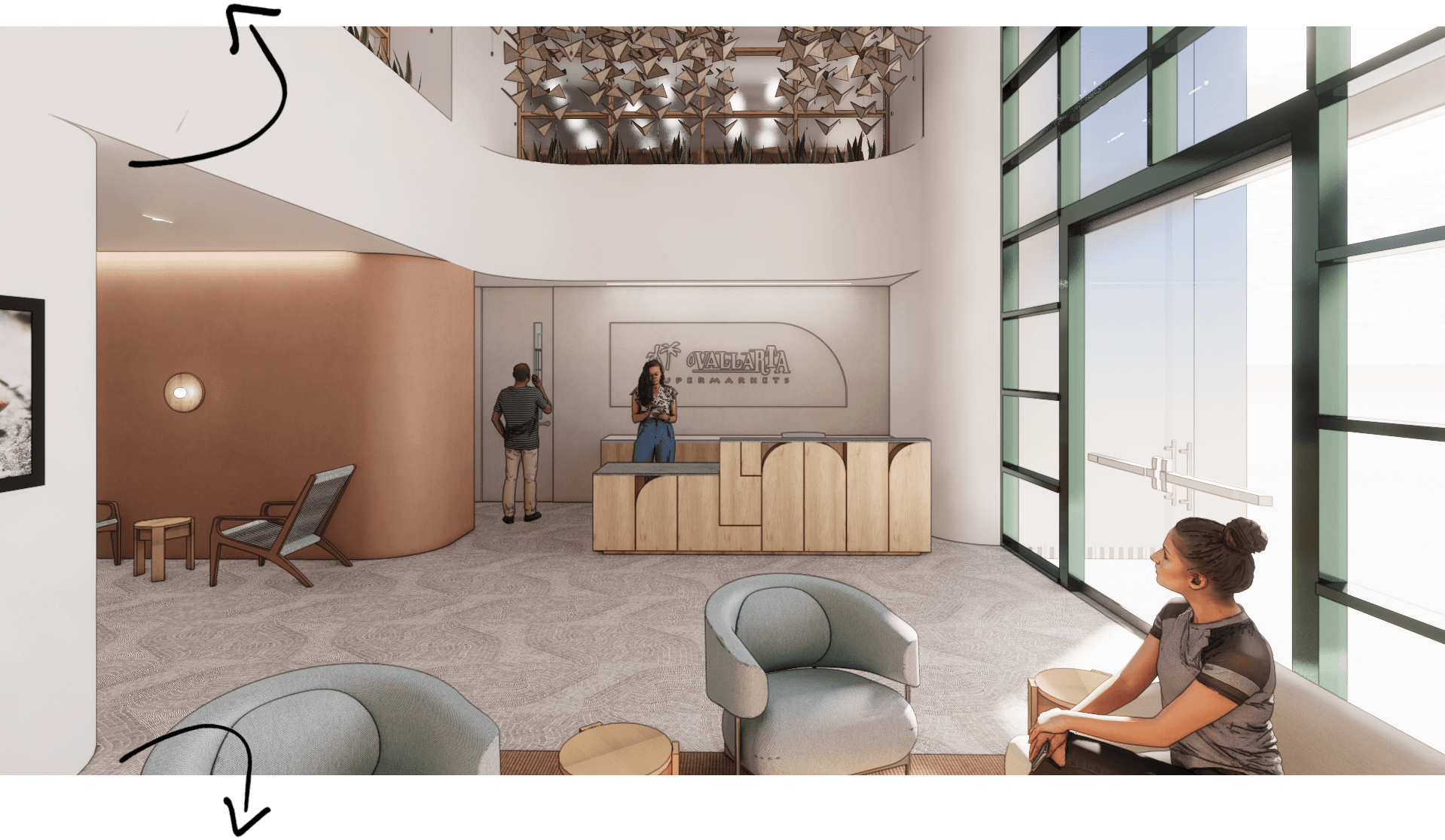
Case Study: Vallarta Supermarkets Corporate Office, Santa Clarita, CA
Vallarta Supermarkets, one of the largest Latino-owned supermarket chains in Southern California, had an opportunity to re-think their approach to workplace design as they planned to relocate their corporate office to a new building and fit out the interior for their future. Although the project isn’t seeking third-party certification, the design team assessed the embodied carbon of the acoustic ceiling tile and carpet selections because those categories are large volume contributors to the overall project.
In addition to GWP, the design team also considered other impacts to human health and climate health: 100% of the acoustical ceiling tile and carpets have VOC emissions testing reports, 88% of the products installed on the project have published chemical content inventories, and 75% of the selected products have Environmental Product Declarations (EPDs).
These metrics are easily tracked within the materials specification documents set up for every project.
Acoustic Ceiling Tile
CLF Industry Baseline:
- 1.3 ft2 kg/CO2e
Product Specified:
- 0.83
Embodied Carbon Reduction:
- 36%

Carpet Tile
CLF Industry Baseline:
- 11 kg m2/CO2e
Product Specified:
- 1.41
Embodied Carbon Reduction
- 87%

HGA integrated additional tracking features within our material specification tools to develop consistent data on GWP reduction potential for interior materials.
Looking Forward
Through our ongoing research and integrated design process, HGA is making incremental strides toward positive change within each space we design. By advancing our knowledge, resources, and support, we are empowering our project teams to design better buildings that radiate positive impacts to the users, community, and environment.
For more insight on how we collaborate with colleagues and clients to select materials that support climate health, visit The Value of Decarbonizing Interior Materials.