
In this ongoing conversation about reducing embodied carbon in the building industry, our interior designers offer a primer on reusing and repurposing existing materials
In the design and construction industry, building for the long term has long been a central theme. Certifications such as LEED, for example, set a 60-year minimum lifecycle as a benchmark for accreditation. When we present a finish palette, clients inevitably ask: “How long will this last? Is it designed for the long term?”
But what does “building for the long term” really mean? A building or workplace may never be truly permanent, yet the materials within it can outlast the structure itself—becoming part of a global system of resources ready to be reused and repurposed.
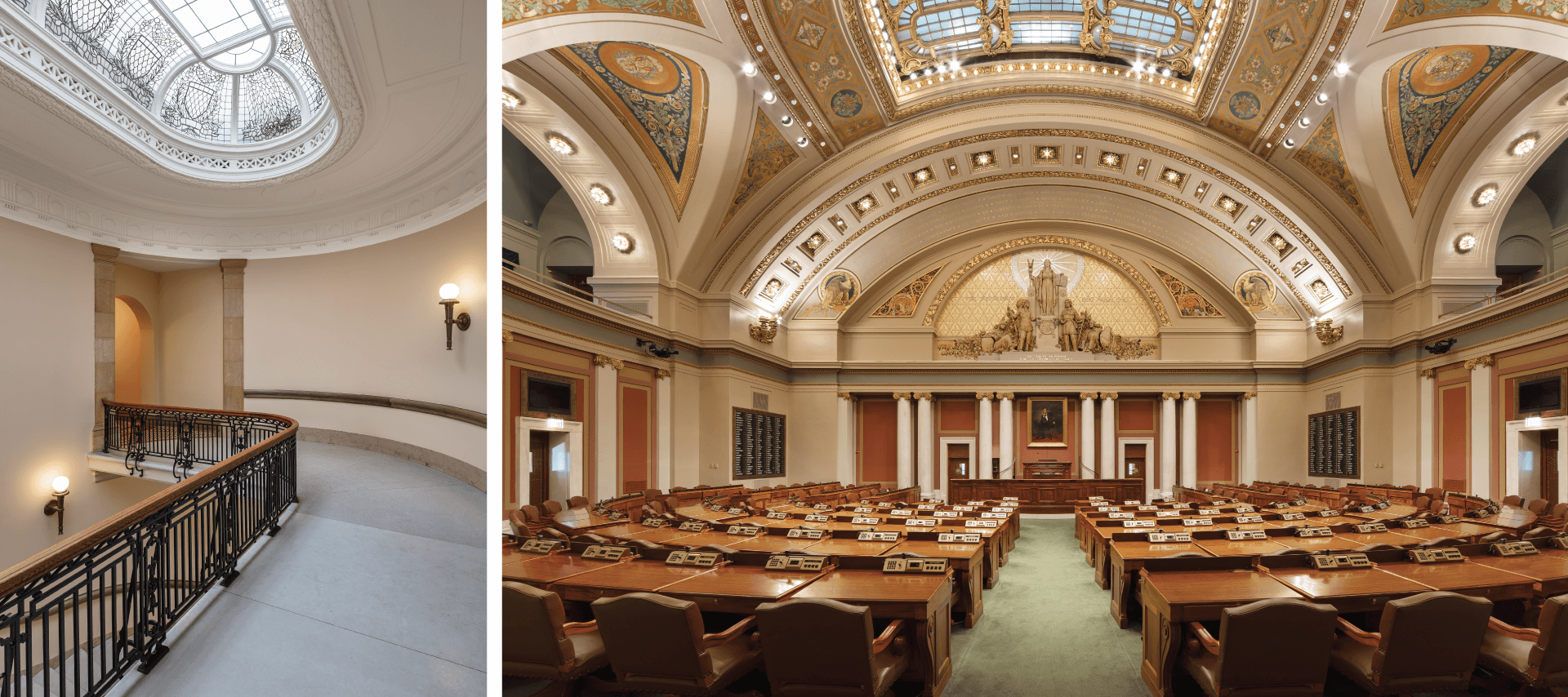

The Minnesota State Capitol, completed in 1905, was restored with careful attention to historic preservation.
A Mindset Shift
Building for the long term requires a shift in perspective. Architect David Bergman, known for integrating architecture and eco-design strategies, encourages us to see buildings as “temporary assemblies of borrowed materials.” When we view existing buildings as material repositories, we can begin to convert a linear system into a closed loop—where materials and finishes, structural and mechanical components, light fixtures and electrical accessories, appliances and furniture all reenter the supply chain after each use.
As designers, we can challenge the default of “new,” while balancing our commitment to safety and respect for innovative products that eliminate harmful chemicals or incorporate recycled content. Yet we also know that the lowest-carbon material is the material that already exists. Specifying reclaimed or refurbished materials is a critical step toward meeting carbon-reduction goals. By designing for future deconstruction and reuse—rather than traditional demolition—we increase the likelihood that our projects return valuable resources to the broader materials economy.
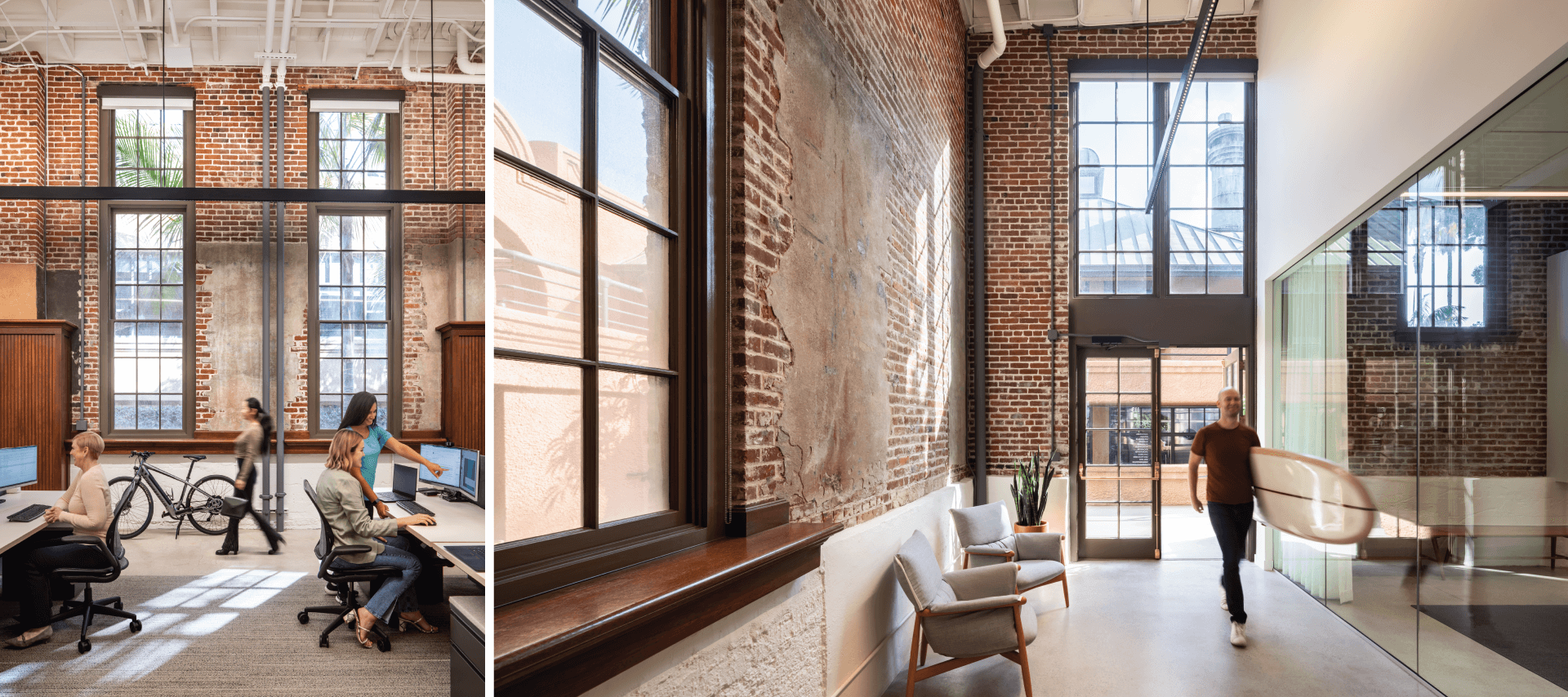
HGA’s San Diego office treated the existing building as an “archeological site,” creating essential, simple spaces for collaboration while celebrating the beauty of its original materials. The exposed brick walls exemplify legacy material reuse, supporting a sustainable global resource of reclaimed materials.
Meet Projects Where They Are
No one can predict the true lifecycle of a building. But as interior designers, we have a wealth of knowledge about how people use space—and how long they are likely to stay in a space. Office tenants often operate within 3- to 10-year leases, while state or federal clients may plan for a 15- to 20-year cycle. As noted in our previous article, Balancing Material Goals: Human Health and Climate Health, a project’s specific context drives how we select materials and evaluate lifecycle impacts.
To build on that idea, the following three project types illustrate strategies for rethinking and reusing existing materials while balancing them with low-carbon new products.
 Cultural Institutions
Cultural institutions—such as art or history museums—often plan for lifespans of a century or more. Highly durable, timeless materials—granite, marble, terrazzo—are key to that longevity. Yet these materials are also carbon-intensive. When designing a new cultural building, we often source materials regionally, partnering with North American rather than European quarries. We also aim to offset that high-carbon footprint elsewhere in the palette by incorporating carbon-sequestering materials, such as, constructing back-of-house millwork with plywood and linoleum instead of standard melamine or laminate.
For renovations or additions, we benefit from a direct historical precedent. A museum’s original building may already be more than a hundred years old. Its current condition reveals which materials have endured, how they have responded to local climate conditions, which cleaning protocols have worked best—and may even provide attic stock of legacy materials that can be incorporated into the renovation.
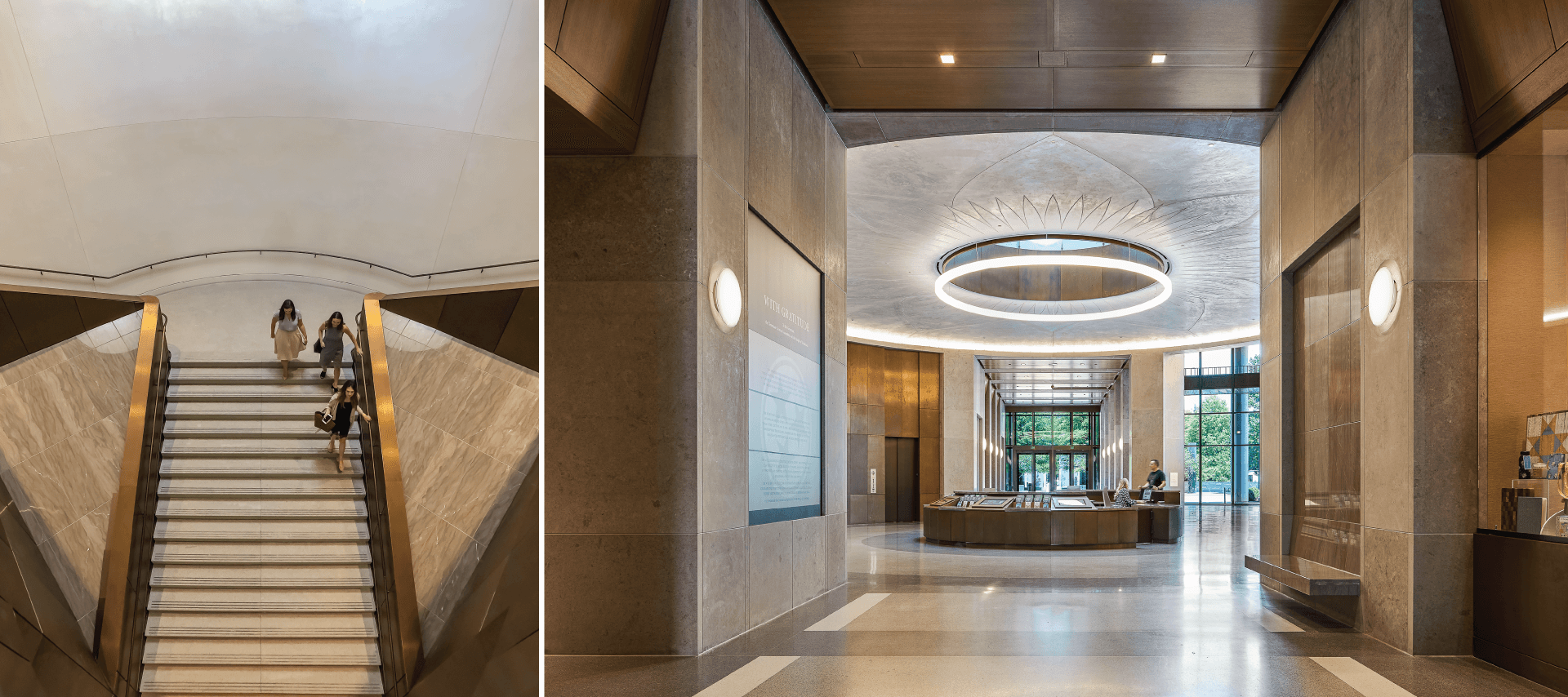
The new Tennessee State Museum is a cultural landmark that highlights the state’s rich history while enlivening Nashville’s Bicentennial Mall for future generations.
Tenant Improvements
Unlike cultural institutions, a tenant improvement may not even guarantee a ten-year lifespan. From a longevity perspective, designers can approach a tenant improvement as a collection of material resources that a future designer could disassemble and reuse. Here, tried-and-true materials and a simplified palette can go a long way. Bringing in color through artwork or furniture—items a tenant will likely take to a new space—supports a neutral backdrop that can serve the next occupant. Fastening materials mechanically, such as using clips rather than adhesive, makes panels easier to remove, modify, or repurpose for the next tenant.
Designing for flexibility is equally critical to longevity, enabling multi-use spaces to serve both today’s needs and those of the future as a company’s mission evolves. This can be achieved with flexible or reused furnishings, prefabricated components, and movable wall systems.
Healthcare Facilities
Flexible materials and durability also are central considerations in healthcare projects. These buildings often exceed LEED’s projected 60-year timeline and face the added challenge of needing to be disinfected effectively to prevent infection.
Smooth, joint-free surfaces simplify cleaning, and terrazzo—a legacy product dating back to Ancient Rome—is widely regarded as the gold standard for healthcare flooring because it supports comfortable patient transport and easy maintenance. To increase terrazzo’s chemical and stain resistance, modern formulations often include epoxy systems rather than the traditional clay or cement base. Yet these formulation changes raise the question of whether they are truly necessary, given that terrazzo’s traditional mix has proved its durability for hundreds, even thousands, of years.
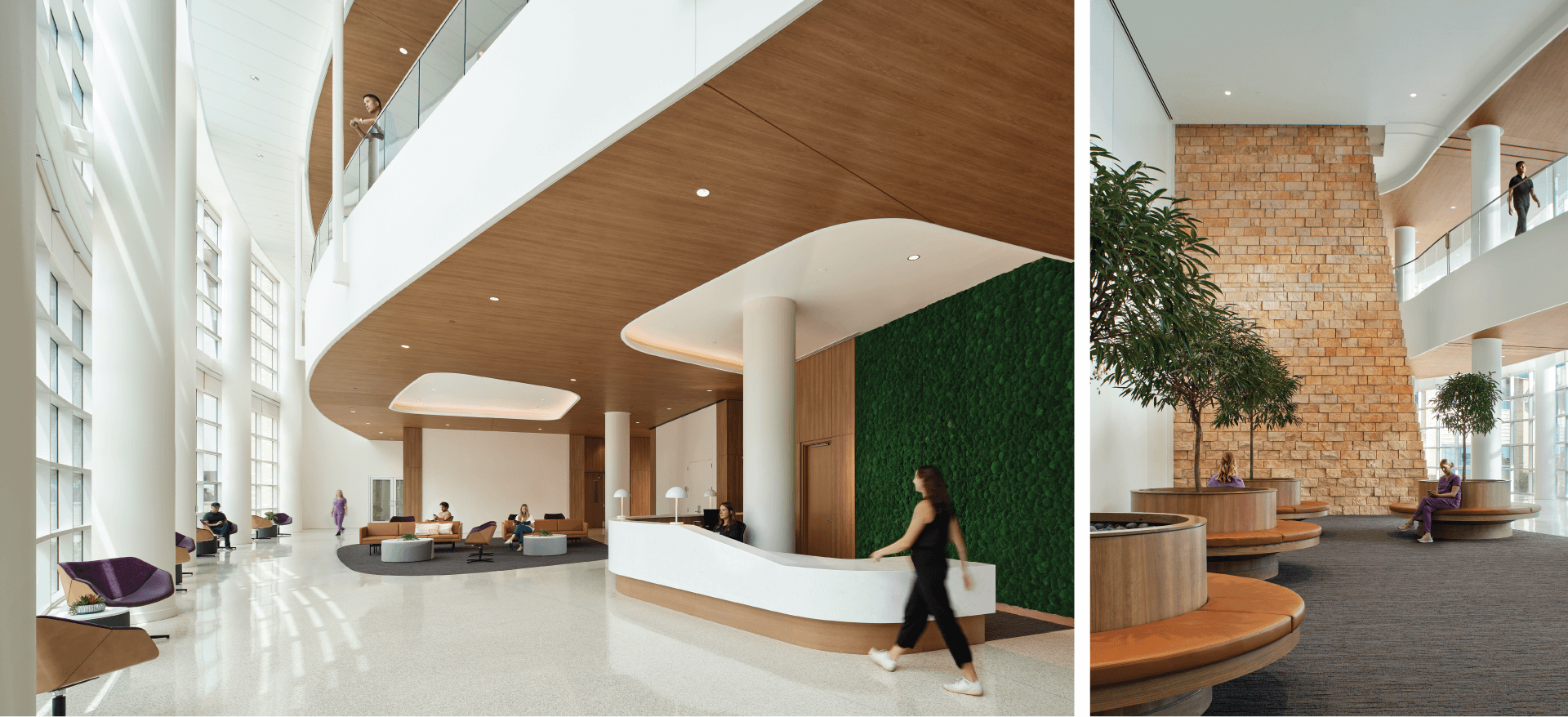
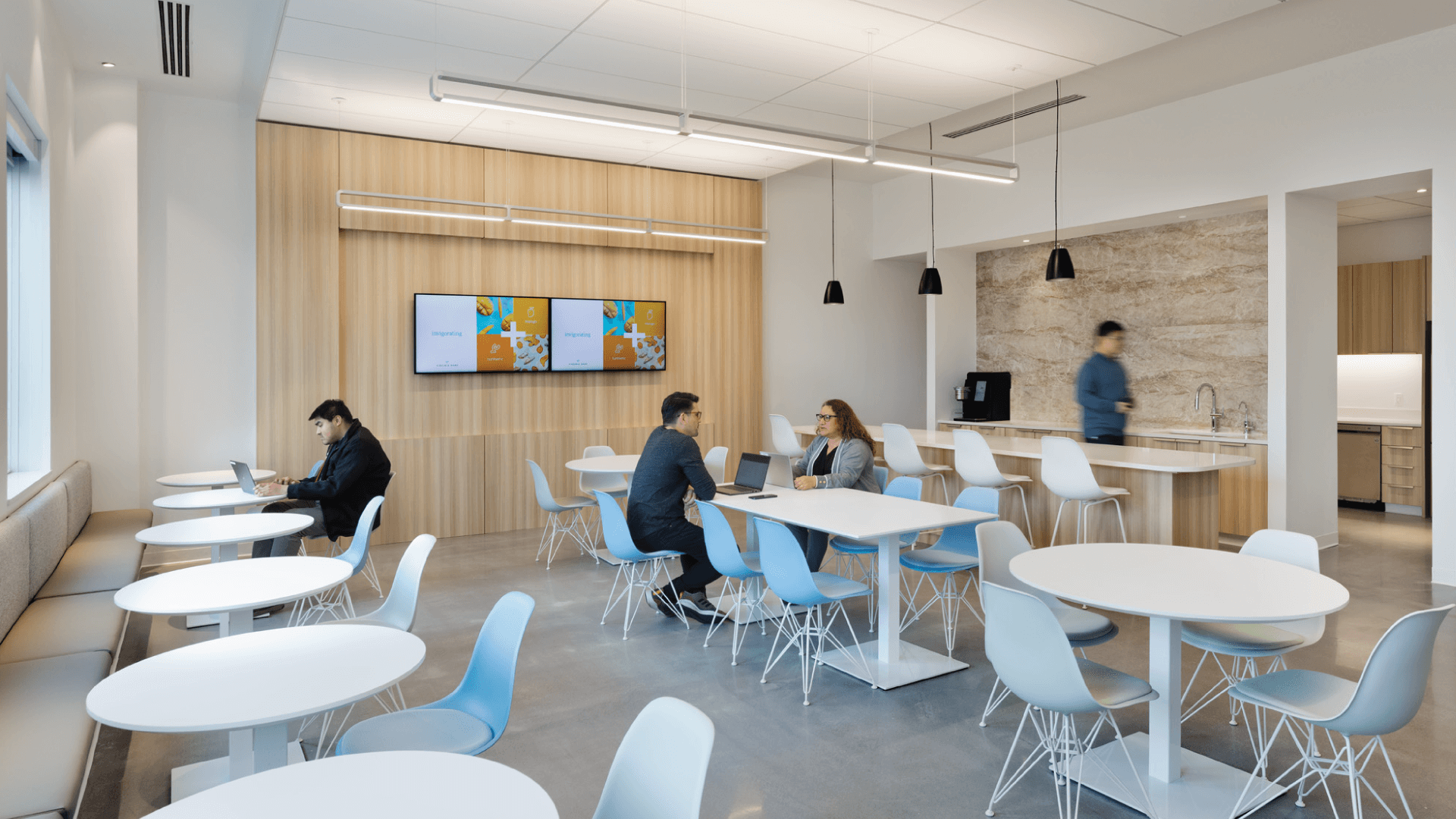
Norman Regional Health System services on its main campus, creating operational efficiencies to deliver high-quality care to the community. The project preserved a historic stone legacy wall and prioritized durability with terrazzo flooring and highly scrubbable, recyclable glass panels throughout.
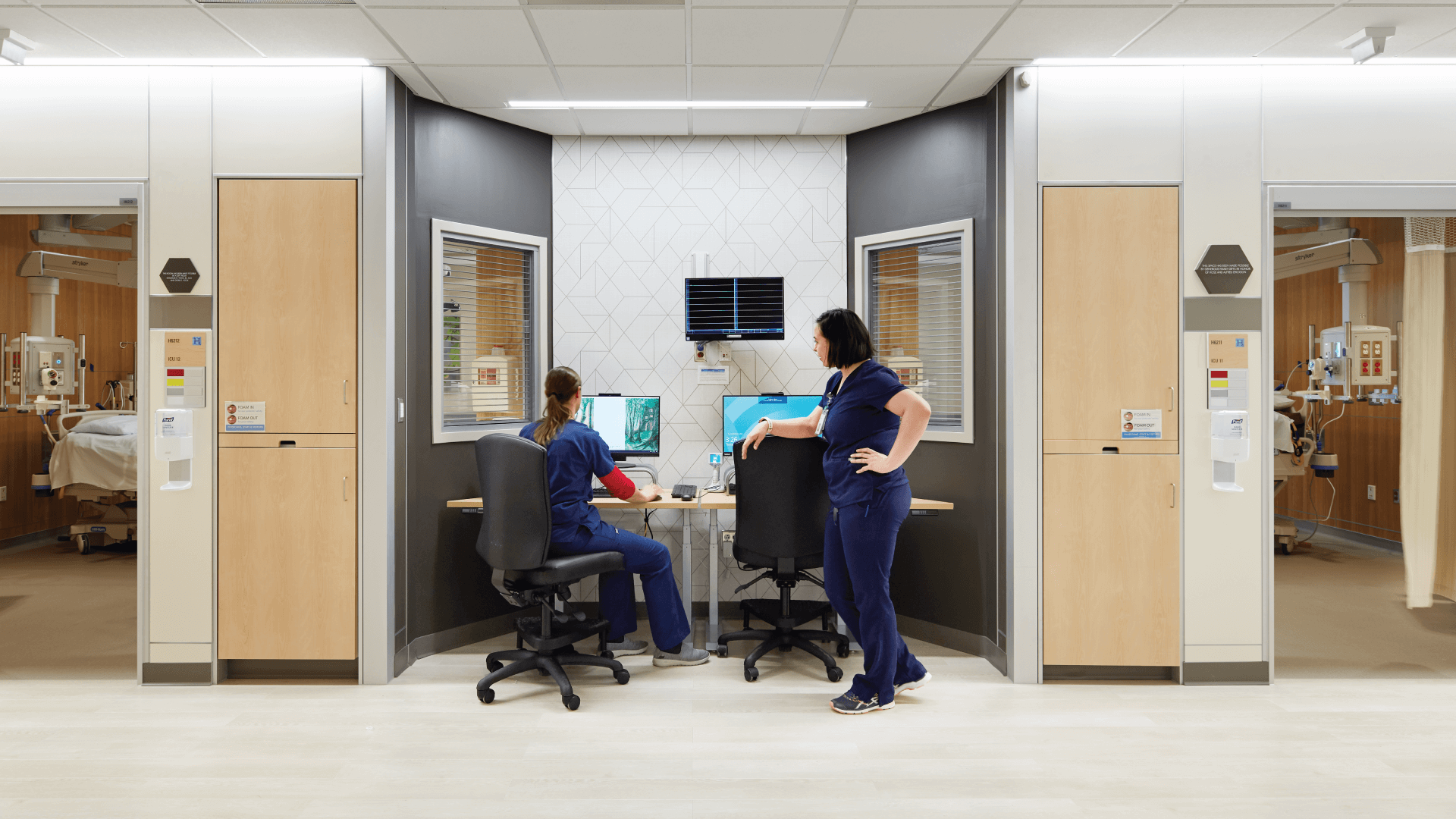
Healthcare facilities often opt for universal platforms where clinical spaces can be adapted and scaled to meet evolving care models. A consultation room, for example, can be designed with the same components to eventually function as an exam room. Using demountable wall systems and prefabricated headwall components in inpatient spaces allows facilities to adapt—from something as small as relocating an outlet to something as significant as reconfiguring an entire corridor layout.
(Deconstructing) The Path Ahead
Sourcing regionally and selecting low-carbon materials backed by Environmental Product Declaration data is vital to reducing emissions. But the idea of regionality has even greater impact when we see it as more than simply sourcing new or virgin materials. Our existing buildings are true material repositories. The word reuse derives from the phrase “to rise up, lift.” Reusing materials as part of our design toolkit lifts the entire design industry and strengthens local economies. This approach points our profession toward a circular economy—a topic we will explore in more detail in our next installment.
More in the series . . .
“Adopting a Philosophy of Longevity” is the fourth installment in a multi-part series exploring strategies to reduce the carbon impact of interior materials. For more information, read our first three articles:
About the Authors

Natalie Pullen
Empathy is the ethos of Natalie’s design process. From space planning to material selection, she promotes human health and wellbeing by working from a foundation of accessible and sustainable practices.

Sophie Kjeldgaard
Sophie Kjeldgaard, CID, WELL AP, LEED Green Associate, has worked across market sectors, including healthcare, corporate and cultural with tasks ranging from design, product and finish research, construction documents, interior detailing and construction administration.