
In our fifth installment on reducing embodied carbon, we explore how to shift from a take-make-use-waste model to a circular approach—one where construction and demolition waste becomes fuel for new opportunities in the building industry.
We have a waste management problem. In the U.S., existing landfills are, on average, 50 percent full—and filling fast. The building industry’s role in waste generation cannot be ignored.
The built environment produces roughly one-third of the world’s landfill waste, with 90 percent generated during demolition. In the U.S. alone, demolition accounts for approximately 600 million tons of waste each year, according to the Environmental Protection Agency.
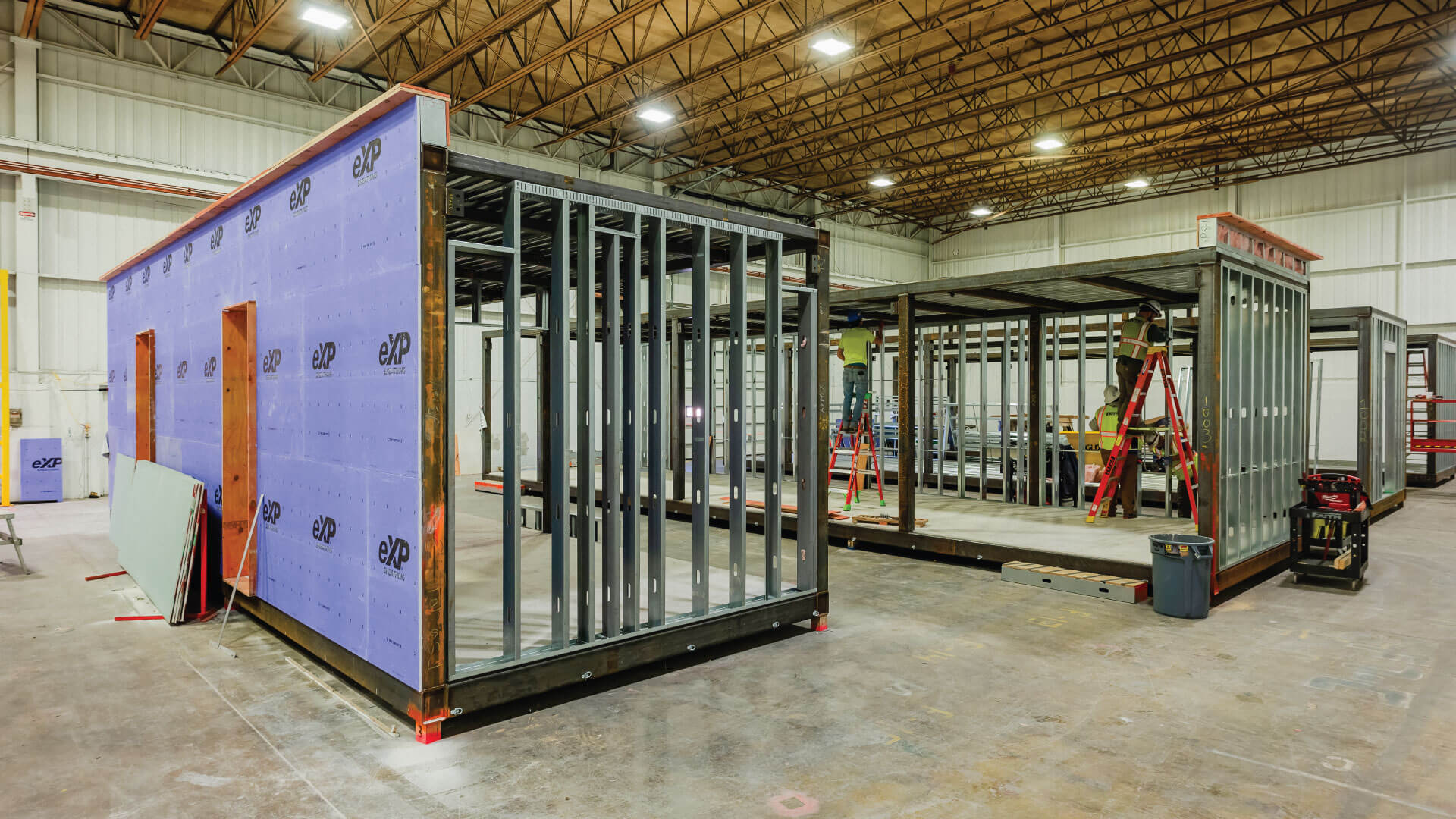
Approximately 75 percent of that waste consists of clean materials (such as wood veneer, metals, appliances) or legacy materials (such as old-growth lumber), meaning that nearly three-quarters of demolition waste could be reused.
Overlooked Costs
Beyond the environmental toll of landfills, we are also perpetuating economic fallacies.
Take furniture. Contract-grade furniture is designed to last three or four lifecycles beyond its original usage. Yet less than one percent is recycled, a small percentage is incinerated, and the remaining 80 percent ends up in landfills. Every 10 years, our industry sends $1.4 billion in furniture directly to the dumpster, according to Davies Office, a national office-furniture manufacturer, at the 2025 Build Reuse Conference.
As landfills reach capacity, tipping fees rise—creating direct costs for owners during construction and renovation. These pressures can also contribute to increased municipal and state taxes. When landfills eventually are capped, regional jobs will be lost, and waste haulers will travel longer distances to uncapped waste sites.
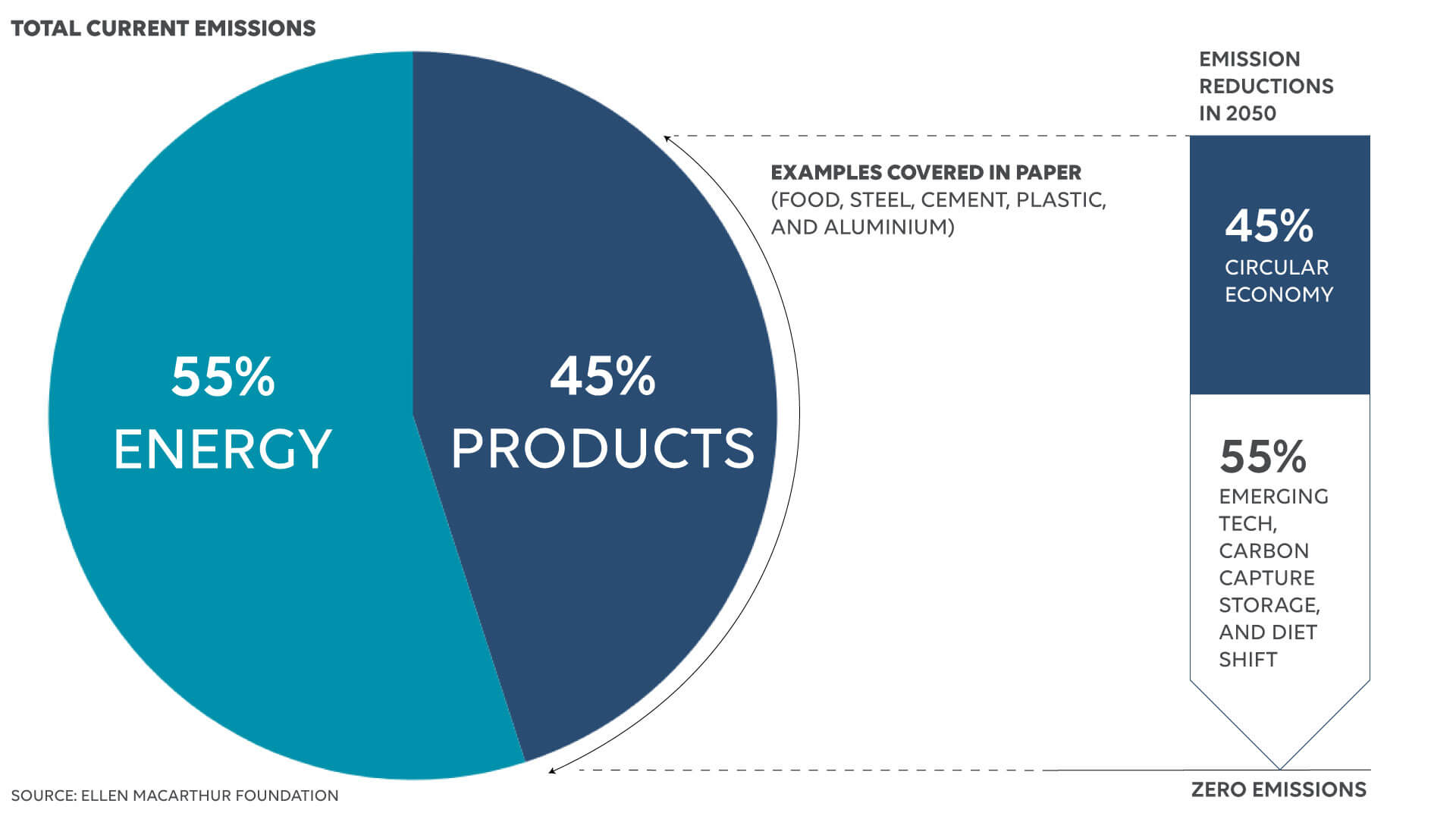
Of course, the cost of reuse is not necessarily negligible. Yet the immediate assumption that circular practices will end up costing more than traditional demolition is a misconception.
A case study by Structure Tone Building Group in Boston compared two approaches for removing 32,000 square feet of acoustic ceiling tile from an office building. A “standard” demolition process—using comingled recycling, dumpsters, and labor—totaled $16,527. An “atypical” approach, which involved palette-prepping the ceiling tile for a manufacturer’s take-back program plus labor, totaled $14,777.
Too Much Potential to Ignore
If waste generation is an economic fallacy, reuse is an economic engine. A report published in Recycling Magazine by GAIA, an international environmental alliance, highlights the job creation potential of shifting from a linear economy to a circular one:
- Remanufacturing existing materials and products creates ~30 times as many jobs as landfills and incinerators
- Recycling creates ~70 times as many jobs
- Reuse creates ~200 times as many jobs
Rather than funneling dollars into landfills, those resources can circulate within local economies—supporting bio-based and green technologies, reducing waste, and producing materials for sustainable biological reuse. In the process, we build new expertise, new markets, and new employment opportunities.

- Owner
- Owner’s rep
- Engineers
- PM
- Designers
- General Contractor / Subcontractors

- Owner
- Asset Manager
- Owner’s rep
- Material Broker
- Engineers
- Salvage Auditor
- PM
- Circularity SME
- Designers
- Decon Contractor
- General Contractor / Subcontractors
- Product / Service Reuse Vendor
Marcus Hopper of Gensler imagines the design team of the future: pooling the expertise of our current typical team members and adding the know-how from material brokers, deconstruction-specific contractors, and more.
Pockets of Change
Each time we specify materials for salvage, detail components for future reuse, reupholster a set of chairs instead of buying new, or bring deconstruction experts onto a demolition team, we actively help build the infrastructure of a circular economy.
The framework for reuse exists in pockets all around the U.S.—Doors Unhinged, ReSeat, LumberStash, Davies Office, Urban Ore, AllForReuse—to name a few. But this framework needs connections and support—simultaneously building the supply while building the demand.
That demand begins with the ask. When owners, designers, and contractors pose questions—Can we salvage this? Can we find something that’s been refurbished? Can we divert this from the landfill?—they contribute to a much larger inquiry: What kind of world do we want to build?
Deconstruction as an Alternative to Demolition
Deconstruction is a budding industry that requires industry-wide support and demand. Unlike demolition, deconstruction involves taking buildings apart piece by piece—maximizing opportunities for salvage and reuse.
Planning for deconstruction can occur at both ends of a project’s lifecycle. If a project takes place in an existing structure, an initial walkthrough with the contractor and client can determine what can be reused. When designing a new space, consider using materials with high reuse value (such as solid surface counters instead of plastic laminate) that can be removed and refinished. Relying on mechanical fasteners (nails, screws, joinery) rather than adhesives is another way to allow for easy removal and less damage to the material for its next life.
As noted by Dame Ellen MacArthur, a leader of the circular economy and Founder of the nonprofit the Ellen MacArthur Foundation, “In nature there is no waste. Waste is a human invention.”
The Meaning of Materials
Each time something is rescued from a landfill, we preserve its history. Writer Kira Gould talks not of embodied carbon, but of embodied memory—the idea that how we construct and care for our built spaces shapes collective memory, continuity, and identity.
A building’s materials are more than their cost per square foot or their specification requirements. They carry intrinsic meaning and communicate something intangible when we step into a built space.
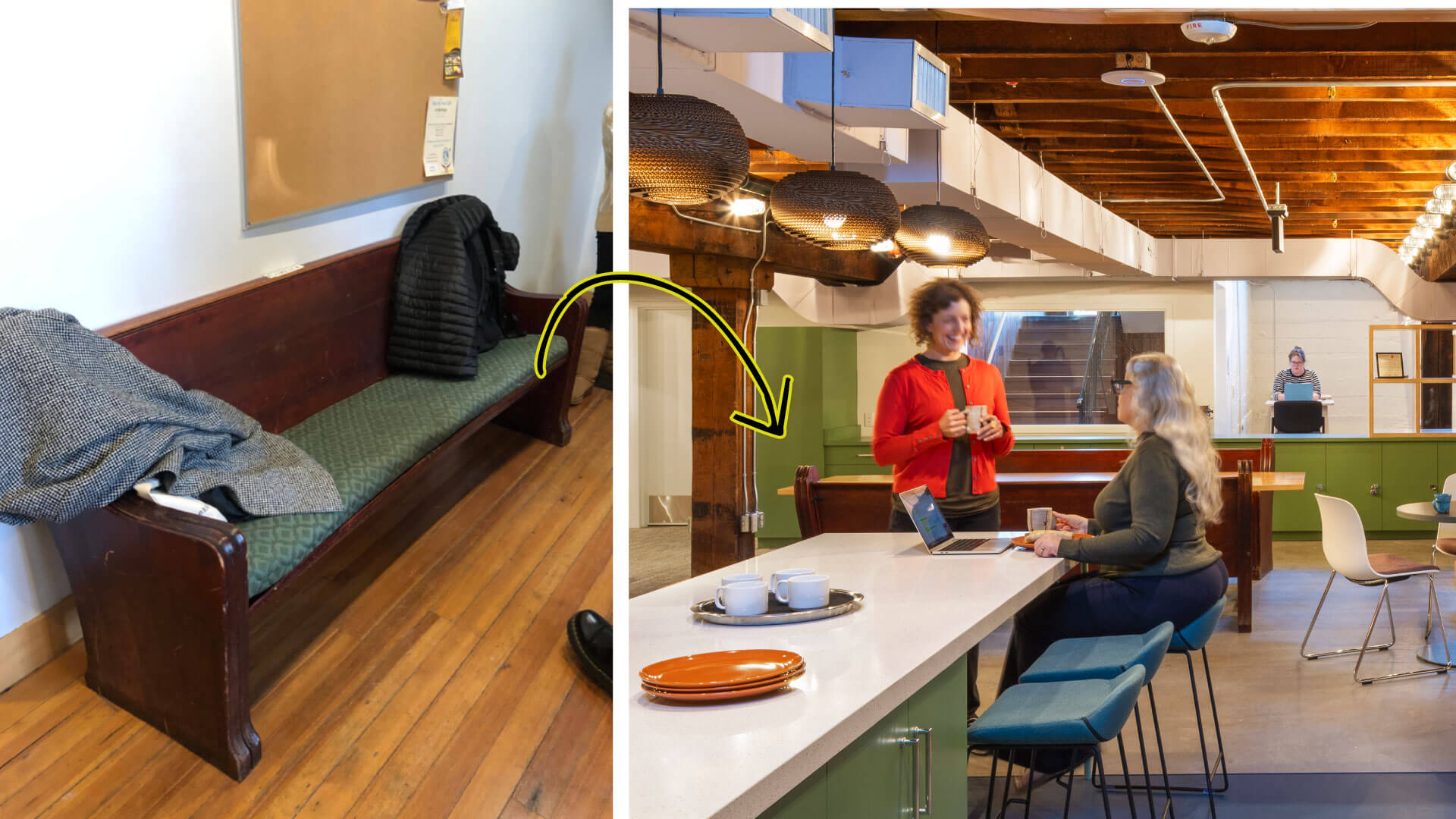

Church pews from the original Playwrights’ Center (left) found a prominent place in the new building (right).
For instance, the former home of the Playwrights’ Center (PWC), a nonprofit organization supporting theater artists, was a repurposed Lutheran church in Minneapolis. The original pews functioned as waiting area and workspace benches.
When PWC moved into its new home in St. Paul in fall 2025, the organization brought the pews with them, preserving their historic value. At the grand opening, patrons recognized them instantly, running their hands along the sloping arms or taking a seat in the freshly reupholstered cushions. These pews could have been disregarded: they are heavy and difficult to move, not the most ergonomic solution, and are showing their age. But they connect the fabric of Playwrights’ Center’s past and future.
Across the Mississippi River in Minneapolis, Water Works Park and Pavilion weaves new construction into existing historic structures, highlighting the beauty and imperfections of the original. The varied materiality and surrounding natural context represent the original inhabitants of the land, the first wave of settlers, and the current immigrant populations. Without resuse, pieces of that story would have been lost to demolition.

The Water Works building is nestled on St. Anthony Falls, a sacred site to the Dakota people for thousands of years. In the 1680s, the first colonial settlers arrived and established logging mills along the banks of the Mississippi River.
Image: Henry Lewis, St. Anthony Falls as It Appeared in 1848, 1855. Minneapolis Institute of Art, Gift of E.C. Gale.
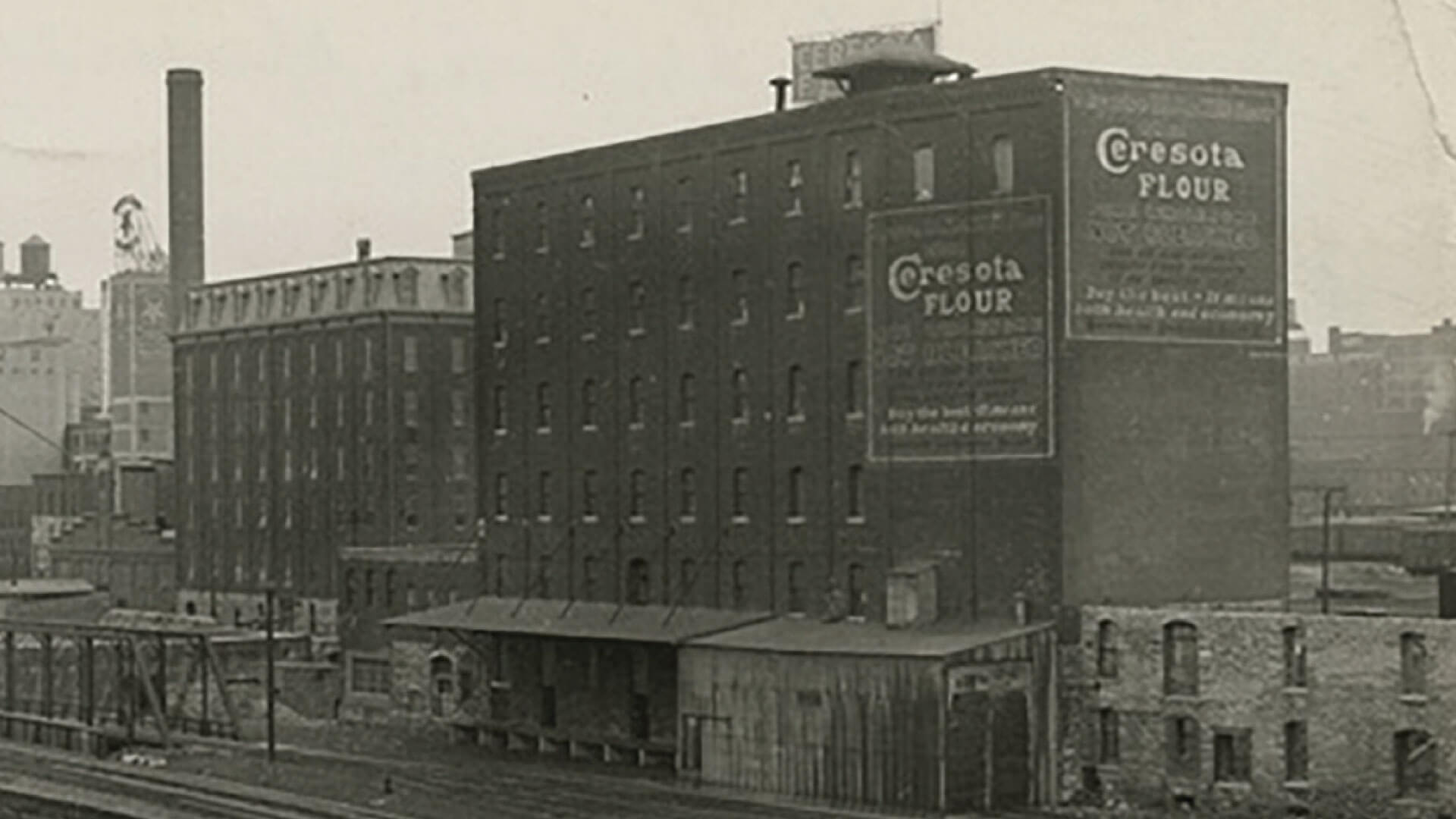
Logging mills became the foundation for the city of Minneapolis itself, its industrial heart shaped by the Mississippi River and the power of St. Anthony Falls. That energy fueled flour mills like the Columbia Mill, built in 1941 on this site before it burned, was abandoned, and fell into ruin.
Image: From the Minnesota Historical Society / Hennepin County Library.
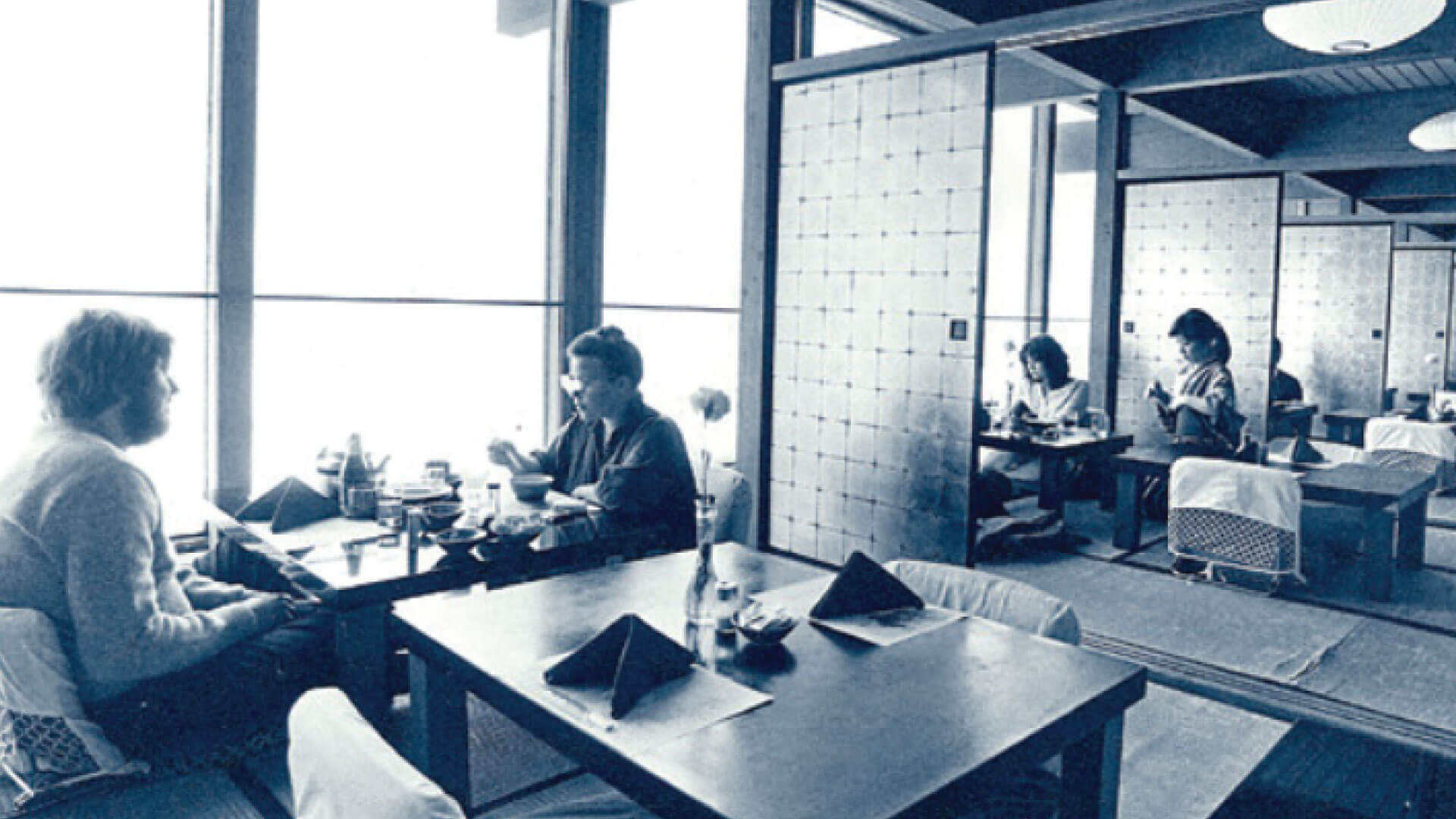
In 1960, Reiko Weston, a Japanese immigrant and entrepreneur, recognized the potential in the ruinous industrial site and founded Fuji Ya Japanese Restaurant atop the remaining flour mills, serving the Twin Cities until the 1990s.
Image: Inside of the old Fuji Ya building, from the Minnesota Historical Society.
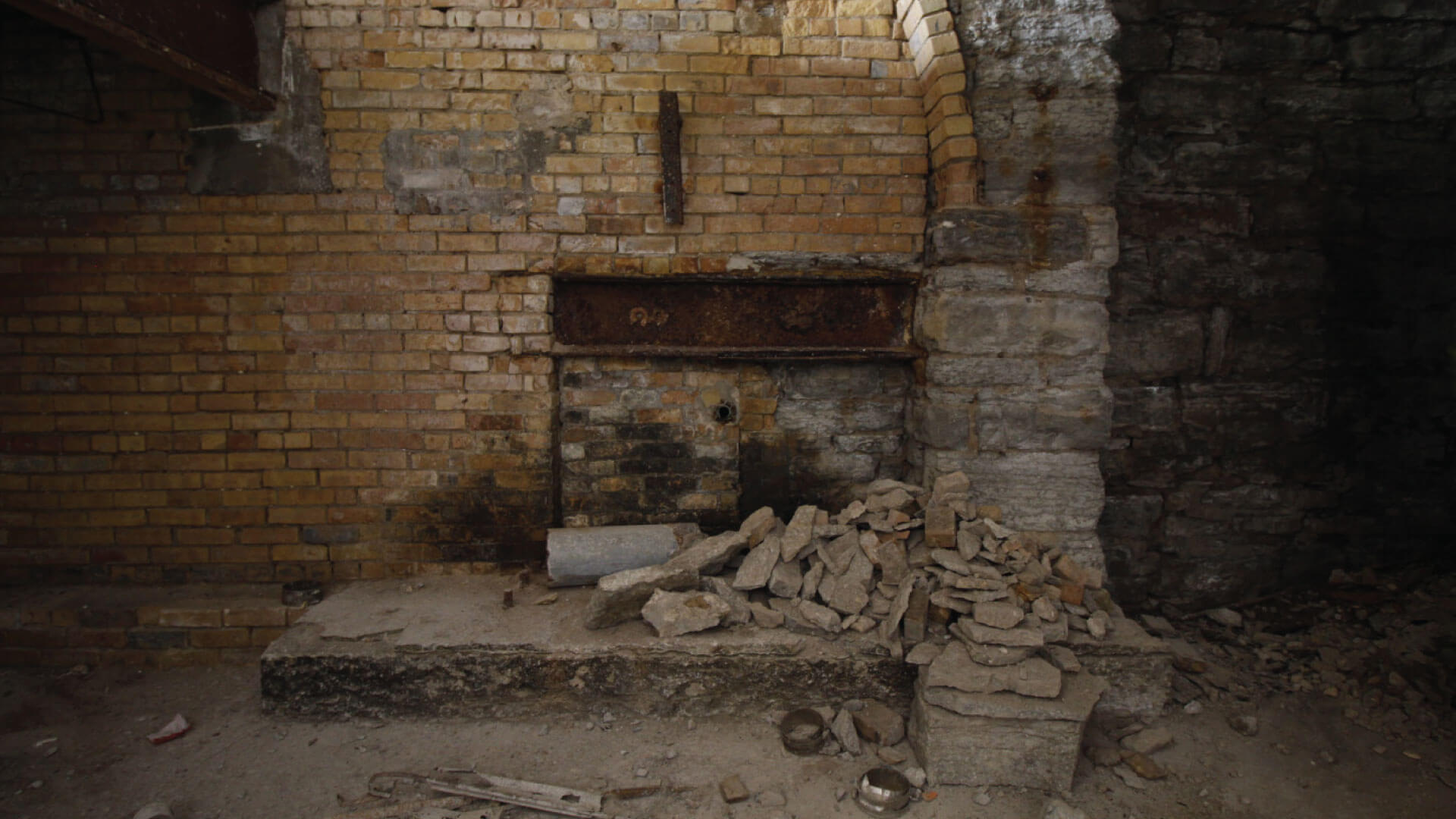
The dismantled patchwork of structures sat dormant for nearly 25 years until the Minneapolis Park & Recreation Board's revitalization of the riverfront breathed new life into the site in 2016.
Image: HGA / Michael Hara
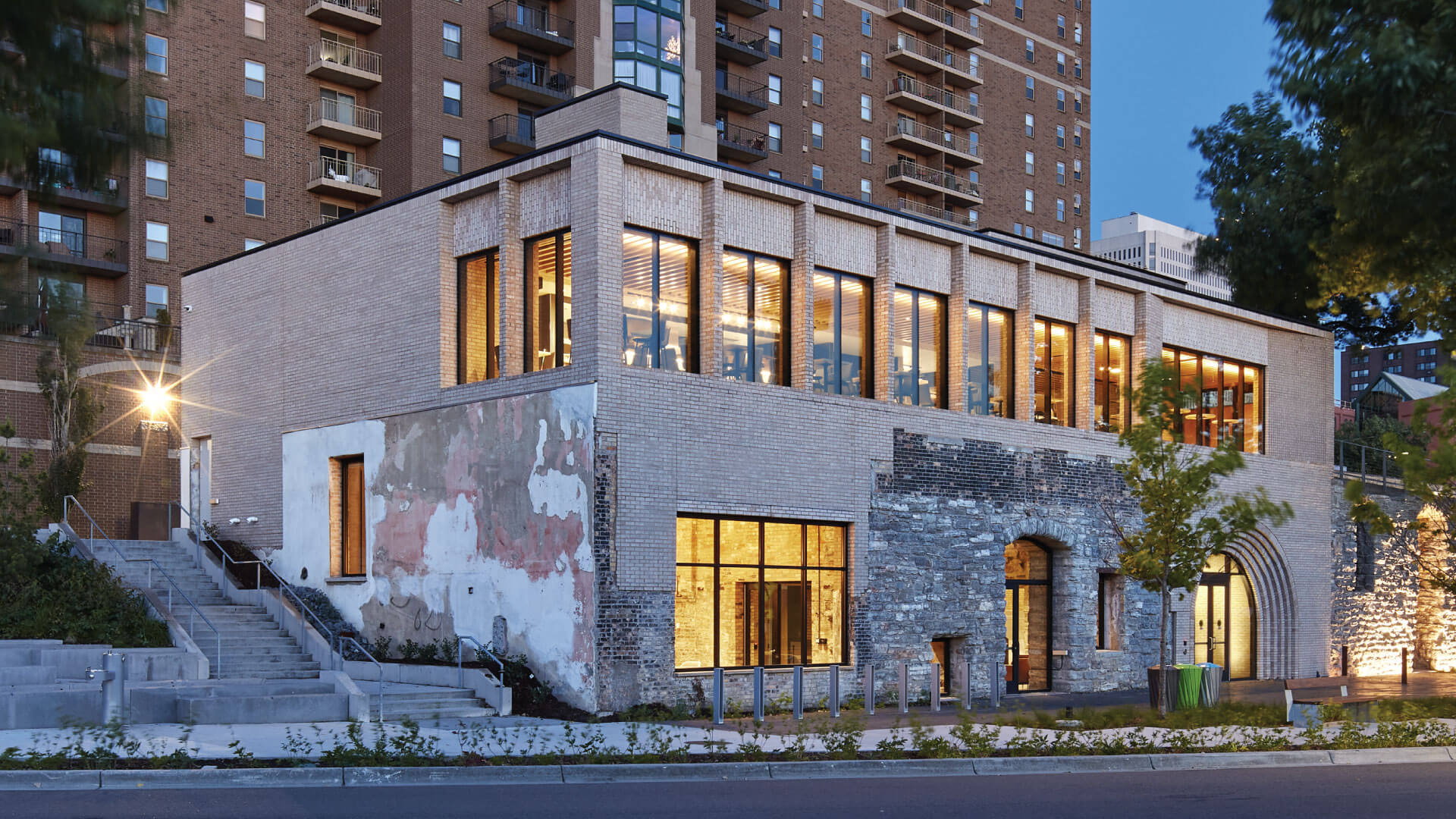
The building became the original home of Owamni, Minnesota's first Indigenous restaurant centered on pre-colonial ingredients — a beautiful representation of the land's origins coming full circle. Today the building is a communal asset for the Minneapolis Park & Recreation Board — offering respite, restrooms, and information for visitors along the bustling River Walk.
Image: HGA
We are All Part of the Circle
The complex work of constructing and reconstructing the built environment cannot be done in isolation. Buildings hold significant meaning for individuals, families, friends, and communities alike—serving as backdrops for life’s milestones and everyday rituals, carrying stories of legacy and connection.
By taking cues from nature, circularity offers a way to regenerate waste, restore ecosystems, and expand opportunity. As we strive to emulate these natural systems, we must remain grounded in place, meaning, and shared responsibility—moving forward together with our collective futures in mind. ∎
More in the series . . .
“Embracing an Economy of Circularity” is the fifth installment in a multi-part series exploring strategies to reduce the carbon impact of interior materials. For more information, read our first four articles:
About the Authors

Natalie Pullen
Empathy is the ethos of Natalie’s design process. From space planning to material selection, she promotes human health and wellbeing by working from a foundation of accessible and sustainable practices.

Sophie Kjeldgaard
Sophie Kjeldgaard, CID, WELL AP, LEED Green Associate, has worked across market sectors, including healthcare, corporate and cultural with tasks ranging from design, product and finish research, construction documents, interior detailing and construction administration.

Cara Haberman
Cara Haberman, IIDA, WELL AP, NCIDQ, is passionate about material health and environmental practices in reducing waste. Within HGA, Cara leads the sustainability resources for the interior design material library and hopes to educate designers to make informed decisions in a field where so many options exist.