
Infusion centers often play a significant role in the journey of a cancer patient. Multiple times a week over the course of months, a patient may be required to visit an infusion facility for several hours to undergo chemotherapy, immunotherapy, and other intravenous treatments. The look and layout of such environments significantly impacts patients and their families, as well as the medical staff tasked with providing care and comfort.
Despite their importance to cancer care, infusion centers are among the most under-researched design types in healthcare architecture. Literature focused on their design and its impact on care delivery is almost non-existent.


Seeking to advance a better understanding of infusion-facility design among architects and healthcare administrators alike, HGA recently conducted a post-occupancy evaluation of the infusion center at the St. Elizabeth Healthcare Cancer Center in Edgewood, Kentucky. The center is part of a six-story, 236,000-square-foot cancer center designed by HGA and completed in 2020.
Many firms conduct post-occupancy evaluations on completed projects. But HGA’s work at St. Elizabeth is notable because it began with a pre-occupancy study in 2018. That initial research, combined with a thorough review of existing literature about the design type, was then used to shape the final design of the St. Elizabeth facility—as well as other infusion facilities. Research contributes to the cycle of design, evaluation, and refinement, forming a “virtuous loop” that allows each HGA project to benefit from the lessons of its predecessors.
Beginning with Research
Before design work commenced in 2018, HGA’s Design Insight Group (DIG) conducted a pre-occupancy study to understand how infusion space design affects staff efficiency, patient experience, and overall satisfaction.
The pre-design research identified several problems, including: lack of patient privacy, blocked sightlines for caregivers, inefficiencies in the delivery of medication, and long travel distances for nurses providing care within the facility.
In response, the design team introduced these solutions:
Privacy by Design
- Problem: Lack of patient privacy
- Design solution: The design includes semi-private bays with solid walls on three sides, frosted glass partitions, and a pod layout to reduce noise.


Clear Care
- Problem: Visibility and communication challenges for caregivers
- Design solution: Nurse stations were co-located with clear sightlines into infusion bays, enabling direct patient monitoring and facilitating quick communication among care team members.
Streamlined Delivery
- Problem: Inefficient medication delivery
- Design solution: Pharmacist workstations embedded in each pod reduced medication preparation and delivery times. This arrangement improved safety by minimizing the steps and handoffs required before medication reached the patient.


Closer Care
- Problem: Extensive travel by staff on the floor
- Design solution: Smaller infusion pods, strategically located supply storage, and direct medication delivery reduced walking distances, enabling nurses to spend more time with patients.
Measuring Outcomes After Opening
In 2022, two years after construction on St. Elizabeth was completed, the DIG team returned to conduct a POE. The research, which combined patient and staff surveys with staff shadowing, measured how well the facility met its original design goals.





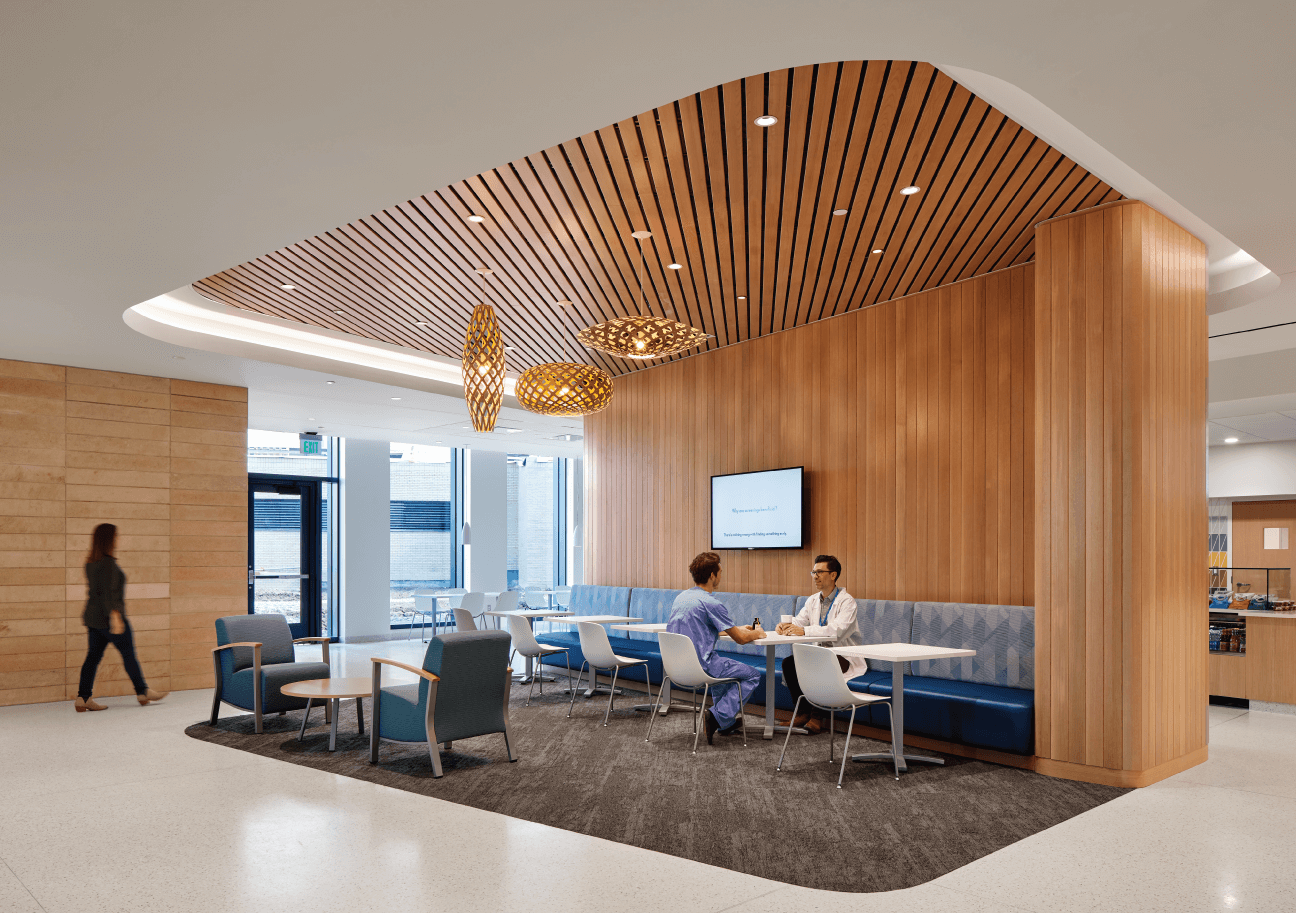



The findings—published here—confirmed that the design strategies implemented during the pre-occupancy phase delivered measurable improvements in efficiency, privacy, and satisfaction. For example, reduced nurse travel and improved sightlines contributed to better workflows and more attentive patient care. Enhanced privacy features were cited by patients and families as reducing stress and improving comfort during treatment.
A Continuing Commitment to Improvement
As cancer treatments evolve and patient needs become increasingly complex, the design of infusion centers must also advance. Insights from the St. Elizabeth project and subsequent facilities illustrate how evidence-based design can improve patient privacy, streamline workflows, and support caregiver well-being. Equally important, such evaluations shed light on areas where HGA can improve—providing invaluable insights for the design of future infusion center projects. ∎
Read the findings from HGA’s post-occupancy evaluation at St. Elizabeth Cancer Center.

Jennifer Ries
As a healthcare planning principal, Jennifer has more than 28 years of healthcare planning and programming experience, with an in-depth understanding of the dynamic demands in healthcare design. Jennifer is dedicated to the Triple Aim in Healthcare: Human Experience, Clinical Outcomes, and Operational Efficiencies.

Paul Widlarz
Paul is committed to supporting his clients’ business strategies. As principal and project manager, he combines his background in medical planning and project management to direct the programming, planning, and design process.