
Health educators are navigating a rapidly changing landscape shaped by evolving technology, practitioner shortages, clinical placement challenges, new care models, and diverse learner expectations. In response, institutions are reimagining both their curricula and physical learning environments. Simulation and immersive learning spaces—once hidden deep within campuses—are now being brought to the forefront and transformed into flexible, future-ready showcase environments.
Through our work with health education partners across the country, we’ve gained valuable insight into the common questions that arise when planning and designing these simulation spaces.
How can we ensure our simulation spaces remain adaptable and future-ready?
Existing simulation centers were often designed around a limited set of activities and manikin products. Today’s designs must anticipate virtual, augmented, and mixed reality (VR/AR/MR), artificial intelligence, surgical robotics, telehealth technologies, interdisciplinary care models, and rapid program growth.

Adaptability begins with embracing multi-use space types. SIM spaces should be tech-agnostic and support frequent reconfiguration. Infrastructure should accommodate both current tools and future technologies. This includes strategic routing of power and data, mobilized equipment, and modular design elements that allow labs and support spaces to flex.

How might we create program visibility, excitement, and engagement?
Thoughtful placement and visibility of a simulation center within a building is an important consideration. Situating a SIM center close to a front entry and on a public corridor (with visual transparency by way of strategic use of glass) can heighten program awareness, build excitement, and foster passive learning. This positioning also supports tours, recruitment, donor engagement, and external partnerships, turning the simulation center into a showcase and driver of change in your community.
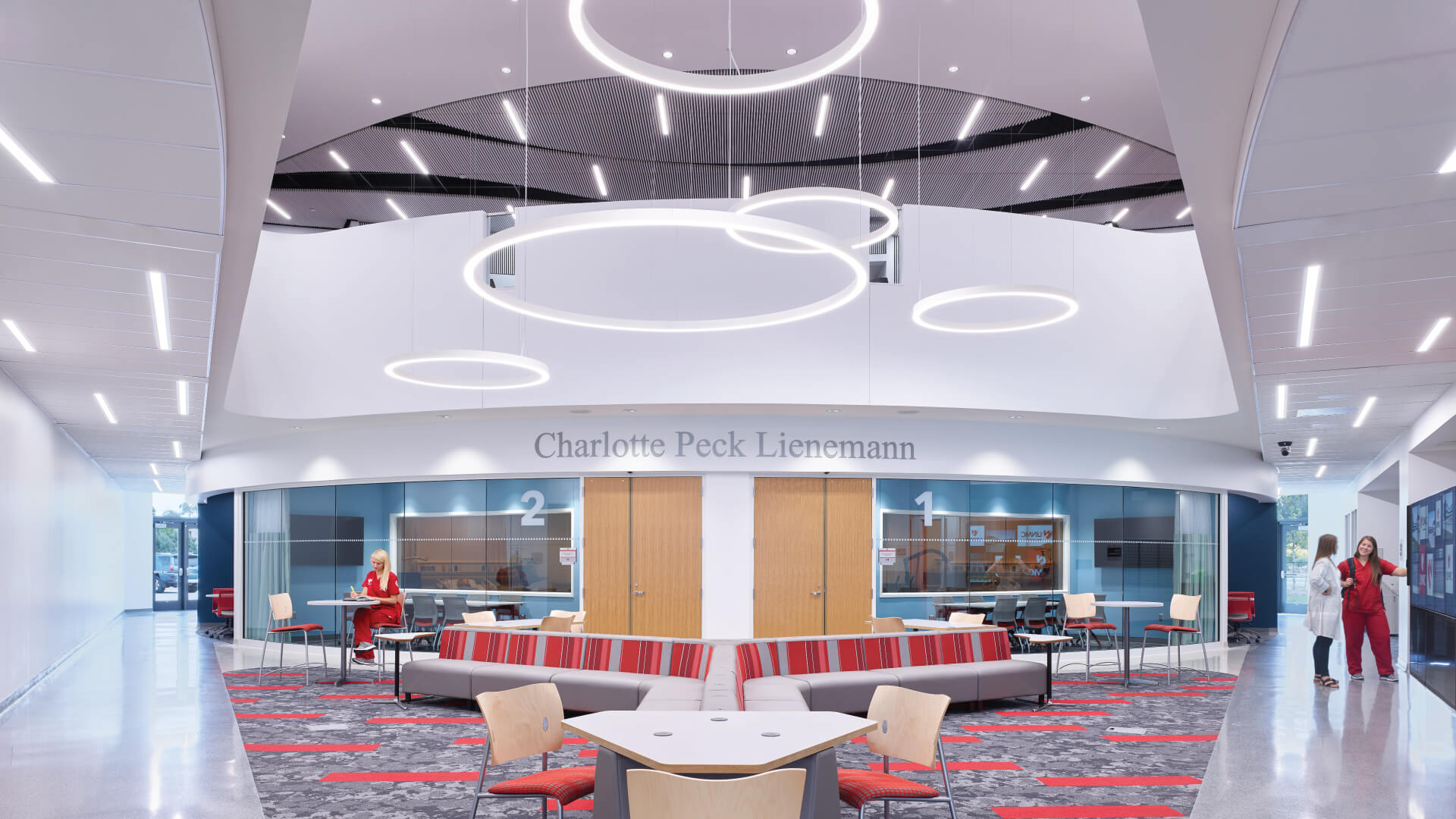

University of Nebraska Lincoln | School of Nursing – Simulation on Display
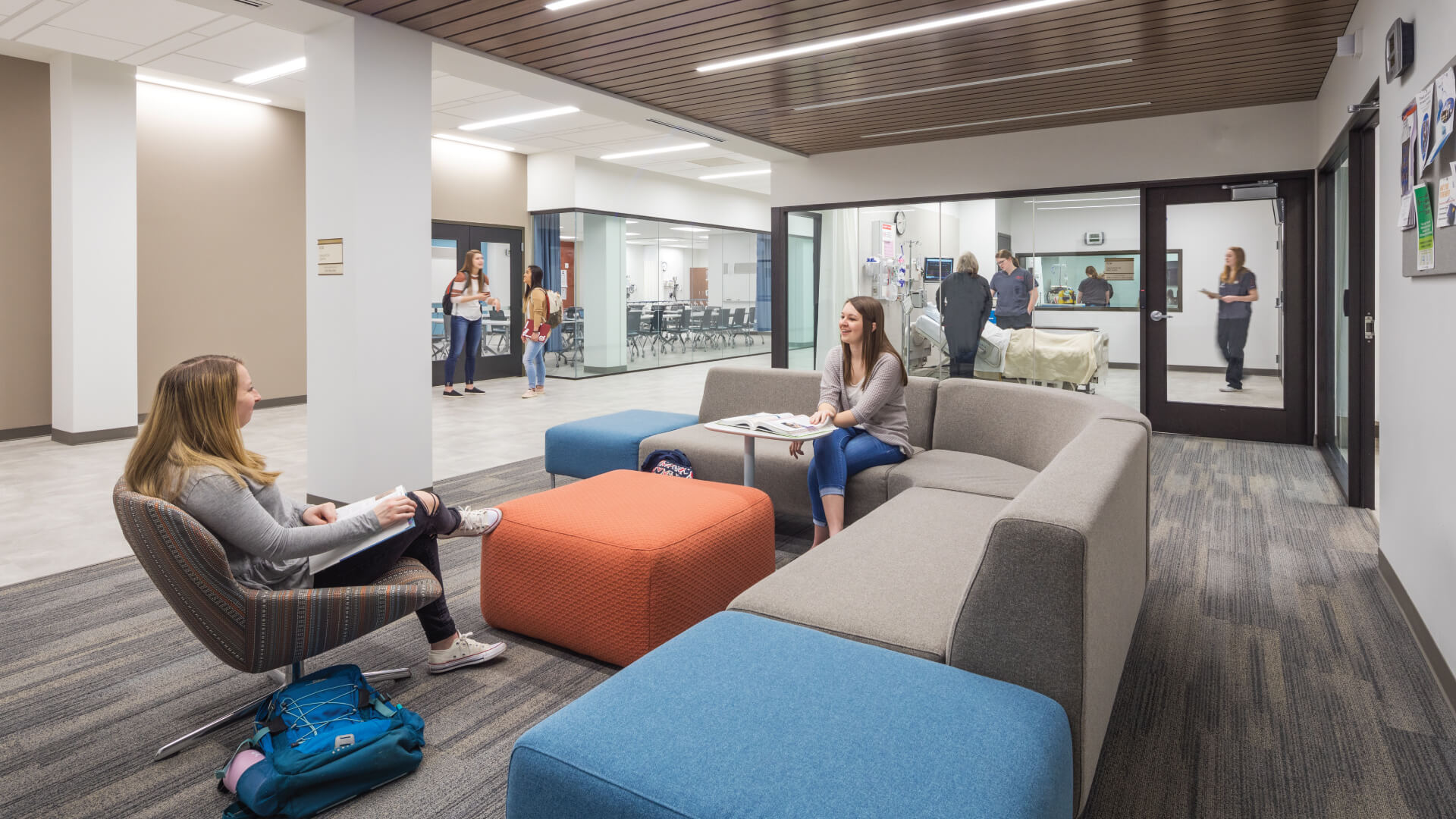
Northwestern College | School of Nursing – Simulation on Display
What comprises an innovative, flexible simulation lab?
Simulation centers typically follow a “Kit of Parts” model, comprised of:
- Simulation Labs (inpatient, outpatient, or specialized)
- Control Rooms
- Prebrief/Debrief Rooms and Observation Spaces
- Support Spaces (storage, prep rooms, reception, staff offices, and SP facilities)
We find that there are many innovative ways to arrange this “Kit of Parts.” The final design should be unique to each institution.
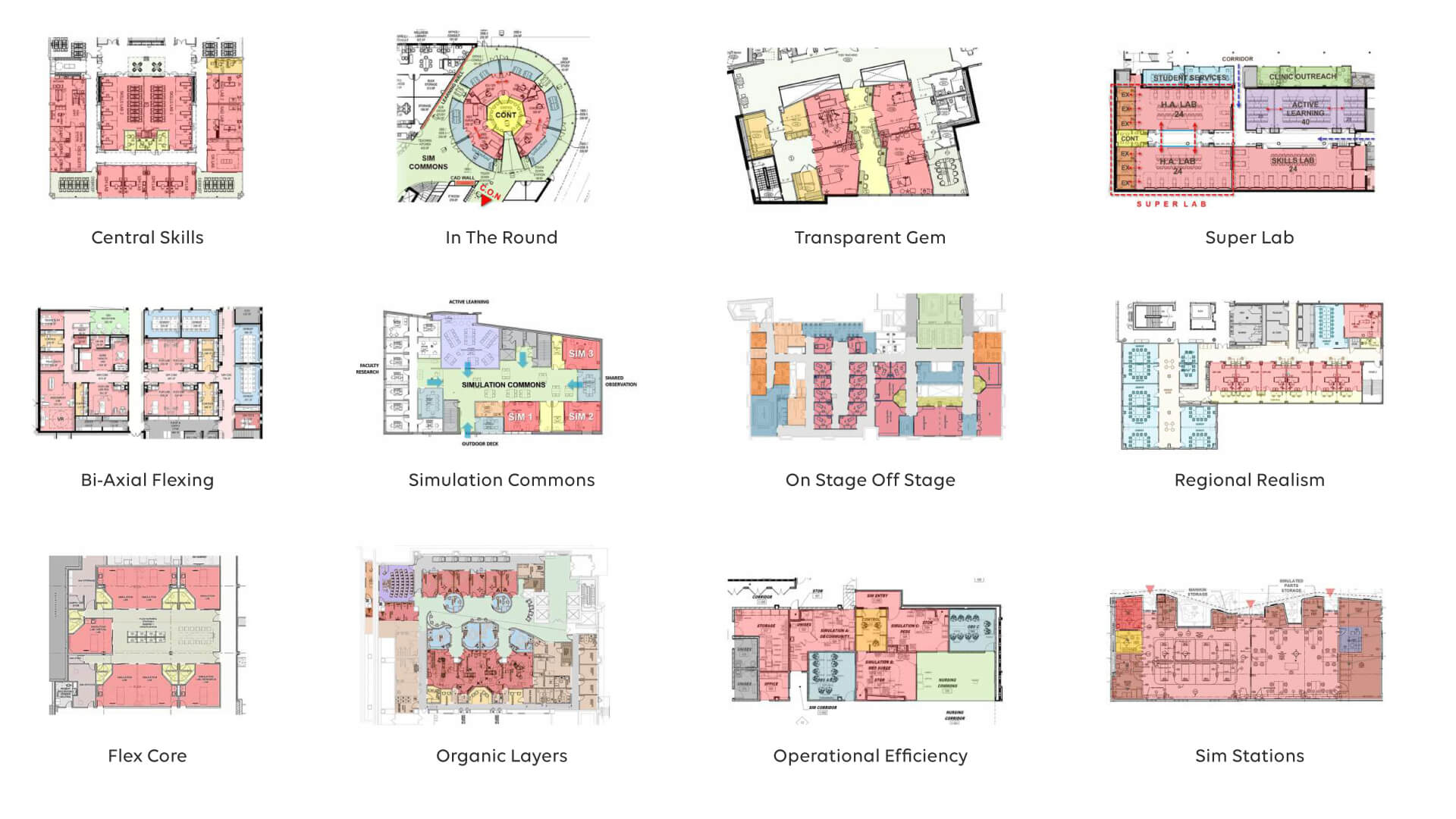
 Simulation Center Theme Variations
 What is a ‘Flex Lab’?
Flex Labs are quickly becoming the new standard in simulation design. These universal rooms are designed to handle most care scenarios—whether inpatient, outpatient, or other specialty areas—with scalability of size and fidelity. They incorporate on- and off-stage circulation to support ideal patient and staff flows, and can flex for different group sizes through use of operable partitions.
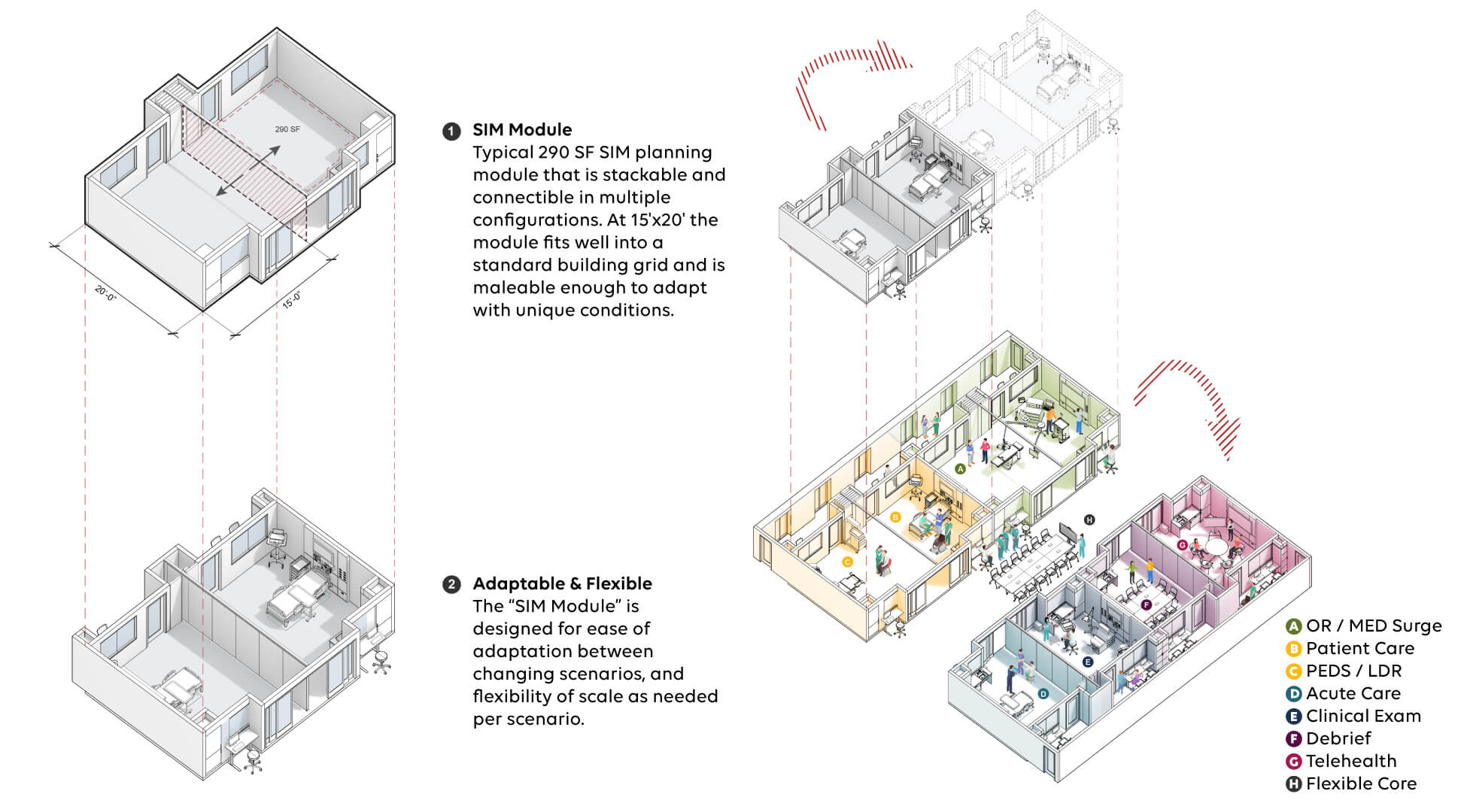 “Flex Lab” Module
 A Flex Lab should include:
- A universal headwall or mobile headwall solution
- Mobile furnishings and equipment
- Integrated sinks, storage, and nurse servers that work across scenarios
- Integrated nurse stations (optional)
- Sliding glass ICU doors for visibility, observation, and overflow
- Flexible audiovisual setups for real time debriefing
- Multi-use screen-based technology for in-lab simulation, informal debrief, and telehealth
- Computer control station for VR facilitation
- Flexible ceiling light, service boom, and dimmable lights
A Flex Lab module is designed to fit within a typical building structural grid but can be pushed and pulled to adapt to project specific requirements. The features provided within Flex Labs allow for highly adaptive environments that serve a wide range of teaching needs.
What state-of-the-art concepts can we implement?
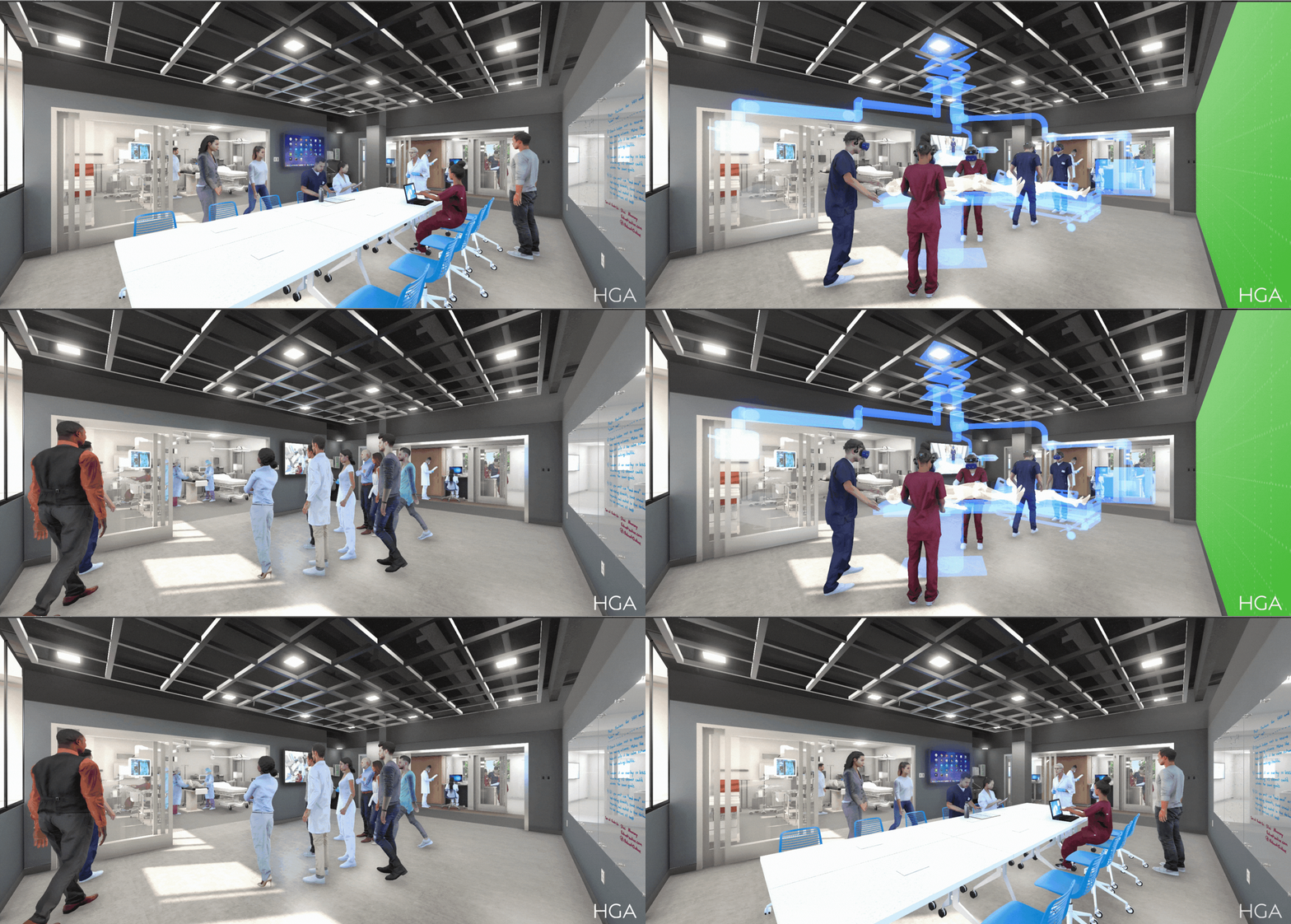
Some of our partners are taking innovation a step farther by incorporating a dedicated “Black Box Technology Lab” into their simulation suites. This highly adaptative space is designed to accommodate evolving digital tools, immersive technologies, and robotics for current and future learning environment needs.
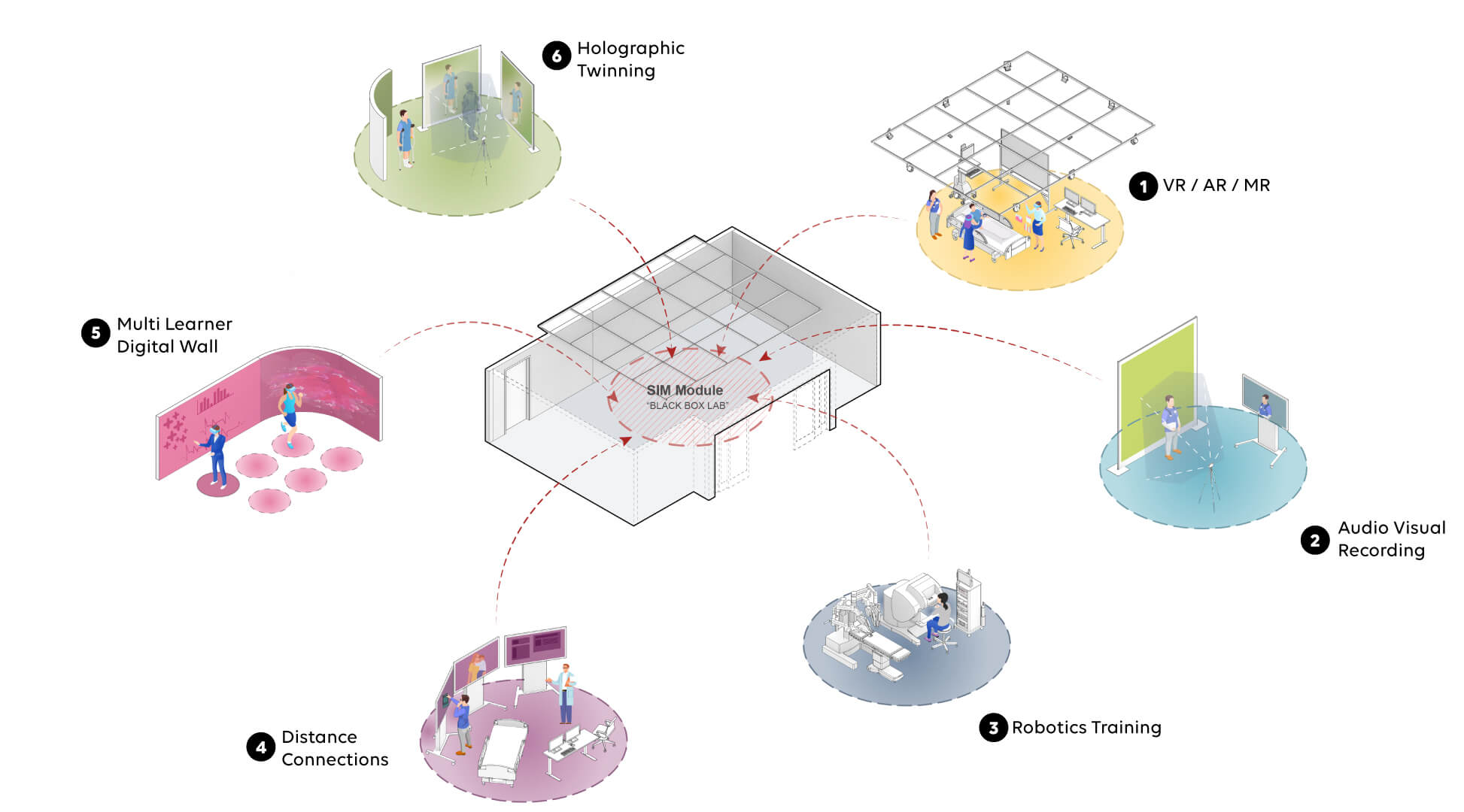 “Black Box Lab” Module
 Key features include:
- A 12-foot diameter clear zone for multiplayer VR/AR/MR simulations
- Additional 5-foot perimeter buffer zone for facilitation observation and equipment
- A Unistrut ceiling grid system for sensors and specialty light mounting
- A dedicated VR computer control station
- Mobile or wall-mounted display monitor
- Adjacent storage and dedicated server room
- Optional features like green screens and A/V production equipment
This kind of lab can serve as a platform to experiment with emerging technologies that may diverge from most Flex Lab scenarios. It can also serve as a content creation studio, distance learning platform, and student technology resource center with dedicated staff and checkout services for digital tools. It provides learning space and a technology hub—ideal for supporting digital-native students and advancing research and innovation.
How can we justify the investment?
The question of return on investment is top of mind for many. Designing adaptable spaces ensures you can meet your needs and budget on day one, while allowing you to experiment and invest in new equipment and teaching models in the future without renovation.
Investing in a simulation center designed to meet the Society for Simulation in Healthcare (SSH) certification standards can help to alleviate placement pressures on local providers by allowing educators to facilitate a portion of clinicals and residencies on their campuses.
Simulation centers can also generate revenue by renting space to local providers for continuing education and professional development. Some institutions find that building state-of-the-art simulation environments spurs inquiries, strengthens partnerships, and attracts grant opportunities.
Preparing for Tomorrow, Today
Today’s simulation environments are the front line of educational innovation, bridging the gap between classroom and clinic. By prioritizing adaptability, integrating emerging technologies, and engaging learners, these spaces empower the next generation of healthcare professionals to be skilled, empathetic collaborators ready to make meaningful impact in the future of care delivery.
Explore HGA’s Health Education portfolio to see how we design resilient, equitable spaces for the next generation of healthcare learning.
About the Authors

Joe Lilly
Joe Lilly is a senior health education planner at HGA with over a decade of experience in architectural planning, programming, and design for public and private universities, academic medical centers, and healthcare institutions. He brings specialized expertise in simulation environments and is known for his collaborative, interdisciplinary approach.

Kim Jensen
Kim Jensen is a healthcare principal and director for HGA’s Rochester office. Her specialty in Health Education merges her passion for healthcare design with her strengths to elevate the educational experience. She uses her listening to action skills to elevate clients and employees to their greatest potential.