
Effective benchmarking and space planning are essential for optimizing life sciences laboratories, enhancing workflows to support research needs, and balancing investment and operational costs with sustainability and future flexibility. By considering industry best practices, labs can be designed to foster collaboration, support evolving research needs, and meet sustainability goals. A well-balanced lab-to-office ratio is important, as it ensures adequate space for both research and administrative functions. An optimal ratio enhances productivity, communication, and safety, while preventing the drawbacks of excess office space or insufficient lab capacity. Together, these elements create an environment that drives innovation, ensures regulatory compliance, and supports cutting-edge scientific discovery.


At HGA we examine key metrics from our comprehensive database of life sciences projects to identify trends that influence program, cost, and sustainability. Among these metrics, the lab-to-office space ratio within research floorplates is especially a critical metric—and a frequent conversation topic at lab design conferences and panel discussions. The debate often focuses on the industry standard “60/40 Lab-to-Office” ratio, as it serves as a key measure of the effectiveness and capacity of a lab building’s systems. This ratio has become the standard for purpose-built life sciences lab buildings, particularly for core/shell developments that must remain flexible to accommodate a diverse range of lab tenants. Planning a building to accommodate a 60/40 ratio allows a tenant to design wet lab space up to that ratio on a given floorplate, with the confidence that Base Building systems will support typical mechanical and electrical requirements of the wet lab space.
The 60/40 lab-to-office ratio has become so ingrained in the industry that life sciences users approach us with this ratio as the starting point for their program. It wasn’t always the case. Before biologics, cell and gene therapies, and genomics research became dominant, chemistry-driven programs and small molecule drug discovery had a different lab space profile. Chemical fume hoods were once installed at much higher densities in lab spaces than is typical today, with fewer researchers occupying the space compared to current standards. Despite the higher net square footage per person in the lab, the lab-to-office ratio was typically 50/50. Private offices were common, workstations were more spacious, and printing and file storage areas were still the norm.
With the shift to biology-driven lab spaces and a reduction in private offices, the industry now views the 60/40 lab-to-office ratio as a better reflection of contemporary research needs. The post-pandemic era has demonstrated the power of molecular biology, such as mRNA technology, in addressing not only COVID-19 but also genetic diseases, cancer, and autoimmune disorders. The 60/40 ratio aims for greater efficiency—maximizing the use of expensive lab space while leveraging hybrid work-from-home models for office functions and computational research. However, is there a mismatch between these efficiency goals and actual buildouts? While HGA’s data generally supports the industry standard, many lab projects are still built closer to a 50/50 ratio. This variation can significantly impact space utilization, construction cost, operational cost, and carbon footprint.
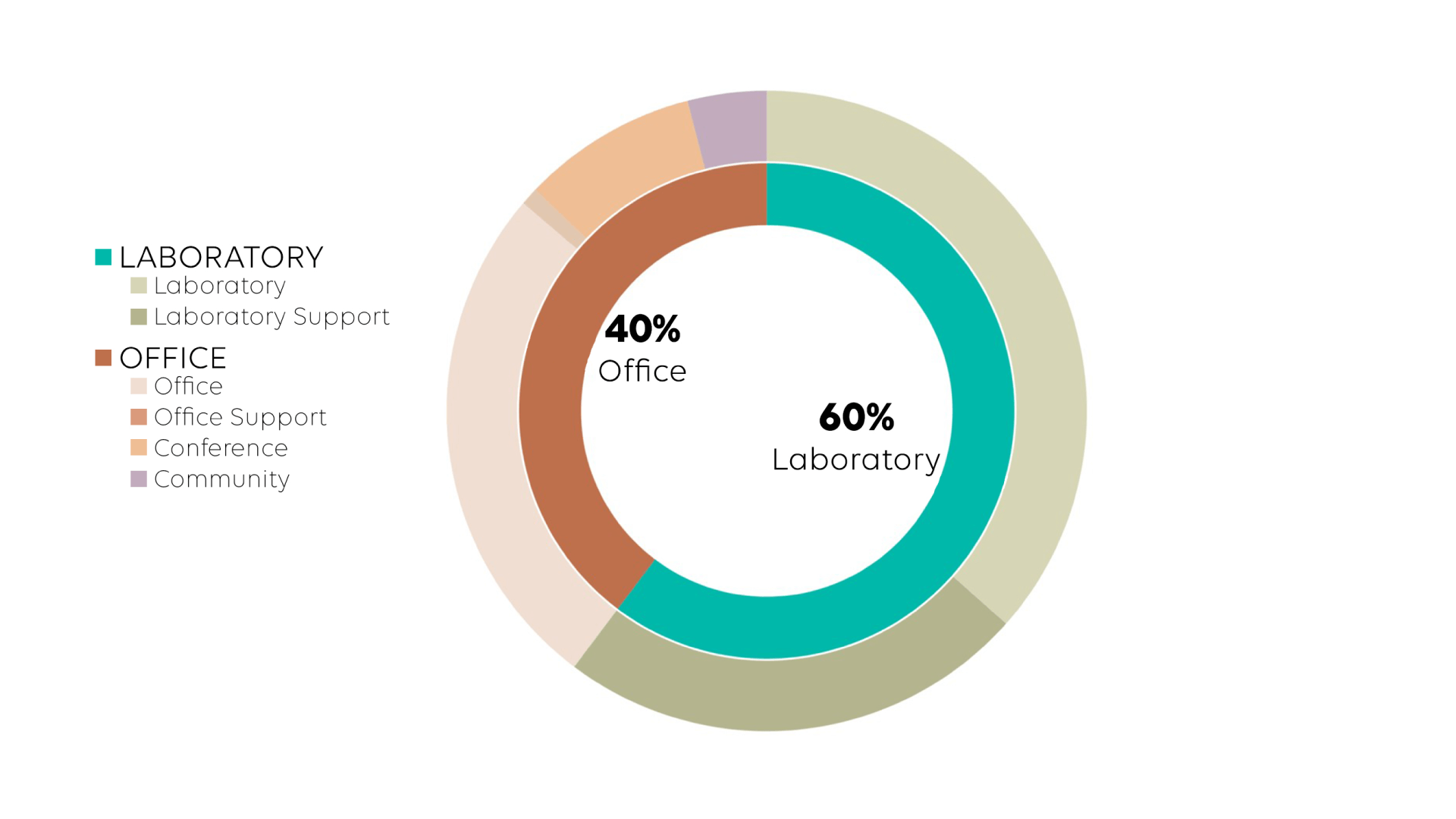
 A well-balanced 60/40 lab-to-office ratio ensures adequate space for both research and administrative functions. In the graphic above, Laboratory includes laboratory and laboratory support spaces, and Office encompasses office and office support, conference rooms, and community convening areas.
 If the typical life sciences tenant targets a 60/40 ratio, why are wet lab spaces often a significantly smaller proportion? One reason is that the shift to biology-driven research has increased the density of researchers at the bench. A 10,000-square-foot lab that once housed 30 synthetic chemists and associated staff now accommodates 50 biologists, biochemists, and their teams. This increase in population has created a greater demand for non-lab spaces, including offices, meeting rooms, and kitchenette/café areas, which are used by lab users when they are not in the lab. Additionally, advances in computational biology and AI have increased the numbers for researchers outside wet lab environments, with the limitations of remote work prompting more of them to return to the office. There is also a growing recognition that office spaces designed to foster collaboration, such as multi-purpose gathering areas, are essential to the success of research environments.
There are caveats to where these trends may lead, as our data still shows a median lab space ratio of 58%, just below the 60/40 industry standard. As one countertrend, life sciences users with large animal facilities, cleanrooms, or clinical manufacturing and pilot lab space are likely to see their lab space ratios rise back to 60/40 or higher, pushing the median of our dataset upwards. These lab types tend to have fewer staff per square foot, which necessitates a lower ratio of office space to maintain efficiency.

How should architects and building developers react? To maintain long-term flexibility, designing buildings at the 60/40 ratio remains justified for planning purposes. However, since many research tenants and organizations may initially have lighter usage, deferring more robust infrastructure may be warranted on a case-by-case basis. Developers may want to retain flexibility for future 60/40 usage and could consider modular strategies for supplementing Base Building HVAC and electrical infrastructure, rather than investing in higher ratios at first occupancy. For example, pre-planning for additional equipment in a mechanical penthouse could allow for increased lab supply and exhaust air for future tenants. Research tenants outfitting space in these buildings may benefit from tenant improvement (TI) allowances stretching further when the lab-to-office ratio is lower, as lower lab space reduces operational costs. The fixed TI allowances provided by landlords on a square footage basis will cover a greater portion of the buildout when there is less lab space, which is typically three to four times more expensive than office space.
As the life sciences industry evolves, the traditional 60/40 lab-to-office ratio is being re-examined to align with shifting research needs and workplace dynamics. HGA’s data indicates a trend toward lower ratios for many users, driven by higher researcher density, advancements in computational biology, and changes in scientific discovery. Flexible, modular design strategies can help developers and tenants adapt to these shifts while optimizing cost and efficiency. By comparing industry standards with actual use cases, lab environments can be better tailored to meet evolving research needs, sustainability goals, and financial objectives.
About the Author

Mark Allen
Mark Allen leads the Life Sciences practice within HGA’s Science + Technology sector, working with biotech, pharmaceutical, biomedical, and institutional research clients nationally. With a deep understanding of emerging research trends, he delivers tailored, data-driven design solutions that support client needs.