
Data centers are one of the largest growth markets in the building industry today. The innovations in digital services, cloud computing, artificial intelligence, and 5G are driving this growth, attracting infrastructure investment from public and private developers and leading tech companies. According to a recent report by CBRE, approximately 4,750 new data centers are projected to be in development nationally by 2025, a figure that continues to rise. In addition to the explosive growth in the data center projects, the power capacity increases are outpacing the growth of facility size, providing direct evidence of the increasing power density that these modern data centers are requiring.
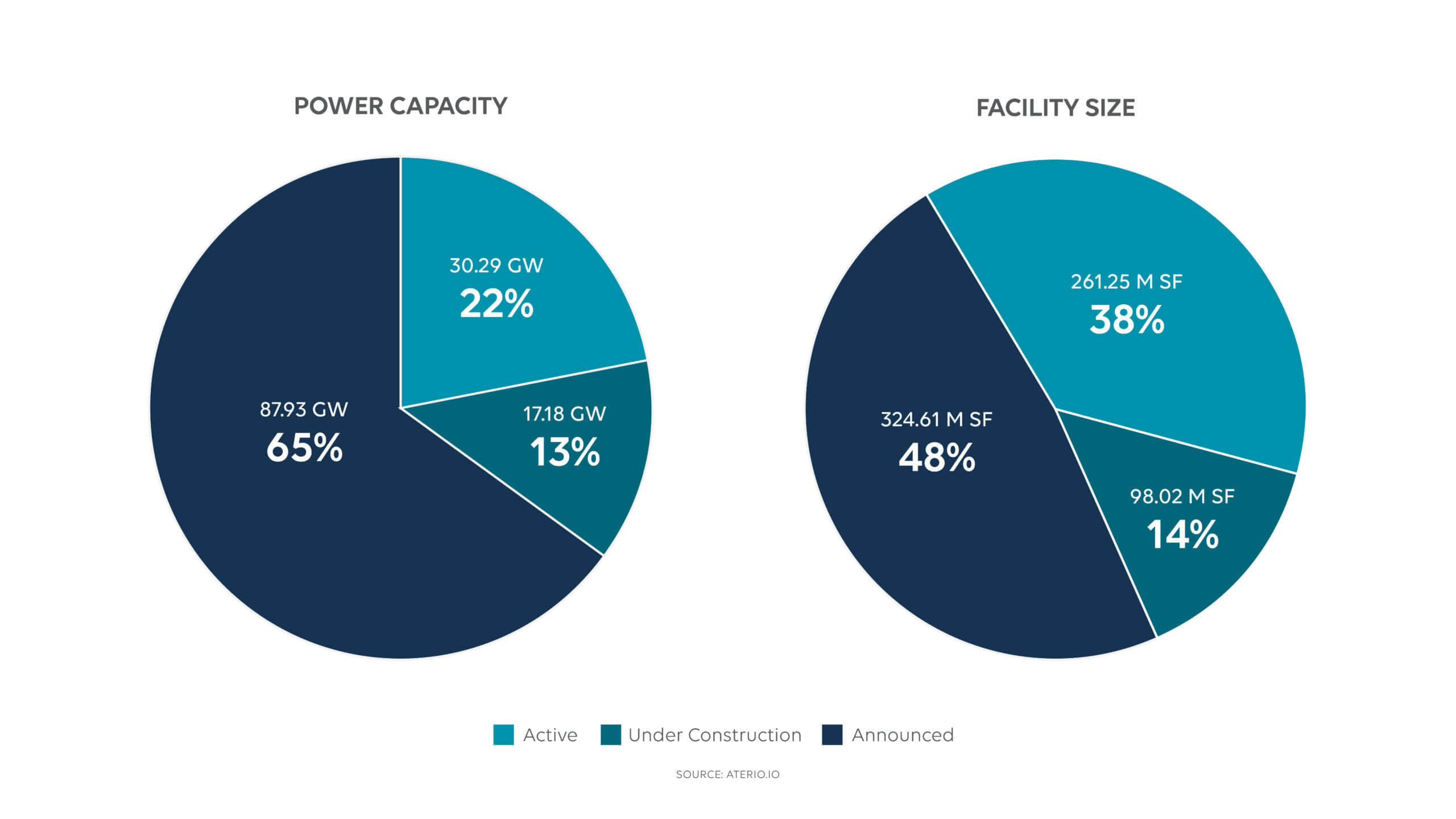


Building Tomorrow's Power Puzzle: Same Footprint, Exponential Juice
However, data centers are also among the most energy-intensive buildings, consuming vast amounts of electricity primarily for IT operations and cooling systems. As the demand for computing power grows, sustainability has become essential for operators aiming to reduce operational costs and improve efficiency. Here are four actionable strategies operators can implement to maximize efficiency, reduce downtime risks, and enhance long-term financial performance.
 Optimize Cooling Systems for Cost Savings
Cooling accounts for up to 40% of total data center energy use. Traditional air-cooled systems are inefficient, especially at scale.
- Why It Matters: Direct-to-chip liquid cooling enables higher-density server racks while cutting energy costs, making it a critical solution for hyperscale and enterprise data centers.
HGA’s work includes the deployment of chilled water plants integrated with predictive control strategies that significantly enhance cooling performance. In a comparable industry-leading example, Meta’s Gallatin Data Center in Tennessee showcases what’s possible when advanced thermal design is paired with liquid cooling. The facility employs a combination of highly efficient chilled water systems and direct-to-chip liquid cooling to achieve a Power Usage Effectiveness (PUE) of 1.1—placing it among the most energy-efficient data centers globally.
These techniques not only lower operational costs but also support high-density computing environments while maintaining thermal stability.
 Reduce Energy Costs Through Smart Power Distribution
Optimizing power usage improves efficiency and lowers electricity bills. Many data centers over-provision power capacity, leading to wasted energy. Data centers achieving a Power Usage Effectiveness (PUE) below 1.2 are significantly more cost-effective.
- Why it Matters: Reducing PUE and transmission losses directly translates into lower electricity costs and improved system reliability.

HGA’s approach to smart power distribution includes designing electrical architectures that minimize conversion losses and balance loads dynamically. This avoids unnecessary oversizing of electrical systems while ensuring reliability through built-in redundancy. A notable industry example is Google’s St. Ghislain Data Center in Belgium, which implemented AI-driven energy management and right-sized its power distribution to meet actual server loads. This approach enabled Google to achieve a sustained PUE of 1.12 while improving power reliability and reducing overall electricity consumption. Similar design principles guide HGA’s work in microgrid integration and predictive power modeling to optimize infrastructure investments while keeping energy costs under control.
 Integrate Renewable Energy and Waste Heat Recovery for Long-Term Savings
Integrating renewable energy sources, such as onsite solar and wind, and heat recovery reduces long-term operating expenses and environmental impact.
- Why it Matters: By incorporating solar, wind, and waste heat recovery, operators can reduce dependence on volatile energy markets while cutting cooling and heating expenses.

Reducing operational expenses requires more than just high-efficiency equipment. HGA develops carbon master plans that align financial and sustainability goals, guiding clients toward cost-effective energy strategies. In municipal and higher education settings, HGA has helped organizations reduce their emissions and utility bills by integrating building electrification, solar photovoltaics, and heat recovery systems. These lessons are directly applicable to data centers, where on-site renewables can offset power demand, and waste heat recovery can be redirected to reheat or preheat systems, reducing thermal loads and grid dependency.
 Plan for Scalability and Future Proofing for Competitive Advantage
With energy prices steadily rising, designing data centers for long-term efficiency and adaptability is essential.
- Why It Matters: Implementing scalable infrastructure reduces long-term capital and operational expenditures, making data centers more competitive in the market.
As illustrated above, integrating high-efficiency cooling strategies, waste heat recovery, and microgrid solutions helps data centers lower Power Usage Effectiveness (PUE), demonstrating that energy efficiency and resiliency can be successfully achieved together by reducing reliance on the grid, and improve redundancy without over-provisioning. Scalable infrastructure enables facilities to adapt to evolving power densities and IT demands. This strategic foresight not only cuts capital and energy costs but also positions operators to remain agile and competitive in a rapidly changing industry landscape.
A Call to Action
As energy costs and regulatory pressures rise, sustainability is no longer just an environmental goal—it is a financial and operational necessity.
We invite data center operators, mission critical facility managers, and IT infrastructure leaders to explore the following next steps:
- Consult with our experts to assess opportunities for energy savings.
- Schedule an energy audit to identify inefficiencies in cooling, power usage, and redundancy strategies.
- Learn from real-world case studies—see how other high-performance facilities have cut costs and improved resilience.
By applying proven design strategies, operators can reduce operating costs while ensuring high-performance, scalable infrastructure that meets the demands of modern computing. ∎
About HGA
At HGA, we apply a structured, data-driven approach to enhancing energy efficiency, leveraging deep expertise in district thermal plants, net-zero energy planning, and renewable energy integration to achieve optimal performance while minimizing costs. Learn more about our interdisciplinary expertise in Energy & Infrastructure.
About the Author

Matthew Freitas
Matthew Freitas, PE, is a Senior Building Performance Engineering at HGA in our Boston office. He leads the design, optimization, and implementation of high-performance building systems, driving sustainability, energy efficiency, and decarbonization strategies for clients across life sciences, biopharma, data centers, healthcare, and cultural institutions.