
The SEC climate-related disclosure rules for public companies reveal how risk assessments of building assets are integral to maintaining profitable business operations.
When the U.S. Securities and Exchange Commission (SEC) announced new rules regarding climate risk and emissions disclosures for public companies in March 2024, the agency in charge of implementing investor protections in the securities markets recognized the impact climate change is having on companies’ profits and operations. The disclosures include:
- Climate risks and how they were assessed
- Climate change mitigation strategies
- Costs associated with addressing and mitigating these risks
- Scope 1 and Scope 2 carbon emissions (only required for companies whose shares meet or exceed $75 million)
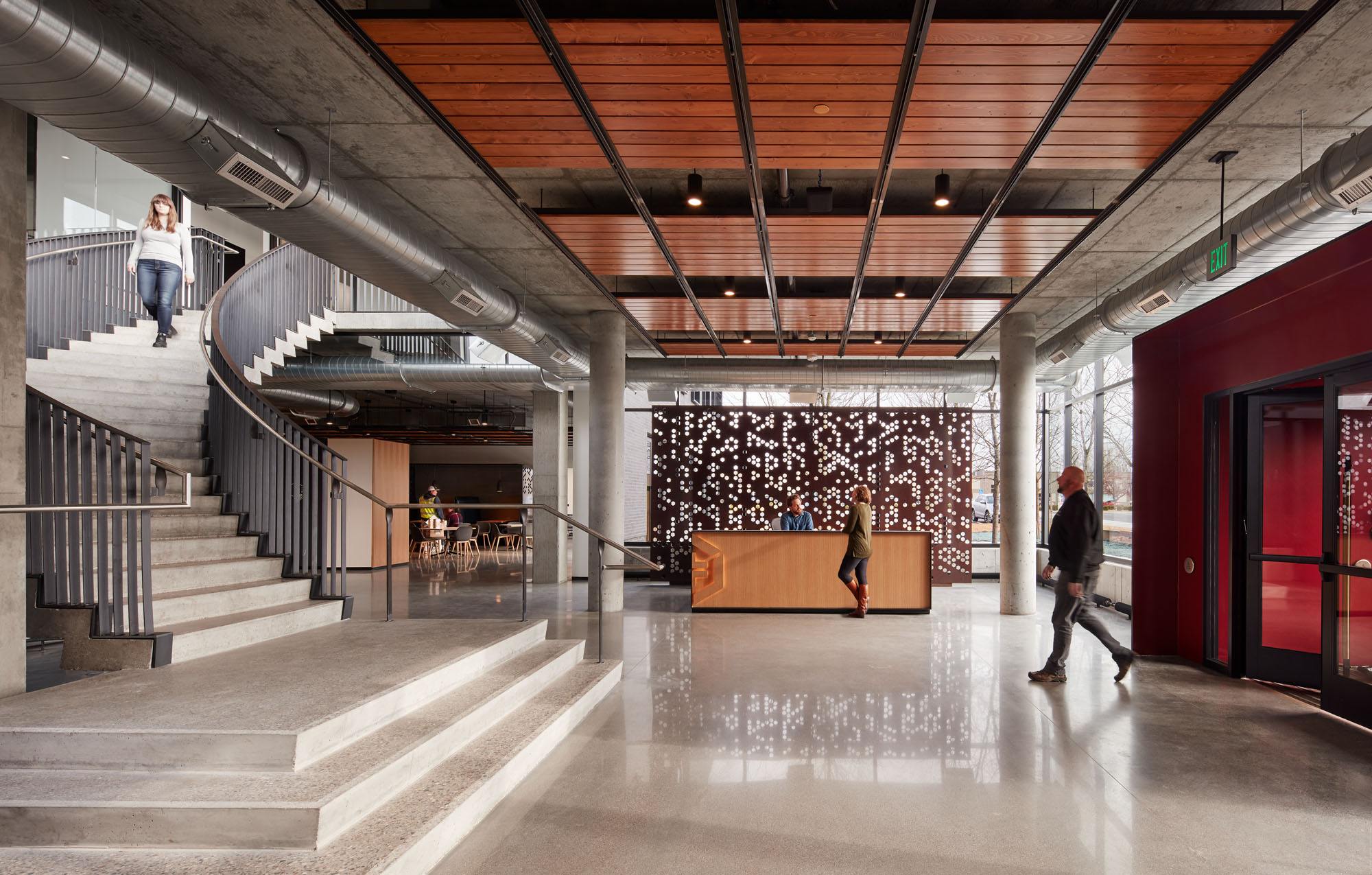

 McGough’s headquarters in Minnesota emphasizes environmental sustainability, resilience, and employee wellbeing, resulting in WELL Platinum certification.
 As of this writing, the SEC climate risk disclosure rules have been stayed pending litigation. However, many companies are already voluntarily publishing climate risk information following the existing Task Force on Climate-Related Financial Disclosures (TCFD) and the Climate Disclosure Project (CDP), which overlap with each other and the SEC rules. From these resources, we can see how executives are considering the risks to their built assets and why others should consider their own climate risk assessments.
What Does Climate Risk Disclosure Look Like?
Climate risk disclosure begins with an assessment in which a company reviews all the possible hazards that may pose risks to operations, supply chains, and facilities because of climate change. This might include physical risks associated with such hazards as forest fires or severe weather events. This could also include transition and compliance risks, such as those posed by environmental policies, which may add costs. These risks are then disclosed to investors.
The following examples are snippets from actual Climate Disclosure Project submissions that likely will resemble the SEC disclosures (company names have been omitted for anonymity).

“Acute physical impacts are considered a relevant operational, strategic, and/or financial risk that is always included in risk assessments. Examples of risks considered as part of acute physical include exposure to extreme storm events, such as hurricanes and floods (for example, flooding at facilities in Germany and New Jersey in 2021). Facility-level risks are documented as part of Business Continuity Plans (BCPs) and managed at a corporate level through multiple parties. Certain acute physical risks, such as flooding are also evaluated through our comprehensive water risk assessment process, whereby all manufacturing and/or R&D locations have undergone a risk assessment, and high-risk sites must develop mitigation plans.”

Company B
“Acute physical risks could have a significant impact on company operations. As climate change intensifies, the frequency and intensity of natural disasters, such as wildfire, drought, or flooding increase. We have conducted acute physical risk assessments at over 500 priority sites with outside consultants, evaluating the impacts of climate-related disasters on our domestic facilities and data centers. We also have conducted a scenario analysis of how acute risks, including wildfire and extreme precipitation events in a changing climate, may impact our data centers across multiple possible future worlds for a 2030 to 2050 time horizon.”
The disclosures illustrate how each company’s mission (as well as shareholder equity) could be impacted by climate change. This offers investors the opportunity to gauge how well companies are responding to risks. For example, knowing the climate risks to a company’s facilities—and the company’s response—may turn off a pension fund from investing in that company to protect shareholders from potential losses.
How Can Climate Risk Analysis Inform Building and Infrastructure Design?
Climate risk cannot be eliminated, but it can be reduced. If a hazard is identified and poses a risk to a planned project, the design can consider strategies to lower that risk, such as:

Site Selection

Building Envelope Tightness

Indoor Exercise Facilities

Degree Days

Energy Insecurity
- Site selection – Do the operational benefits of a particular building site outweigh the risks of fire, flooding, or drought?
- Building envelope tightness – With an increase in storm severity, should the building envelope infiltration performance be better than code?
- Indoor exercise facilities – With the risk of increased heat, should a building program include an indoor exercise facility to protect employees?
- Degree days – Do ASHRAE heating and cooling degree days for the location still make sense given the increasing temperature peaks? How can the mechanical system be balanced with the uncertainty of the future load?
- Energy insecurity – Is a microgrid required to maintain continuous operations for a minimum period?
The Challenge to Designing for Climate Change: Climate Projection Data
Unlike in finance, building design has worked on the assumption that past performance is a reasonable predictor of future results through use of historical weather data. However, designing for climate change is necessarily a forward-looking process, and updated climate projections are needed to assess how a building designed today will react to an uncertain world of tomorrow.
The problem for company stakeholders is that there is no industry-accepted method on how climate projection data should be obtained or used for building projects. That said, research institutions, agencies, and associations are beginning to work on solutions that could eventually be adopted industry wide.
 HGA's "Climate Forward?" research report outlines how architects and engineers are—and aren’t—using climate projections to inform design.
 For our part at HGA, we offer resilience and risk management services to our clients, using climate projection information to inform risk assessments at all scales, from city to site. We recently worked with the University of Minnesota Climate Adaptation Partnership (MCAP) to produce Climate Forward? How Climate Projections Are(n’t) Used to Inform Design (above). And we are continuing to collaborate with MCAP and the University of Minnesota’s Center for Sustainable Building Research to develop “Typical Meteorological Year” files from MCAP’s climate projection models for the State of Minnesota. This work will result in the integration of climate resilience into Minnesota’s B3 and Sustainable Buildings Guidelines.
Looking Onward
It is unclear whether the SEC rules will emerge unscathed from current litigation. Regardless, companies will continue to face growing climate risk, and many will continue to disclose those risks, mandate or not. While a company’s building assets are just one piece of a larger disclosure puzzle, getting an early understanding of risk profiles can result in productive conversations about risk tolerance, climate projection assumptions, and resilience strategies that result in improved design and operation. The ongoing development of this process remains a priority at HGA. ∎
Learn more about our work in engineering systems that address climate risk.
About the Author

Drew Dillmann is a building performance specialist at HGA, where he focuses on sustainability, energy efficiency, and commissioning. He recently wrote about the integrated energy master plan at the Milwaukee Area Technical College.