
Large urban healthcare systems face numerous challenges, including intractable health disparities in their communities, changing demographics and reimbursement models, and a growing awareness of the links between human and environmental health. They also increasingly need to solve these problems with restricted budgets and aging infrastructure. This is often the moment when system leadership seeks to establish a vision for who they will be and how they will function in a rapidly changing world — and how they can best allocate limited resources through a campus master plan.
Effective master planning requires a holistic approach that accounts for the impact the campus will have on employment, business, and real estate development. It is crucial to engage the community and to build public support to understand their unique needs. A key part of this is planning with sustainability principles to ensure that the campus will enhance the health of its community.
Comprehensive data analysis lays the groundwork for HGA’s hospital campus master planning process. Studying demographic trends in the surrounding region allows us to anticipate evolving community needs. We combine this research with stakeholder and community engagement, service strategy and phasing, and sustainability and resilience planning to provide for our clients and enhance the well-being of the regions they serve. We also generate strategies to support the financial health and long-term strategic direction of the healthcare system.
The following recent examples, UMPC and MetroHealth, illustrate how our long-term campus master planning process supports and strengthens neighborhood connections, sustainability and resilience, and economic impact.
 UPMC – Strategic Service Alignment and Community-Focused Planning
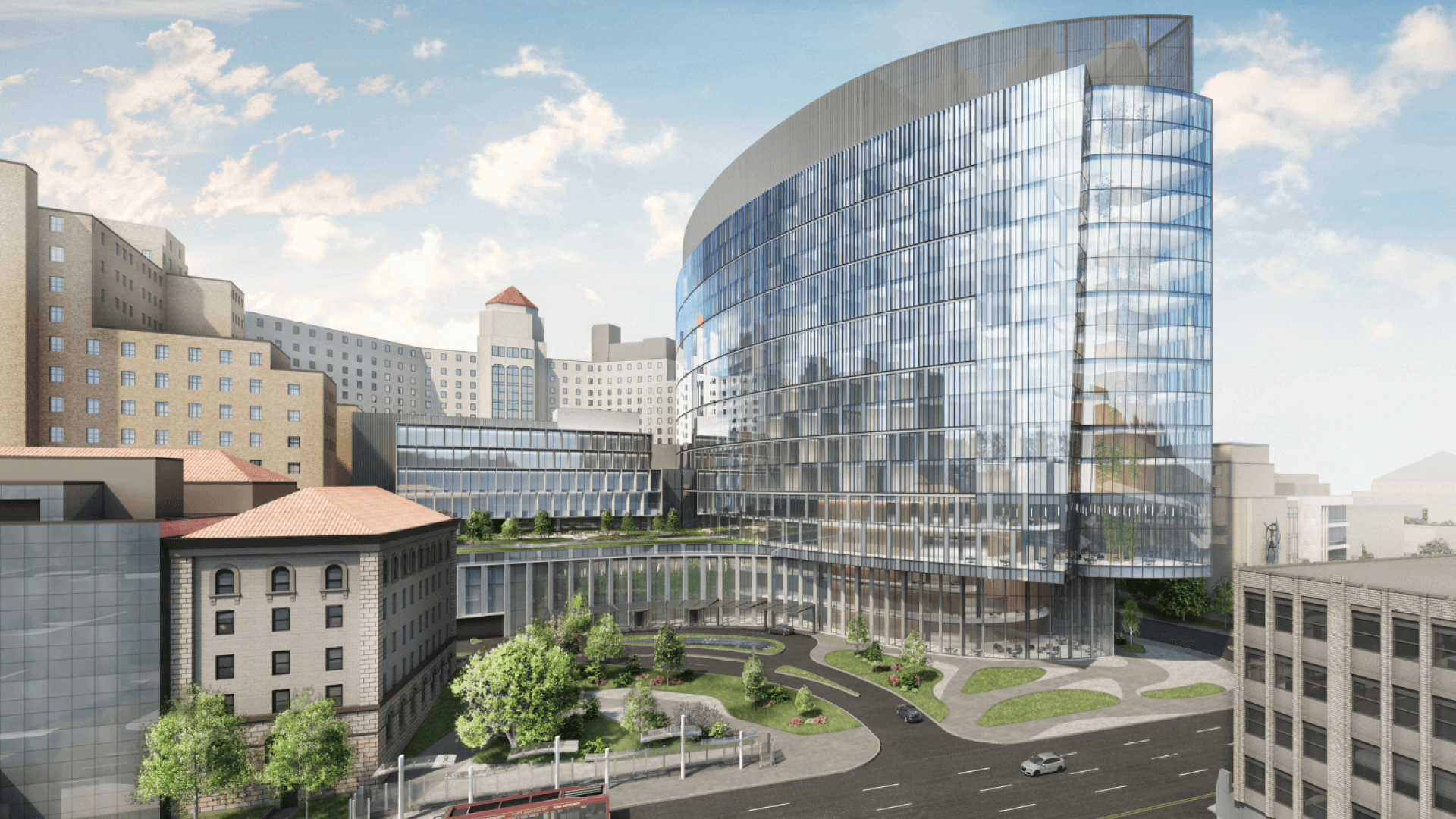
UPMC envisioned a network of world-class specialty hospitals. To achieve this goal, we used deep data analysis and research, coupled with our campus and system master planning process, to develop a holistic master plan that transformed their tertiary and quaternary care hospitals.
HGA led this process by asking operational data-driven “big questions” through a Lean filter to identify potential waste in the process. Data on service volumes was reviewed to determine which campus location would provide the best access for patients while also delivering the highest level of clinical outcomes. The result of this effort was a comprehensive space program and master plan for UPMC’s Presbyterian campus. The plan reimagines the future of healthcare delivery in an academic medical setting, redefining the ways in which technology and nature can transform healthcare delivery, graduate medical education, and patient experience.

 Design Experience and the Lifestyle Village
As part of our design work for the Presbyterian bed tower, we asked: What if this hospital could serve the community in ways that extend well beyond the traditional hospital?
A project of this scope is an opportunity to positively impact users and community—and at HGA that opportunity is also central to our mission. To achieve this, we leveraged a process that included interactive and inclusive design and ethnographic research with UPMC’s patients, families, staff, residents, and community partners to determine the service and experiential needs for the new building.

One of the results of this process is the allocation of 30,000+ square foot of public and family-centric space in the master plan. This space, referred to as the “Lifestyle Village,” was prioritized and championed within the new bed tower to support holistic family-centric care and well-being of staff and community members. Visitors experience a natural refuge that offers various amenities. The entire entry experience, clinical waiting areas, staff/visitor services, and patient floors all enjoy park views.


 Metrohealth – Large-scale, Urban, and Resilient Development
MetroHealth continuously researches new operational processes and delivery methods to address diverse patient needs. We partnered with them to form a research-focused team to design a cost-effective, sustainable, and patient-focused hospital campus.
In the early stages of our engagement on this project, MetroHealth requested that HGA recast the long-term vision for the campus to include a new inpatient hospital and an outpatient facility. This master plan included developing a strategy for serving the community by decentralizing off-campus. To support this, we were challenged to design a hospital with limitless flexibility to accept and withstand change in technology and care delivery.
To achieve this, we turned to a Process Neutral Design approach that considers the best solution the most flexible one, easily adapted to future change while still responding to today’s intended function. This approach stresses design that utilizes assembled rather than constructed parts—including modular and open plans, prefabricated components, movable walls and demountable systems—to establish a flexible, neutral platform where rooms and spaces can quickly be reconfigured depending on patient needs, advances in care, and changing programs.
In the design research process, we discovered that the project’s location, the Clark-Fulton neighborhood on Cleveland’s near west-side, is a “green desert,” lacking a natural park for the community to enjoy. The master plan addresses this issue by creating a new 25-acre park and replacing aging infrastructure to soften the edges between the campus and the community.

The existing campus consisted of buildings constructed over decades, resulting in an inward-focused healthcare experience with the main entrance buried deep within the design. This aging infrastructure created a barrier between the hospital and the community it serves—the main entrance has now been repositioned along the new 25-acre park, with clear and defined access, opening toward the neighborhood.
The park serves as the campus’ ‘”front yard,” creating a physical and symbolic connection between the community and MetroHealth. Located along the primary commercial corridor and spanning five blocks, it is a welcoming and inviting community asset, attracting users and restoring commercial activity along West 25th Street. The master plan also designates open space along the perimeter of the park for future development, reinforcing the economic impacts.
 Reflecting the Community
As a public healthcare institution, MetroHealth reaches out to the communities it serves through the actions reflected in the master plan, such as the inclusion space for high school programs focused on exposing students to possible careers in healthcare. The overall site development reaches out to the community with activities and services to make a more livable and vibrant urban center by providing active and passive zones in the park-like environment. Inside, the main lobby converts to an amphitheater for arts programs and performances that serve patients, families, and the public.


 The World’s First Health-Anchored EcoDistrict
In the early stages of master planning, MetroHealth requested that HGA use EcoDistricts, LEED, and the WELL Building Standard to reimagine the long-term vision for the campus. This process included evaluation of existing campus engineering systems and new and anticipated campus needs, with the goal of creating energy-efficient infrastructure systems.
EcoDistricts is a new model of urban regeneration and community development rooted in social, economic, and ecological innovation to address the complex and intertwined issues of neighborhood conditions, poverty, and community health. The Clark-Fulton/MetroHealth Ecodistrict is the first in the world to be anchored by a health system, the first certified eco-district in Ohio, and one of only four in the country.
The new Glick Center reduces water consumption and uses onsite stormwater. Occupant health and wellness is supported through advanced air filtration, daylighting, and lighting controls, with energy performance approximately 20% better than ASHRAE 90.1. Preliminary annual energy savings and reductions projected from the first seven months of operation include:
- $209,000 in average annual utility cost
- 51% in average annual gas usage
- 66 Energy Use Intensity (EUI) savings from baseline
- 68% reduction in fossil fuel used for heating
- 1,900 MT of CO2 reduction
Key elements of the MetroHealth/Clark-Fulton EcoDistrict that shaped the master plan and future urban planning efforts include:
- Equity – access to education, affordable housing, employment opportunities, health and wellness, and fairness in development.
- Food – access to grocers that sell healthy food, and education about food and food prep.
- Climate protection – clean water, air, and reduced energy costs.
- Mobility – more access to jobs and amenities, improved safety, walkability, and other transportation methods.
Looking Forward
As healthcare organizations seek to maximize resources while preparing for a more sustainable and equitable future, integrating comprehensive data analysis, engaging with stakeholders, and prioritizing resilience and inclusivity will support their mission to serve as pivotal community assets.
The case studies of UPMC and MetroHealth illustrate how thoughtful planning and innovative design can enhance healthcare delivery, foster community connections, and promote economic and environmental sustainability. As we move forward, the principles and practices exemplified in these projects will continue to shape the future of urban hospital campuses, ensuring they remain vital, supportive, and forward-thinking centers of care. ∎
Learn how HGA’s Healthcare teams design hospital campuses to meet healthcare needs and positively shape their neighborhoods and beyond.