
Our interior design experts share advice on identifying and reducing embodied carbon in interior design materials and finishes — with direct benefits to clients.
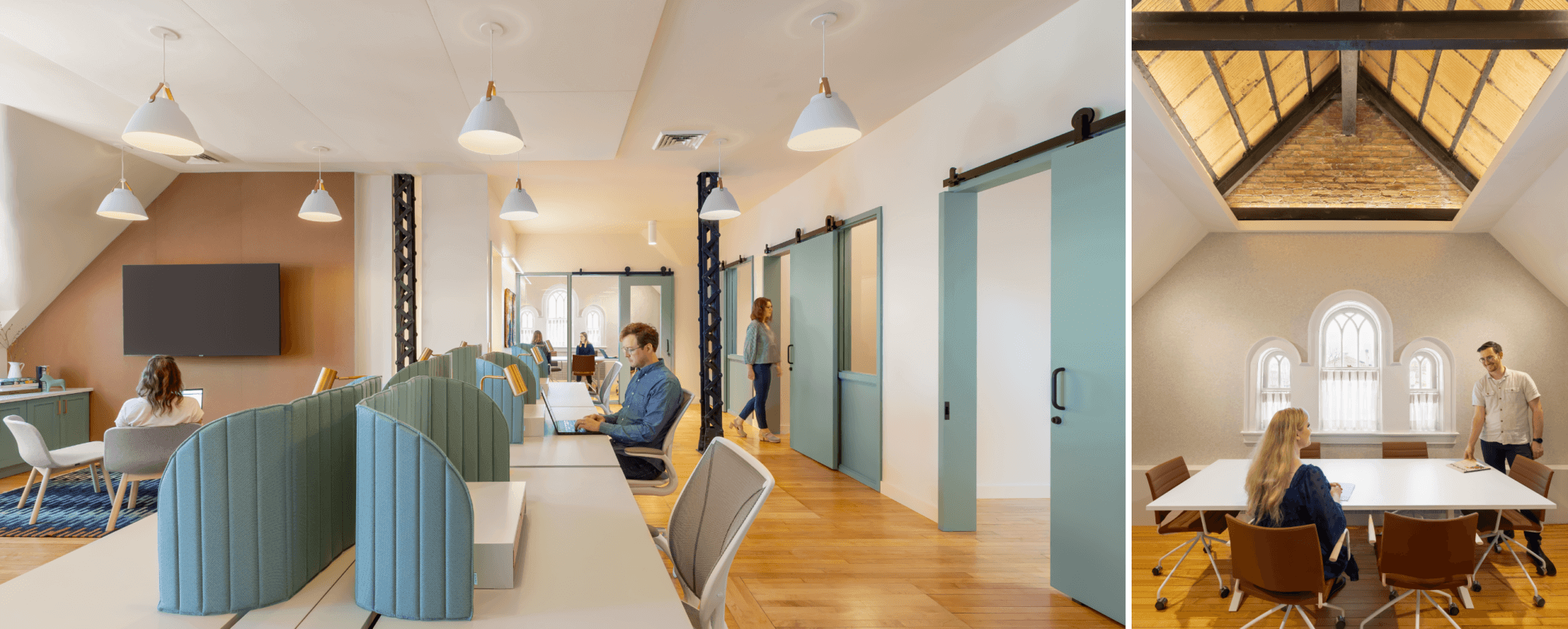
A renovation of an historic Carriage House for the American Swedish Institute converted unused space into museum staff offices, uncovering the character of the building’s original structure and materials.
As interior designers working within an interdisciplinary design firm, we are on the forefront of tracking embodied carbon and researching ways to reduce negative environmental impact. Yet the tools of our trade—interior building materials, finishes, equipment, and furniture—inherently contribute significantly to the embodied carbon of a building’s lifecycle. That’s why we are in continuous dialogue with colleagues and clients to design more sustainable spaces with products that consider the impact on climate health.
Below we have outlined a series of questions and topics we use to guide this conversation. Consider this a primer, always open to revision as new information becomes available.
What is embodied carbon?
Embodied carbon is the carbon dioxide emissions generated from extracting raw resources, manufacturing, transporting, and maintaining construction materials and finishes for a new or renovated building. You can think of this as “upfront” carbon because it’s a large influx of carbon that is primarily generated at the beginning of a building’s life. Operational carbon, on the other hand, is the emissions generated from heating and cooling a space, water usage, and running lighting, equipment, and appliances. This tends to garner more awareness from building occupants because it’s part of their daily activity and reflected in utility costs.
Why is the topic of embodied carbon in interior materials important?
Embodied carbon is directly linked to climate change. Interior renovations and tenant improvements are some of the biggest contributors to carbon in our atmosphere due to the frequency of renovation work done over a building’s lifecycle. Any material we select increases the carbon footprint, a design solution that intentionally reduces the number of materials used/specified, or can be easily disassembled for future reuse, will have a huge impact across our projects.

HGA’s San Diego office is in a former brewery that was converted into office suites. Minimal construction and new materials were used to reduce the embodied carbon footprint of the interior renovation.
How can designers minimize carbon impact?
The goal of minimizing carbon output encourages us to rethink how we typically approach projects. Instead of focusing purely on form and aesthetics, we can leverage data outlined in Environmental Product Declarations (EPDs) to prioritize carbon reduction and make better decisions. This shift has changed our perspective on success, looking beyond the surface to the story we are telling through design that supports climate health. A product’s content, where it comes from, how it’s installed and maintained, how long it lasts, and where it goes at the end of its useful life all factor into its carbon footprint and our decision-making process.
Why Now?
We are at a global inflection point. We should collectively be working to reuse, reduce, and sequester carbon just to maintain a global temperature increase of 1.5 degrees Celsius. If we do nothing, we will experience a 2 degree Celsius rise this century, which would further amplify the effects of climate change, extreme weather events, and reduction of biodiversity. The construction industry is responsible for approximately 37 percent of global emissions; each designer is a factor within that 37 percent of the pie. The decisions we make now affect the future health of our environment.

How does HGA share information supporting climate health?
We are educating our Interior Design staff on how to start these conversations with each other and our clients, how to read an EPD, how to calculate reductions, and how to identify greenwashing tactics that make misleading environmental claims. As our team becomes more climate literate, these tools will become second nature in everyone’s practice.
How is the interior design industry approaching this topic?
There is a moment of fight/flight/freeze for designers around sustainability in general, but specifically about carbon because it’s a daunting topic that historically has not been a part of interior design curriculum. For interior spaces, our industry is having a hard time identifying a common baseline—when truly, the real goal is zero carbon emissions. Every decision we make should be getting our projects as close to zero global warming potential (GWP) as possible and eventually reaching carbon negative (or carbon sequestering) status. If our industry is founded on the principle of “protecting the health, safety, and welfare” of our clients and communities, then it is our obligation to account for climate health.
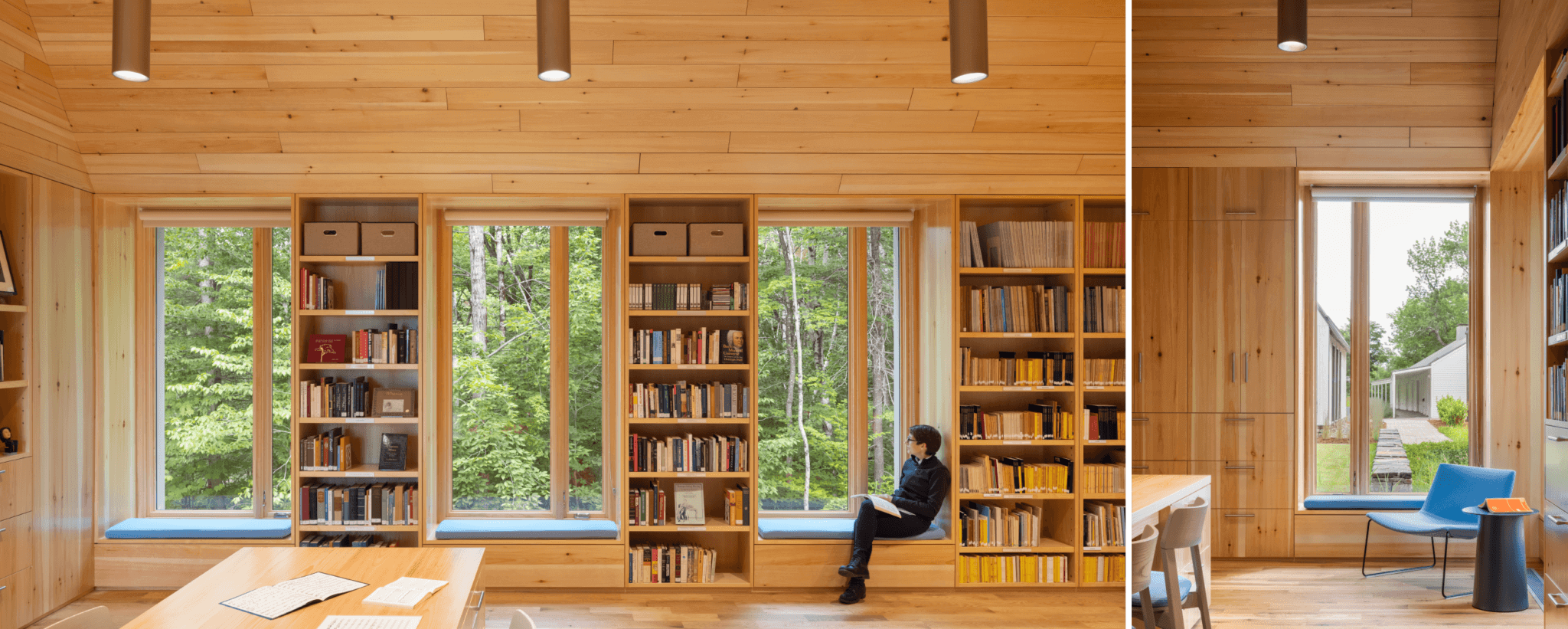
Marlboro Music Reich Hall stripped away unnecessary ornamentation to allow the beautiful natural materials of knotty pine walls and ceilings and solid oak flooring to shine.
What are key design considerations in optimizing carbon reduction?
When approaching a new project, a designer can look to the following to monitor and reduce our carbon impact:
- Balancing carbon goals with material health – Interior renovations and furniture contribute significantly to embodied carbon. Increased focus will contribute to decarbonization targets. Focus first on “heavy hitters”—carbon-intensive materials with the largest quantity or the most exposure to users, such as carpet, gypsum wall board, acoustic ceilings, and paint.
- Assessing carbon in the design process – The design process itself can be carbon intensive. As such, we need to evaluate our typical day-to-day workflow to better monitor our own carbon impact, such as material-sample ordering processes; frequency of in-person visits for non-local projects and how we get there (car, train, plane); and even using new AI tools (knowing their data servers have significant associated emissions).
- Adopting a philosophy of longevity – It’s important to disrupt the desire for “new” and instead embrace existing materials, in addition to local and regional building materials. This reduces travel distance for those materials, supports local economies, and provides rich storytelling for the duration of the building’s life.
- Material circularity – Many designers within HGA and the industry are looking at how to design within a circular economy—an economic system based on the reuse and regeneration of materials or products, especially as a means of continuing production in a sustainable or environmentally friendly way. Yet there are limited products, projects, or tangible outcomes associated with this because historically there has been little incentive to devoid waste from landfills and reuse existing fixtures and materials.
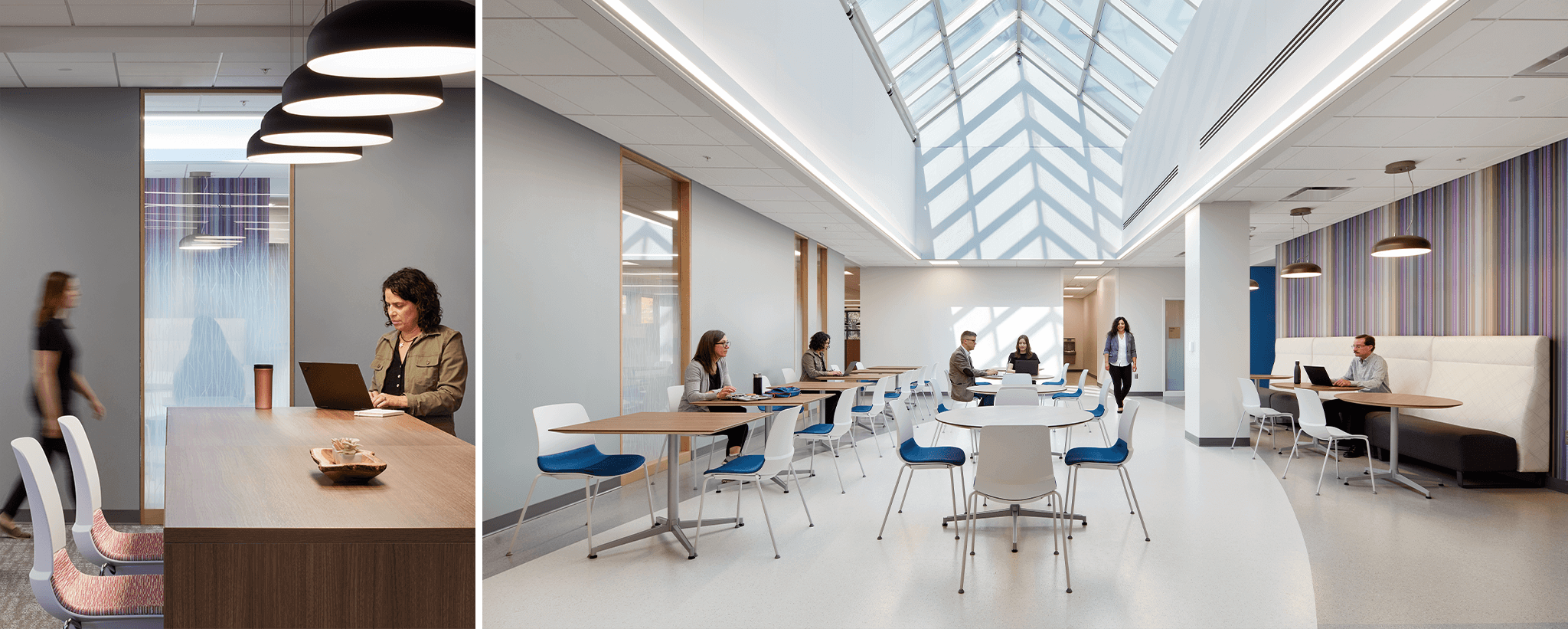
Masonic Institute for the Developing Brain carefully balances new materials while also celebrating existing elements, such as skylights and uncovering large window expanses that were previously behind built walls.
What value does decarbonizing our interior material selections have for organizations?
We have a professional responsibility to select low carbon materials, as well as consider the impact of all the elements of our work processes. This translates to direct benefits to the organizations we design for, as noted below:
- Offers better data & authentic goal alignment – Reduction from industry benchmarks could align with corporate ESG commitments and support the values held by organizations—and the values of their employees, users, or clients—by sharing this information with the people that use their spaces.
- Saves money through re-used materials – Thoughtful re-use of materials, infrastructure, or furniture allows organizations to minimize their investment into new interior fit-out construction projects and distribute those cost savings to other areas of their business.
- Doesn’t add cost for new materials – There is a misconception that sustainable materials cost more. Specifying new products with lower embodied carbon doesn’t cost more than another material with higher embodied carbon—it just takes an informed design team asking the right questions of our manufacturers to make the best decisions.
- Improves scheduling – Prioritizing materials that are locally manufactured and sourced can decrease lead times and overall construction schedule while reducing the emissions associated with transportation.
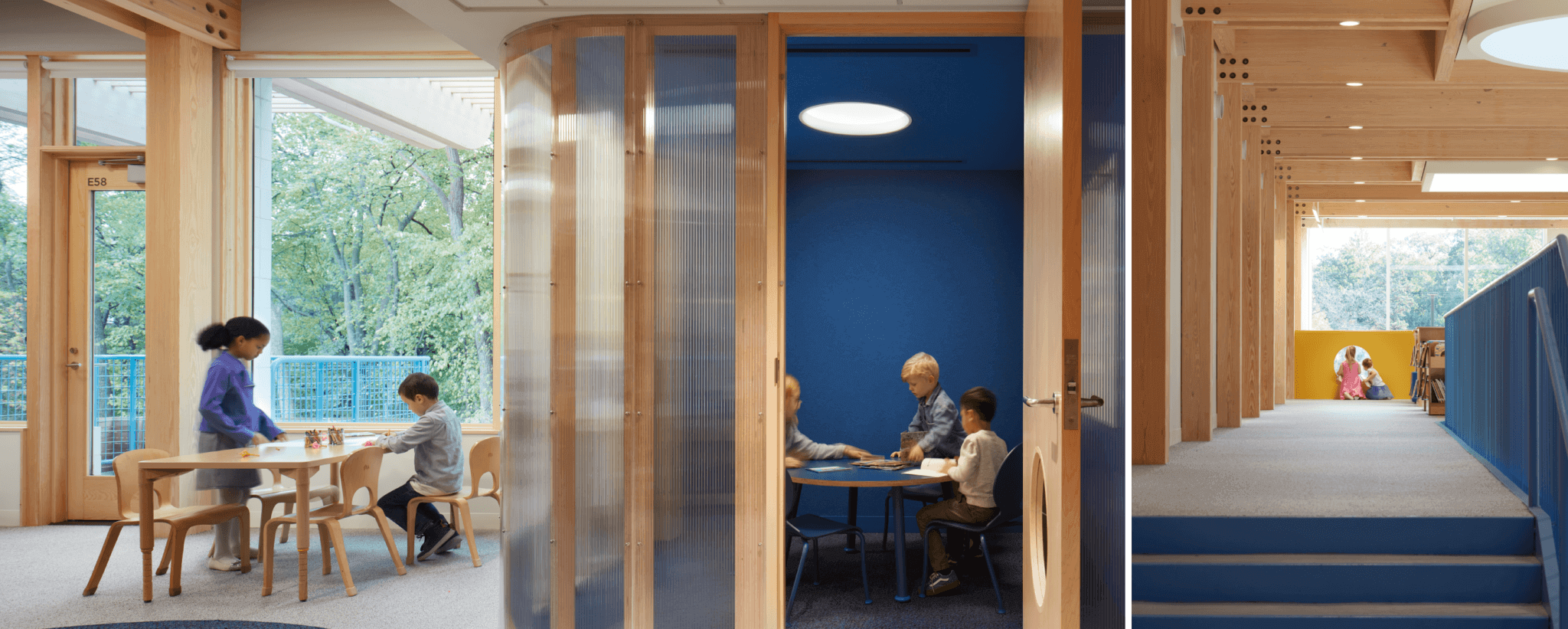
Blake Early Learning Center utilized exposed mass timber, bringing warmth and character to each space from the structural system alone, while nodding to the future with other sustainable strategies, such as a geothermal heat pump and all-electric system.
What’s next?
As representatives of the design industry, we need partnerships to make this happen—and move the building industry forward. Our industry peers, manufacturer partners, clients, and construction partners must also be advocates for change and share relevant data on the products they manufacture, specify, and install. Through industry-wide partnerships, we can shift away from carbon-intensive materials (steel, plastics, traditional concrete mixes, virgin material) and move toward biogenic materials that are rapidly renewable or carbon-sequestering (heavy timber, cellulose insulation, carbon-reduced concrete mixes, re- or up-cycled material).
This is a global effort—with global urgency. We will continue to build our internal resources and share insight with clients and colleagues to meet the needs now and onward.
About the Authors
Natalie focuses on a client-centered process that tells each client’s unique story. From space planning to material selection, Natalie promotes human health and well-being by working from a foundation of empathetic and sustainable design practices. Driven to enhance client culture, reflect and elevate brand, and infuse local context, she believes strongly in cross-disciplinary collaboration to craft authentic spaces that meet current needs and foster future growth.
Sophie has worked across market sectors, including healthcare, corporate and cultural with tasks ranging from design, product and finish research, construction documents, interior detailing and construction administration. She works closely with the project team, utilizing her skills in research, design and finishes, materials and furnishings to develop functional and creative solutions for a project with a human-centered approach.