In this second installment of a two-part blog examining the evolving work environment introduced in our first installment, our workplace strategists outline design strategies, processes, and deliverables to engage staff.
Designing a new workplace is a strategic process that begins by gathering insight into a company’s goals and then translating that vision into a built environment that reflects its unique culture. We have developed a series of steps to help us discover what makes each company unique.
Let’s walk through these planning and design phases, keeping in mind that every company is different, and these steps are flexible and adaptable to each client.

Foundations
During this phase, we co-create the entire design and change management process. We establish criteria, vision, desired outcomes, measurements tools, milestones, and resources. We also identify people and stakeholders we need to engage.
Discover
Using a human-centered mindset, we leverage a variety of qualitative and quantitative research methods to unpack work processes, employee behaviors, and experiences. Using employee surveys, field observations, interviews, focus groups, sensor space utilization studies, and other tools, we delve into the company’s culture and team dynamics to generate insights and identify opportunities for evolution or transformation.
Define
No one wants to focus time and energy solving the wrong problems. That’s why we develop moments that matter (MTM). Built on the results from the previous phase, MTMs frame clear problem statements revolving around space, technology, experience, and workflows. They serve as a launching pad for the design phase.
Design
The purpose of this phase is to transition from the problem space to the solution space. Together, we create future-focused solutions about culture, work process, space use, and technology. Design ideas are targeted yet diverse, ranging in scale of impact and level of effort.
Guidelines
With a finished workspace, we also create guidelines that synthesize adjacencies, furniture solutions, materials, environmental graphics, technology, and new workflows that help people successfully utilize the new space. An appendix documents insight that led to the new space.
Two Design Approaches for Change
Two workplaces—one a well-known national company, another a state agency—illustrate different approaches to designing for change, both placing the employee experience at the center of the design process.
AAA’s Office Adventure
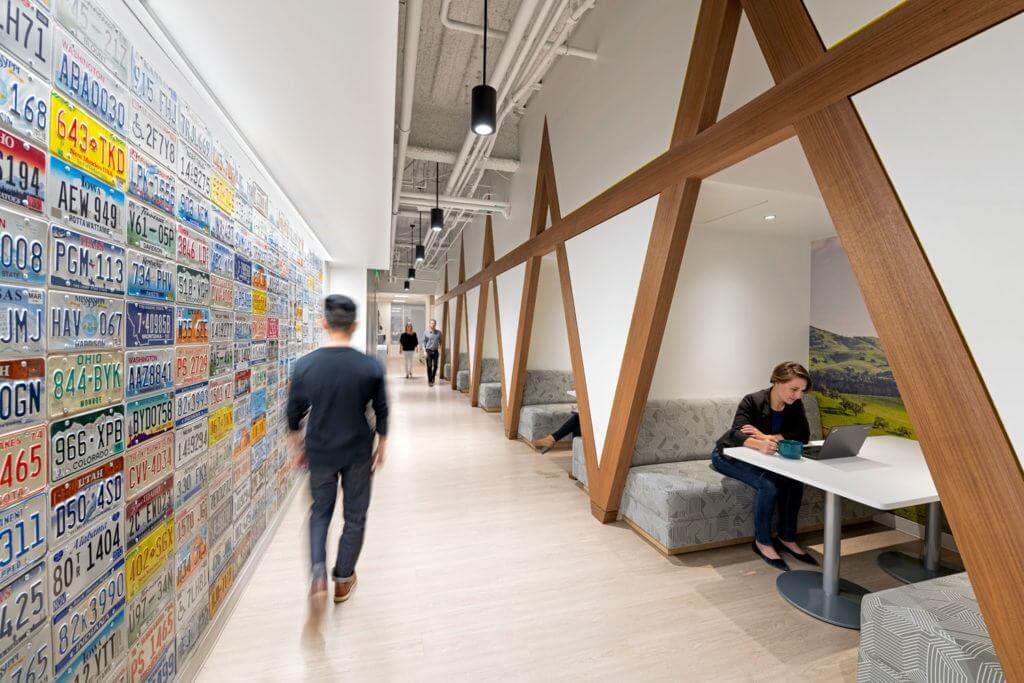
A staple of the automobile industry, AAA recognized that to stay relevant in a fast-changing industry, they needed to focus on “what’s next” when planning their new regional Headquarters in Walnut Creek, California. To answer that “what’s next,” we partnered with them to bridge the gap between their current state and ideal future state.
To start, we explored what worked well and what could be improved, engaging the entire staff through focus groups, surveys, ideation sessions, and even material finishes selections. We learned that the existing office supported heads-down focused work, but there also was a desire to create a balance between focused space and collaboration spaces to recruit new talent. Our research also revealed that maintaining their brand identity was essential to the office design.
The new office accomplished projected goals of reinforcing its iconic brand, breaking down siloes to create shared and collaborative spaces, and attracting new recruits as a go-to firm of choice.
But, as with many companies over the past few years, AAA once again has found itself looking toward the future. As long-time partners with them, we are participating in ongoing dialogue about what this future looks like—and illustrating that change management is a work in progress.
New Work Processes for A State Agency
For a state office building renovation in development, we are working with an interdisciplinary team to undertake a comprehensive structural and interior rehabilitation.
The plan reconfigures the interior and strips the exterior of the 17-story building to the steel frame and rebuilds it with a new fire/safety and infrastructure systems and high-performance exterior envelope, windows, roof, and insulation.
The reimagined interior will seat up to 3,000 team members within a collaborative, flexible work environment for various state agencies currently dispersed across several buildings. The sustainable building also is targeting Zero Net Energy and Leadership in Energy and Environmental Design (LEED) Silver certification.
Part of our planning involves developing guidelines to educate staff about how to use the new space. Because the completed renovation will introduce a new work model for many employees, we established lines of communication across agencies and departments to engage stakeholders in the planning process and solicit feedback.
We developed a variety of communications platforms to fine tune the employee messaging from initial project announcement through post-occupancy, including employee surveys, inhouse newsletter, and website to share photos of construction progress, general information about the building, amenities, transportation, and other details to generate excitement.
Here, change management extends beyond core-and-shell and interior planning—it’s about helping employees adapt to new operations. This holistic approach helps clients through change.
Looking Forward
By applying a strategic, knowledge-based approach to change, companies can explore new work models that will move them forward. But preparing your team can be challenging.
To learn more, visit Part I: Building a Culture for Change Management.