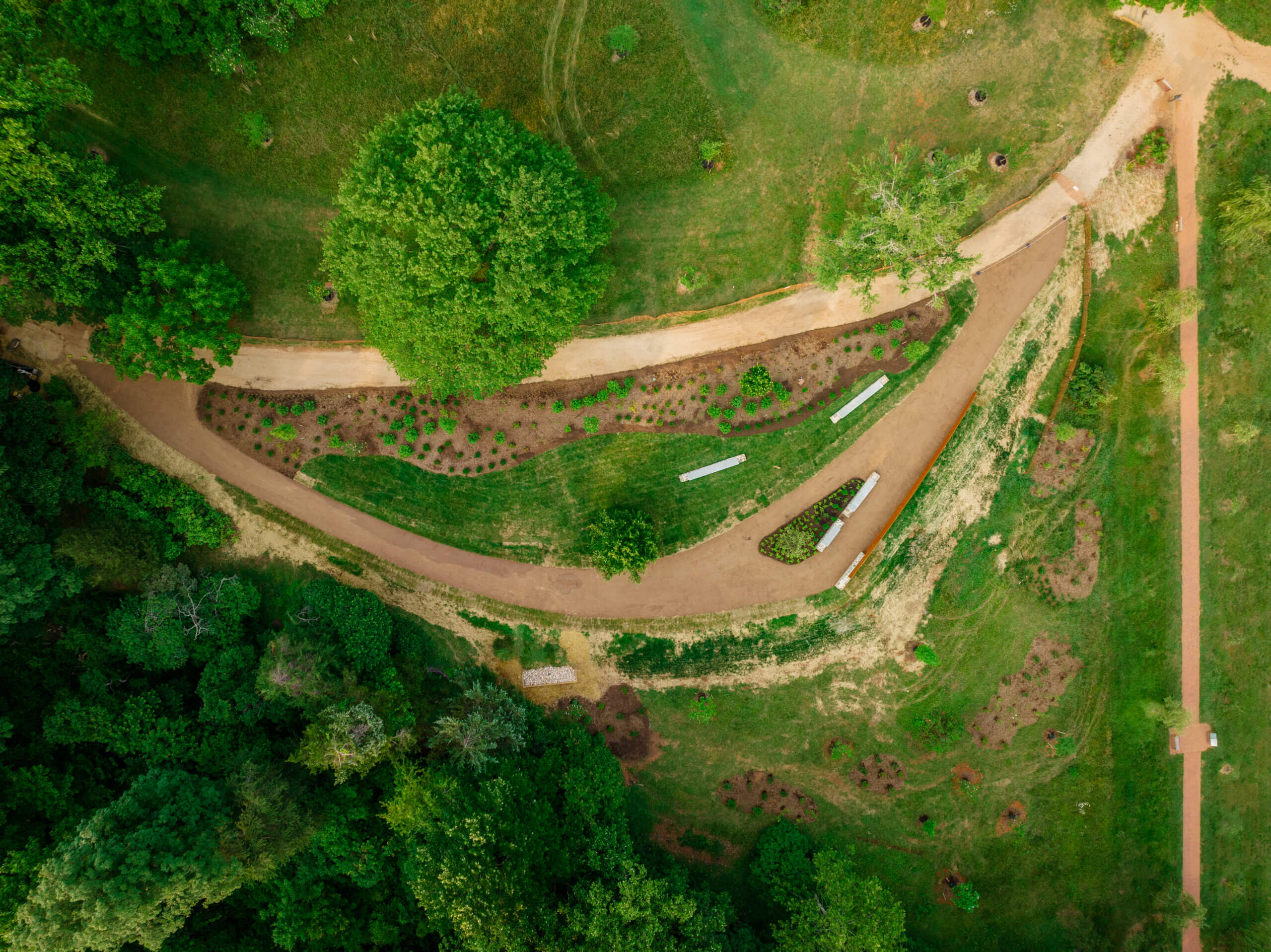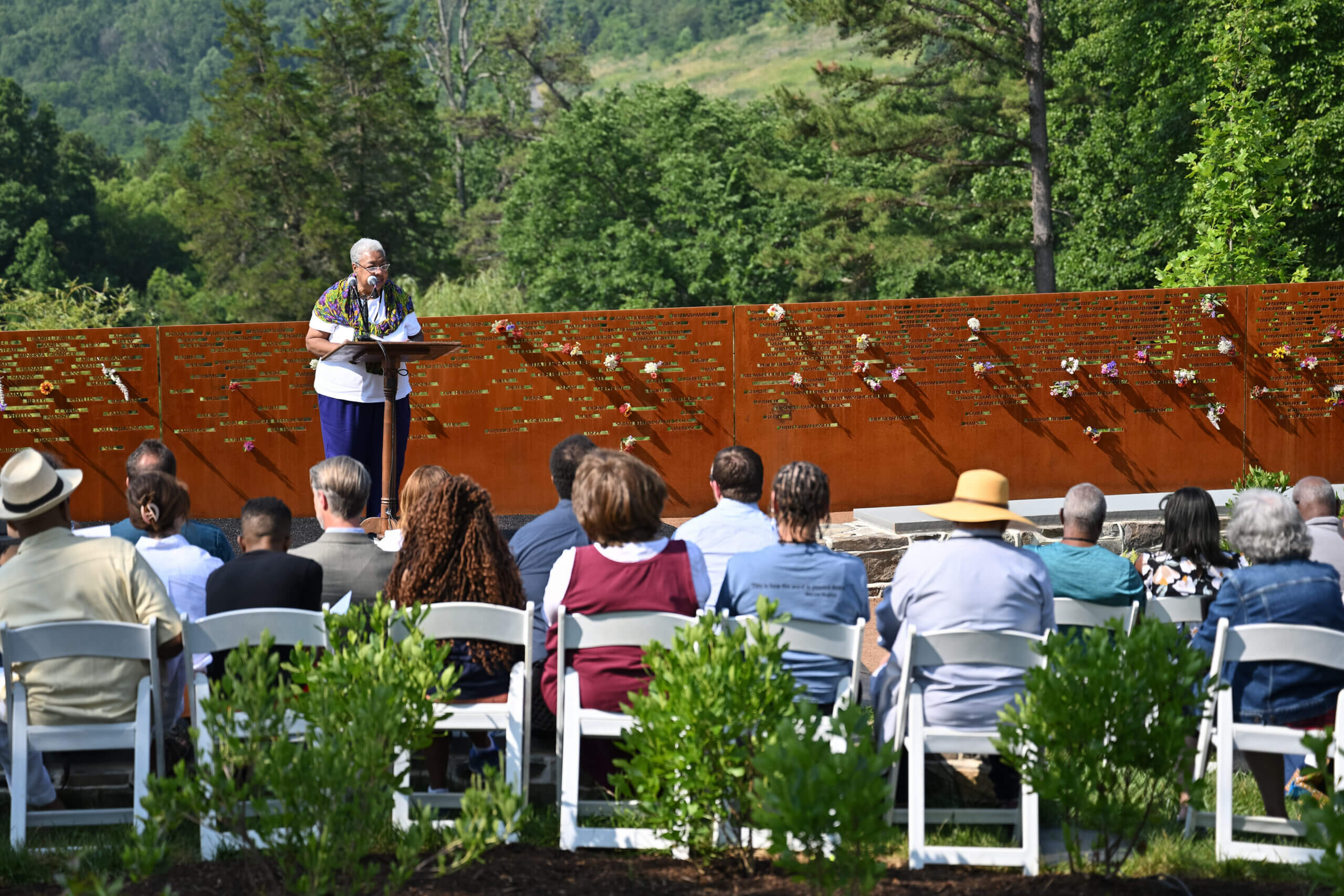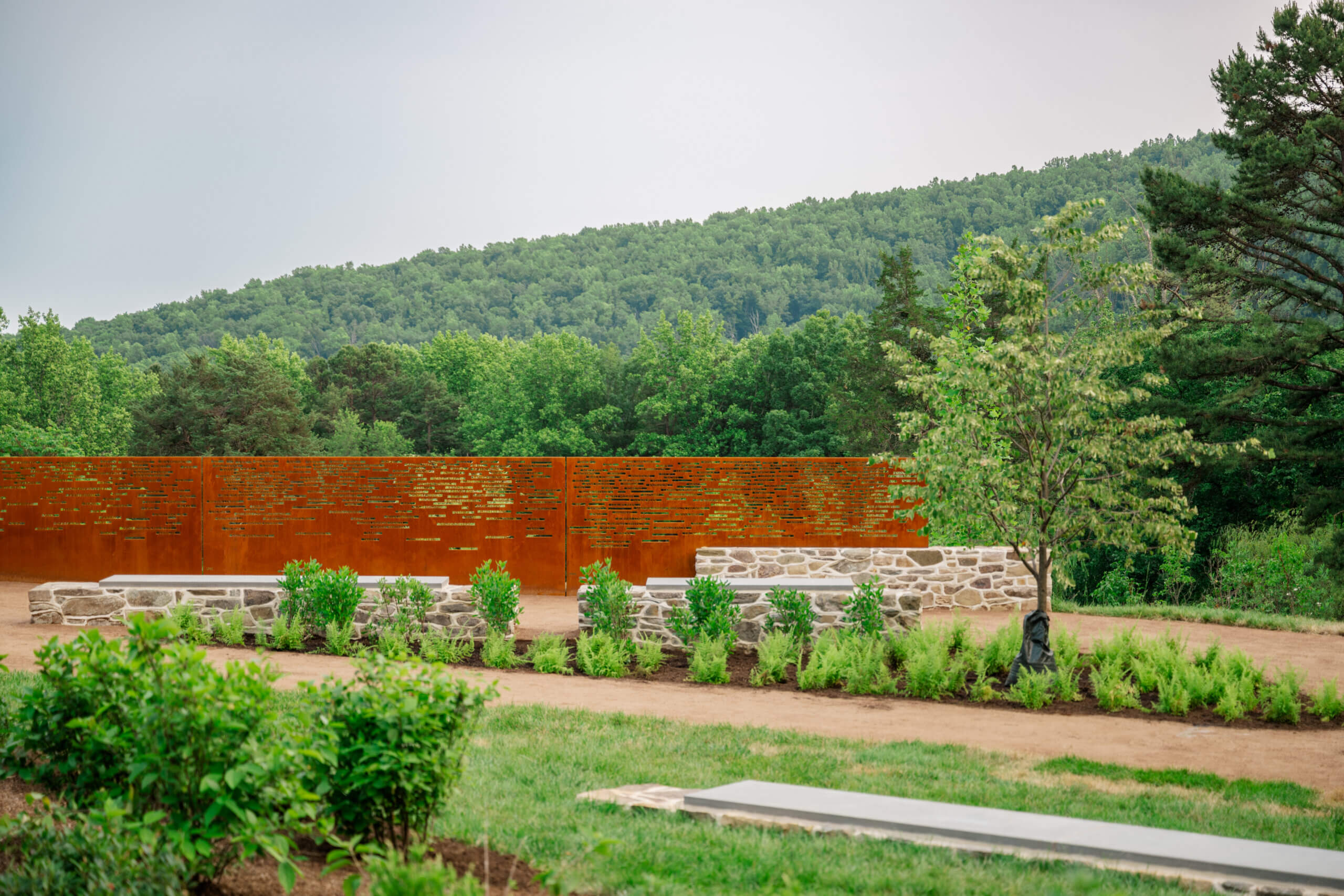
The Site, dedicated during a private Juneteenth celebration, honors the enslaved people of Monticello, while affording a quiet place of reflection and an opportunity for healing.
Video courtesy of the Thomas Jefferson Foundation.
Acclaimed national interdisciplinary design firm HGA, and renowned landscape architecture firm Nelson Byrd Woltz Landscape Architects (NBW) are honored to announce the completion of the Contemplative Site at Monticello. The Contemplative Site was dedicated during a private Juneteenth celebration on Saturday, June 17.
This new place of reflection at the end of Mulberry Row, the industrial hub of Thomas Jefferson’s 5,000-acre mountaintop plantation, honors the 607 enslaved men, women and children who lived and labored at Monticello, and offers an opportunity for greater understanding and healing.
Designed in collaboration with descendants of the enslaved community and Monticello staff, the Contemplative Site provides visitors a place to reflect on the realities of slavery at Monticello, the people entangled in it, and its lasting impact on society today.
A parallel design intervention at the Burial Ground for Enslaved People—the final resting place for an estimated 40 enslaved people who lived and labored at Monticello—which was rededicated on Juneteenth 2022, will create a connection between the sites of labor and final rest.
“Throughout the design process our team read widely and worked closely with a diverse group of stakeholders. This site lies not only with history and memory but also with the opportunity to offer a fuller perspective on the story of Monticello,” said HGA Design Principal Peter D. Cook. “It’s a place where visitors will find respite, a quiet place for personal reflection on the sometimes-difficult stories told on the mountaintop.”
The subtly curved 60-foot-long wall of Corten steel traces a “path of labor” and holds the names of the 607 men, women and children enslaved by Jefferson during his lifetime. The panels also contain open spaces which allow for new names to be added as they are discovered through additional research. The openings—inspired by Maya Angelou’s poem, “Still I Rise”—increase as the wall rises from the ground that was once worked by the enslaved community.
The landscape space held by the Contemplative Site at Monticello brings the visitor alongside the historic path used by enslaved people to bring water from the North Spring to the house. The water carried daily by enslaved people was then used for cooking, drinking, and bathing by Jefferson and his family. The footsteps on this path literally brought life to the mountaintop in the form of water. The long arcing form of the meditative space lies parallel to this historic path of labor, until recently less visible to the eye, revealing it once more and bringing visitors adjacent to the authentic line of energy in the site, built up over time, step by step.
For those in meditation and contemplation, there is a connection created in viewing the individual names on the wall, and rest is offered by the multiple benches and the shade of newly planted trees. The arcing gesture of the paths and walls responds to the collective; the scale of enslavement at Monticello, while the architectural details bring the visitor face to face with the individual names of those who labored here. Thus, the Contemplative Site serves not as a stop along one’s visit to Monticello but as a destination for remembrance and reflection.
“The Contemplative space is designed as a tribute to the people that labored on this site as it brings us into confrontation with one of the most brutal acts that humans can perform one another – the act of enslavement,” explained Thomas Woltz, principal of NBW. “Our collaborative team designed this space to bring comfort by connecting us with the authentic stories that are embedded in this land and to nature. We hope this space of reflection will allow for visitors and descendants and all the people that will encounter this site to consider the lives and the histories of those whose enslaved bodies created this bedrock of American history.”
HGA would like to applaud our collaborators:
- Timmons Group: Civil Engineering, GIS and Geospatial Technology, Environmental Services, Landscape Architecture, Surveying, Geotechnical Engineering and; Construction Management
- Springpoint Structural: Structural Engineering
- Kjellstrom + Lee: Contractor
- Shickel Corporation: Steel Fabricator
About HGA
Celebrating 70 years, HGA is an acclaimed national interdisciplinary design firm committed to making a positive, lasting impact for our clients and communities through research-based, holistic solutions. We believe that great design requires a sense of curiosity—forming deep insight into our clients, their contexts, and the human condition. We are a collective of over 1000 architects, engineers, interior designers, planners, researchers, and strategists. Our practice spans multiple markets, including corporate, cultural, education, local and federal government, healthcare, and science and technology.
About Nelson Byrd Woltz Landscape Architecture
Nelson Byrd Woltz (NBW) is an internationally recognized landscape architecture firm with studios in New York City, Charlottesville VA, and Houston, TX. The firm has been instrumental in steering landscape architecture towards integrated, ecologically performative design, relying on science-based methodology and collaboration with a wide range of systems-experts. NBW has dramatically expanded the traditional role of landscape architecture into the areas of restoration ecology, urban planning, civil engineering, and agriculture. NBW has been entrusted with the design of significant public parks and cultural institutions in the United States, Canada, and New Zealand, placing 20 years of construction and design innovation in greater service to the public realm. The firm has worked in 25 states and 11 countries and garnered over 100 awards within the past 15 years, including the prestigious Amanda Burden Public Open Space Award for Citygarden in St. Louis MO. Current projects include Cornwall Park in Auckland New Zealand, Memorial Park in Houston, and Forsyth Park in Savannah. The work of the firm has been featured in numerous national and international publications including the New York Times and Wall Street Journal and is the subject of a monograph published by Princeton Architectural Press.
Media Contacts:
HGA: Michelle Nelsen, Public Relations Director, MNelsen@hga.com
NBW: Elizabeth Kubany, Kubany LLC., Elizabeth@kubany.co

Images of the Contemplative Site at Monticello. The Site was dedicated during a private Juneteenth celebration on Saturday, June 17. Images courtesy of the Thomas Jefferson Foundation.