
Healthcare education is always evolving. The question of how our healthcare providers of tomorrow are educated, trained, and nurtured is a complicated one, but not without clear paths to success.

At the heart of this issue is technology – the tools we use, how we apply them, and the physical contexts in which they are employed. The advent of virtual reality (VR), augmented reality (AR), and mixed reality (MR) learning tools; the growing use of inter-professional/hybrid pedagogies within the healthcare sector; the ongoing shortage of nursing professionals; and the Covid pandemic are all having noticeable impacts on how future healthcare workers are trained and evaluated.
Are these impacts endemic of some larger generational sea change? Are they sounding the death knell for practical hands-on learning? The answers are not yet clear. But within these grey areas lies opportunities to innovate and improve.
The future of training healthcare workers lies in creating collaborative, multi-use spaces that are both malleable and hyper efficient. We describe it as a blank slate that’s designed to be integrated with all manner of technologies, and easily adapt with the changing landscape.
There’s no question that today’s students learn differently than those who came before them, but when hasn’t this been true? The key difference is that students of any discipline are now able to learn (and train) in virtual settings. And while training to be a healthcare provider may require more hands-on pedagogy than, say, attending law school, a growing number of medical schools and other healthcare educational institutions are keen to the possibilities of hybrid learning models, mixed reality tech, and simulation (SIM) training environments.
“The process of designing SIM environments is a journey of discovery,” says Lilly. “A focus on patient-centered care is changing the spaces, operations, and cultures of healthcare systems. This changes how healthcare workers are trained, which in turn redefines how we as designers of healthcare and training environments approach these spaces.”
As learning needs change, so too will the physical spaces that accommodate those lessons. To those ends, if this mixed-reality landscape is to work to the benefit of healthcare workers-in-training and their future patients, institutions of learning must strike the right balance between virtual and hands-on training, prioritize change management, and endeavor to create flexible spaces for learning that can evolve in lock step with new technologies.
The Evolution of Realism
Telemedicine, robotics, regenerative hospital design, and IoMT (Internet of Medical Things) advances are just some of the latest innovations that are changing the face of healthcare. When it comes to training tomorrow’s caregivers, it stands to reason that healthcare education and the institutions that provide it would follow suit and prepare healthcare workers to operate in this advanced realm. As it happens, simulation training for healthcare workers has been practiced for generations; it’s just the technology that’s changed.

Not too long ago, students practiced administering injections on pieces of fruit and sewing stiches into pieces of felt. In subsequent years, the use of human patient simulators (aka mannikins) and anatomical task trainers enabled students to practice specific procedures in a more life-like context. Today, most students have access to high-fidelity mannikins, while some have access to mixed-reality training applications and can even practice on holographic patients. (The industry is in the nascent stages of applying these technologies.) Virtual learning is also becoming more prevalent within the healthcare sector. From online medical conferences and tutorials to certification and re-certification courses, such tools have growing appeal because of their accessibility and lucrativeness.
According to Anne Costello, Director of Marquette University’s Center for Clinical Simulation, “We receive feedback from students that they feel engaged and believe learning in the simulation environment increases their confidence and skills.” Part of this appeal also concerns the versatility of simulation environments. Healthcare providers are not a monolith. Depending on an institution’s size, location, budget, and in-house specialties, the needs of and corresponding demands on one provider to the next can vary wildly. Accommodating all these variables can be achieved with “blank slate” SIM environments.
“The flexibility of [SIM] spaces is key to accommodating different learning needs,” says Costello. In some instances, devoting entire buildings to simulation and mixed-reality learning is appropriate. In other cases, designating a facility’s common areas to accommodate SIM or creating multi-use spaces to service a variety of virtual and hands-on functions is the right move. Whatever the scenario, curating this level of versatility and adaptability comes down to design. And as designers, it’s critical to identity the unique ways in which SIM environments can benefit each client.
The Adaptable Disruptor
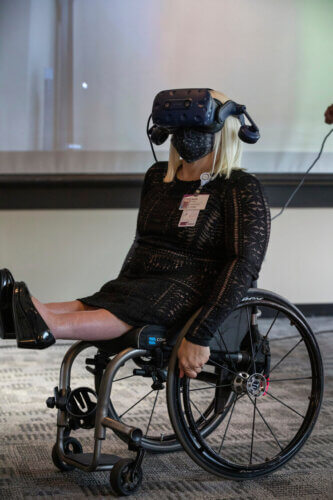
Some disruptors like Lyft, Airbnb, and Carmax had near-immediate impacts on their respective industry’s status quo. SIM environments represent more of a long-term disruptor for the healthcare industry. It’s long term because the technology is adaptable to an educational and design landscape that is constantly evolving. Building designs and real estate needs will continue to change, as will cultures and technologies. Mixed reality is the malleable solution. However, no universal platforms yet exist that would allow MR to become the universal standard in healthcare pedagogy. And perhaps the biggest challenge to making that happen is cost.
We estimate that many of the companies developing MR training technologies are at least two years out from making their tools affordable at scale. Some big-name schools have the budgets and flexibility to experiment with the tech that’s currently out there, to see what works for them and their students. But many more don’t have that luxury.
Another challenge is change management. Marquette’s Costello has some experience with this. When new technologies are introduced, “sometimes there’s an initial perception that the old ways are better or easier,” she says, “because there’s a learning curve or a need to troubleshoot. It’s crucial that we have the right structure of staff and vendor support to assist during these transitions.”
Despite these challenges, the upsides to embracing simulation training and MR technology, in whatever capacity, are an effective selling tool. They provide learning institutions with efficient and safe means of engaging students, their “blank slate” nature translates to minimal infrastructure requirements, and they can be adapted to accommodate changing environments and different learning styles. But as industry disruptors go, mixed reality isn’t poised to replace traditional learning models, nor should it.
Providing healthcare is as much about human empathy as it is about practicing clinical skills. “You still need the physical space. Thoughtful design can bridge the gap between the virtual and physical learning space, so that they complement each other,” says Lilly. “That sensory experience in healthcare training is important, both physically and emotionally. If all learning is performed in a virtual setting, then that benefit is lost.”
Healthcare workers will never go without the physical, hands-on components required to train confident and empathetic caregivers. At the same time, virtual learning tools and pedagogies that utilize MR tech are becoming just as essential to training caregivers who are versatile and highly knowledgeable. (There are even studies being done on how virtual technologies may help enhance caregivers’ sense of empathy.)
“It’s important to incorporate a reflection of traditional healthcare facilities in the design while also leaving room for easy modifications in the future,” says Costello.
Whatever the future of healthcare education looks like, it will not be an either/or scenario. It’s just a question of finding the right balance.