

When it comes to communal food courts and cafeterias, the associations people make tend to be less than ideal. Unsanitary, crowded, chaotic – basically all the qualities that we design professionals (and consumers) know to avoid. Many of us have navigated school cafeterias and shopping mall food courts for years. The food in these environments is undeniably of the “fast” variety, meant to be consumed as mere fuel so we can keep going with our busy lives. Yet, in both our personal and professional lives, our relationship with food has evolved. We are now more aware of the correlations between our diets and the impact they have on our long-term physical wellness. If the last two years have taught us anything, it is the importance of slowing down and enjoying one another’s company. In that regard, the communal food experience can positively impact our mental wellbeing as well.

Honest Food Attracts Talent
HGA is fortunate to have long-standing relationships with several organizations that place a premium on their employees’ health and well-being. One such client is Mayo Clinic. Recently, Mayo set out to create a new kind of employee dining experience.
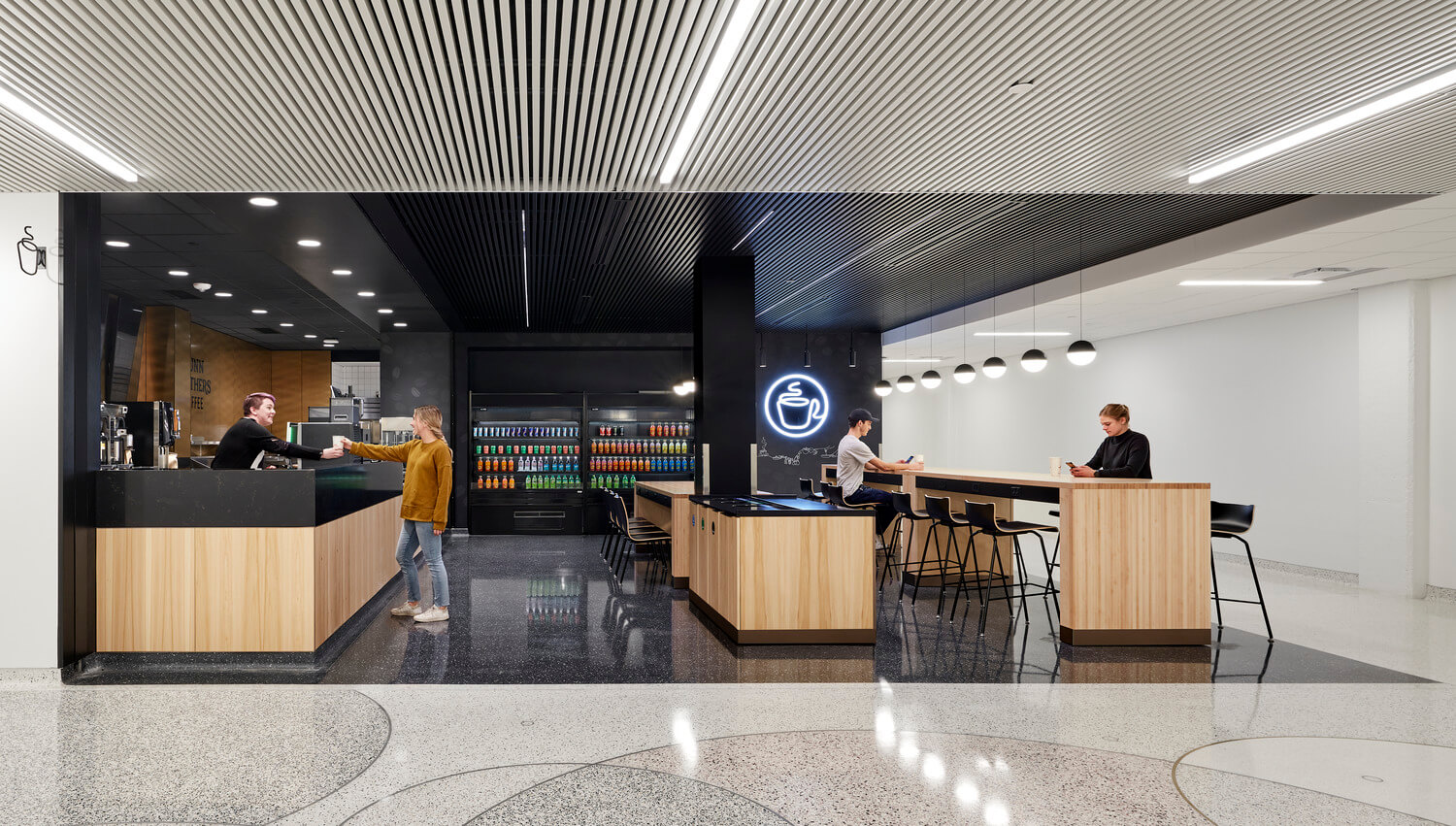
The new 41st Street Employee Cafeteria is the culmination of a multi-year effort on the part of Mayo Clinic and its food service collaborator, Morrison Healthcare, to make healthy food choices not only part of the employee experience, but a key part of their organization’s culture. Mayo Clinic was keen on leveraging its status as an industry leader to create something authentic, community oriented, and focused on health. To achieve this, our design team took note of progressive food service trends in markets ranging from higher education to senior living, as well as contemporary corporate and restaurant environments, and reviewed strategies that would work for a large healthcare organization and, ultimately, service our client’s goal of attracting and retaining top global talent.

A Focus on Health, Wellness, and Equity
If one’s workplace happens to be part of an organization that conducts medical research and provides world-class healthcare, it may seem logical that employer-provided meals would be in keeping with that ethos – nutritious, organic, and locally sourced. All the things that support healthy lifestyles and healthy ecosystems. While this is the case with institutions like Mayo Clinic, we know it is not the norm. The norm lacks variety. The norm doesn’t recognize which foods are in season nor is it preoccupied with building communities around food. The norm has a fry station.
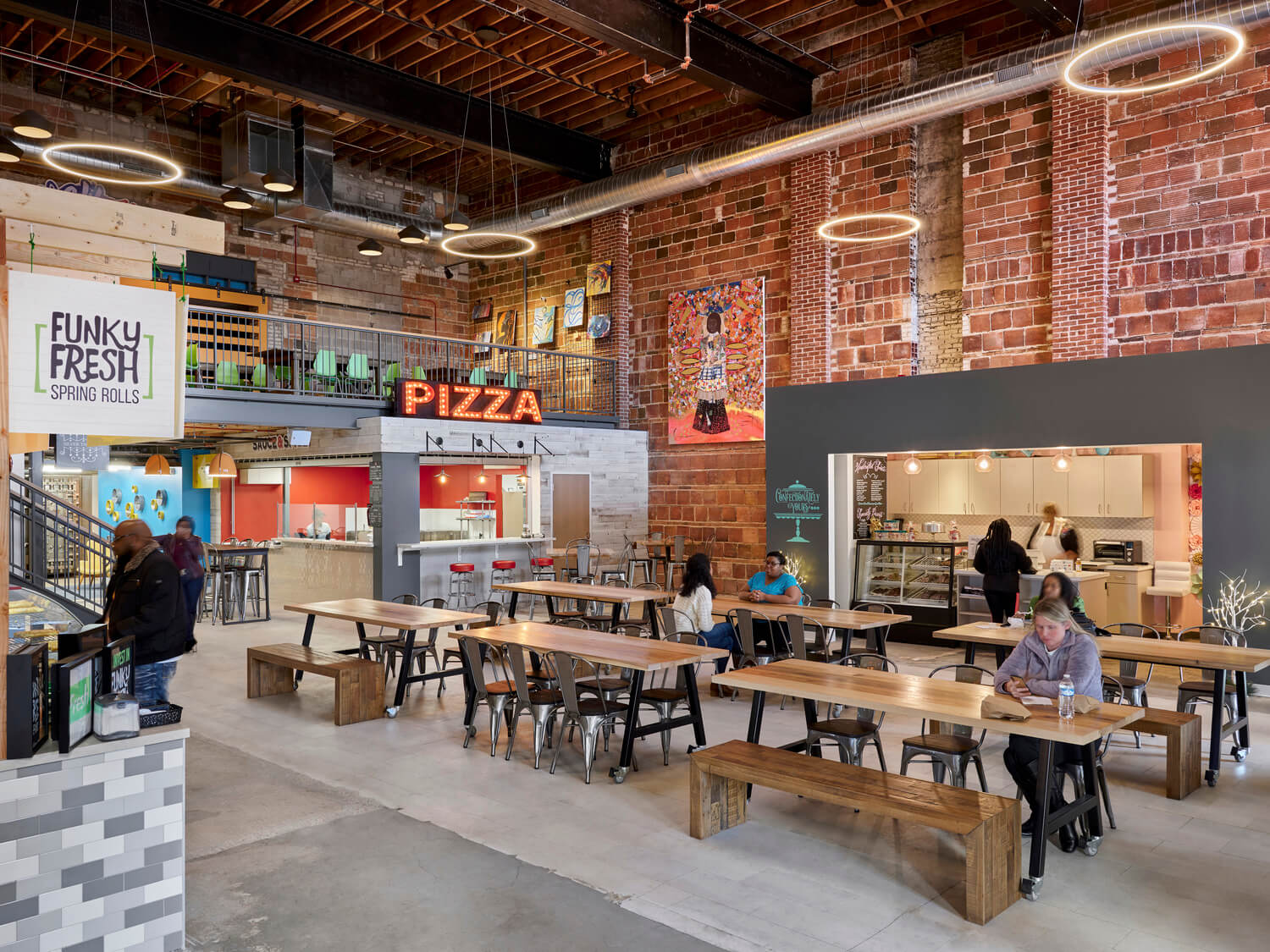
“What are the factors that might encourage people to eat healthier?” wonders Ben Webne, a principal in HGA’s Washington, DC office, and principal-in-charge for a new series of culinary experiences for a client in the region. The projects introduce a variety of dining options for practically every scenario, each organized along a circuitous yet navigable route. Farm-to-table dining options and a teaching kitchen are complemented by a global street food pop-up, a patisserie, and an express market for employees on the go.
This kind of diversity can provide employees with a sense of surprise and discovery, of education and engagement. Studies have shown that, even among consumers unaccustomed to eating healthy, people will choose the healthier options when presented with ingredient transparency and upfront facts about a food’s sourcing methods and point of origin. Some institutions use a “behavioral economics” approach to encourage patrons to make healthier food choices by giving discounts for more nutritious choices. Clients of HGA have found that an embrace of fresh, locally sourced ingredients for its culinary offerings has had no negative impact on upfront costs.
If indeed food is the great connector, then new in-house food service experiences are designed to keep a community of employees healthy, engaged, and ever curious about what new culinary delights await.
Ensuring a variety of authentic food options also speaks to these organizations’ emphasis on creating purposeful and equitable environments for all. Mayo is a healthcare organization with a global reputation that attracts staff (and patients) from all over the world. Mayo’s respective food halls embrace this fact by offering a diversity of foods meant to reflect the cultural and ethnic tapestry that roam the halls and grounds of their institutions every day.
Made-to-Order
Institutions like Mayo Clinic are not small operations. Daily operations and management demands are quite intense, so food service facilities should respond in kind by catering to employees whose schedules are staggered, and whom in many cases are strained both mentally and physically. In a high-stress work environment with heavy foot traffic, designing for convenience is critical.
Such a mandate is especially relevant to Mayo Clinic, whose vast campus only continues to grow. Part of introducing the 41st Street Employee Cafeteria, Mayo’s new flagship food hall, was integrating campus operations with new technologies and digital tools, including smart phone apps and programmable LED menu boards. Such tools enable employees to preview menu items and learn about new cuisines and seasonal options in real time, as well as pre-order meals and use automated self-checkout.
Tech integration on this scale helps create a more balanced and dynamic work environment. It also can help offset some of the stress associated with coordinating mealtimes with colleagues. According to Kim Jensen, senior project manager and office director for HGA’s Rochester office, “Food is a such a vital part of our well-being. It brings people together. Why wouldn’t you want every tool at your disposal to make that coming together happen with greater ease, particularly in a healthcare setting?”

The Experience of the Environment
When it comes to the food we eat, consistency matters. Offering consumers a branded experience – one that’s honest and context-driven – is an effective way to both enhance and reflect a collaborative and community-driven workplace culture. To ensure an experience that is reliable and of the first order, institutions like Mayo Clinic have chosen to implement branded concepts for their offered dining options, with the intent of enabling employees to make more informed and healthy decisions about their meal choices. These measures contribute to customer confidence, solicit customer feedback, and increase the likelihood of new and repeat business through word of mouth.
Of course, the unique challenge of designing first-rate food service environments within healthcare institutions demands the right balance. For that, our respective teams sought a convergence of best practices from the restaurant and corporate workplace sectors yet customized for the healthcare sector. This meant designing for a diversity of options, both in terms of cuisines offered and the physical environments in which to enjoy them. When employees have choices about not only what to eat, but whether to gather in more formal or informal settings, communal tables or private respite areas, the employee experience is enhanced and thus, the workplace culture benefits as well.
Good Culture = Good Health
Returning for a moment to Webne’s earlier question, What factors might encourage people to eat healthier?, it’s clear that environmental factors alone are not enough. Real cultural change is required. Creating a healthcare workplace environment that places a premium on all seven aspects of good health (physical, mental, emotional, social, environmental, and spiritual), as evidenced by great design and thoughtful programming, must include food options that positively impact those very systems.
Mayo Clinic and a few other like-minded healthcare institutions have clearly embraced this ethos, and their workplace cultures are stronger (and healthier) for it.
Learn more about HGA’s research on staff wellbeing here. For information about HGA’s healthcare portfolio, contact Leann Dockins, National Healthcare Business Development.