
Outdoor arts and performance spaces offer unique opportunities to enhance the student experience, spark creativity, and engage a wider campus community.

What if creative learning, artistic experimentation, and the experiences that result were not confined by interior walls? Research shows a more holistic approach to learning benefits students in many ways across all age spectrums and subject matters. That means providing students with opportunities to be outdoors and out of the classroom when it is appropriate.
Connections to the outdoors are particularly beneficial for performing arts educational spaces, where learning often incorporates elements of experimental performance and moments of spontaneous creativity. Yet traditionally, learning takes place indoors and the outdoors is a place to escape from learning for periods of time. This is especially true in climates where seasonal temperatures are more varied.
Increasingly, however, modern performing arts planning is seeing a shift towards creating connections between learning and the outdoors, fundamentally changing the way instructors teach and students learn.
In California and other western U.S. states where temperatures remain moderate throughout the year, outdoor performance venues have a long-standing tradition. Within educational campuses, however, performing arts education still primarily takes place indoors. In addition to the well-documented benefits of outdoor learning, bringing performances out of a four-walled room benefits not only the performers but also the community. Outdoor performing arts spaces are highly visible and integration into the rest of the campus or community is critical to increasing arts appreciation and garnering a wider audience. Offering outdoor experiences allows students to flex their creative muscle in a more informal, experimental setting, in addition to the traditional formal interior performance spaces.
A Community Arts Hub at JAMS
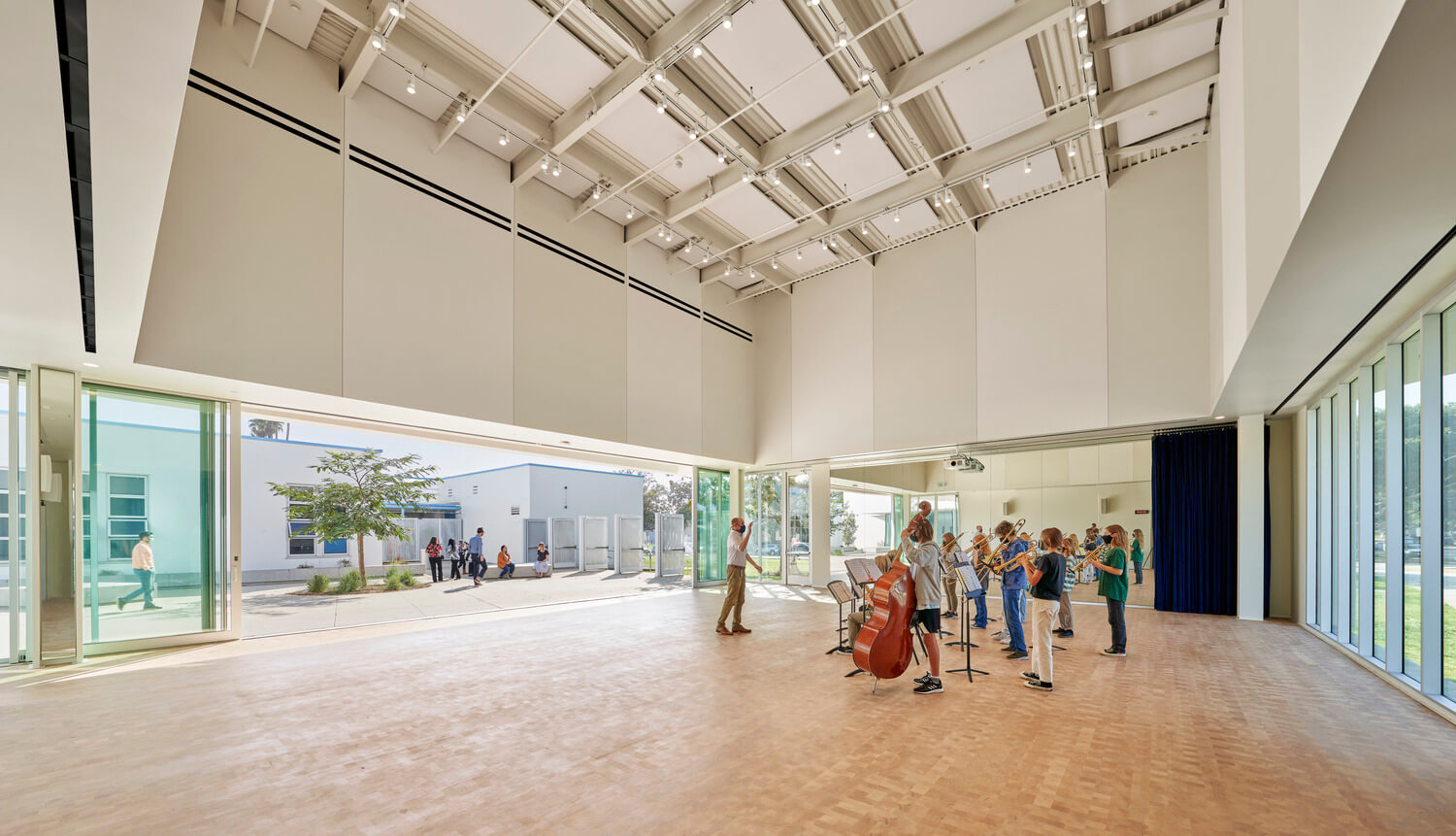
With this in mind, HGA recently worked with the Santa Monica-Malibu Unified School District to design the John Adams Middle School (JAMS) Performing Arts Center. JAMS is a dynamic arts environment shared by the School District and Santa Monica College to amplify opportunities for diverse students to cultivate their talents, while inviting the surrounding community to feel equally at home. The design integrates the needs of both the college and middle school and serves as an inspiring incubator for students to explore and develop their artistic voices.
Connection to the outdoors and community were central to the school’s design to provide a thriving, active arts hub for the area. Performance and rehearsal spaces, often found deep within a building, open via retractable walls to an outdoor courtyard that take advantage of the temperate climate and create flexible spaces for informal gatherings. Large benches in the courtyard are both places to gather and break-out “stages” for performances. Opportunities to create and experience the performing arts—and connect the arts to the community—are integrated into every piece of the building’s outdoor space.
Reimagining Performance at San Diego State

A couple hours south, San Diego State University (SDSU) also partnered with HGA to reimagine their Performing Arts District, with an emphasis on the outdoors. The SDSU Arts District is a collection of new and renovated performing arts facilities on campus that offer a flexible platform for instruction and experimentation, while raising the profile of the performing arts on campus and beyond.
The project consisted of a renovation of the Music Building and the 450-seat Main Stage, a new experimental theater known as The Second Stage Theater, and a new Amenities Pavilion. By turning the performance spaces “inside-out,” a third outdoor stage was incorporated between the music building and Second Stage Theater. This stage is surrounded by gently sloping landscapes for audiences to view the performances and students are given an opportunity to explore diverse expressions and more informal experimentation.
At the Main Stage building, an expanded lobby spills onto an outdoor plaza, acting as both a front porch and space for exhibition or gathering. At a campus scale, the building and landscape design stitch together a network of pedestrian loggias and paths, offering a diverse array of amenities for the daily life of the performing arts students.
Located directly off the Arts Mall that connects the Main and Second Stages, a new Amenities Pavilion consolidates ticketing and concessions for all five spaces into one building. Audiences for every show, regardless of ticket price or location, have a lively and creative space to gather together.
A Front Door for Arts at Cal State Fullerton
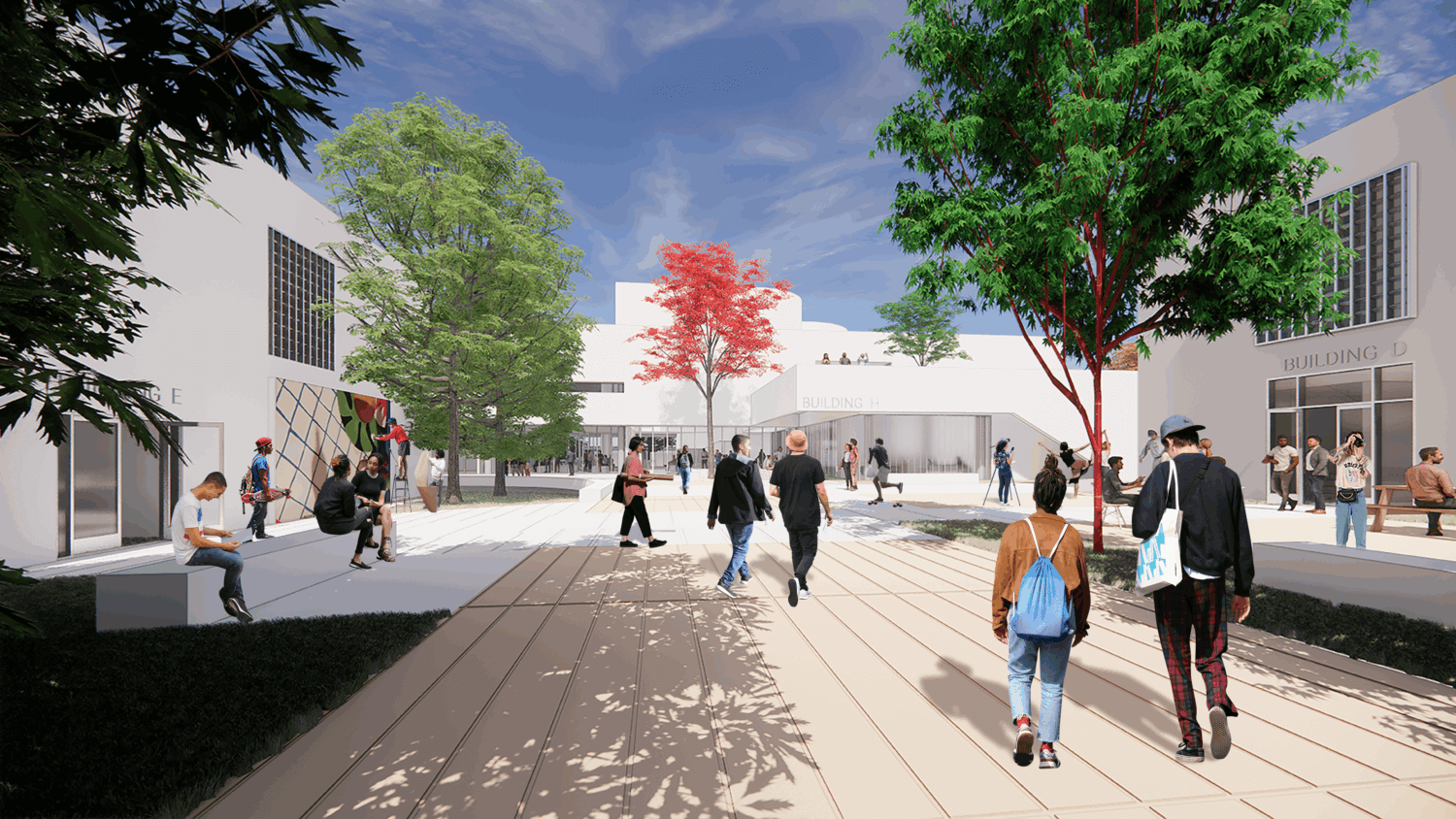
In Orange County at California State University, Fullerton and HGA are also hard at work on a new Visual Arts Campus Modernization. When completed, the modernized Visual Arts Complex will house a constellation of specialized facilities supporting fine arts, new media, and design programs within the Department of Visual Arts.
Over the past 50 years, Fullerton’s student population has changed and is now predominantly Latinx and non-traditional; adults returning to school, part-time students, transfer students, and online students. In addition, the pandemic has challenged educators to ask even broader questions about the interrelationship of Technology and the Arts. The goal was to bring the arts out of the traditional classroom or studio and create connections outdoors throughout the campus in ways that Fullerton’s diverse student population can best experience them—in addition to increasing visibility through transparency. Focused areas are integrated for interdisciplinary interaction with the Visual Arts Campus’ many majors, ranging from Graphic Design to Animation, from Glass Blowing to Ceramics, and core curricula of Painting and Art History.
An outdoor central commons brings students together, giving them a place to step away from their work without having to retreat to their cars or leave the campus altogether. The Arts Mall creates a distinctive identity for the visual arts along a significant pedestrian walkway and opens to the Clayes Performing Arts Center. An outdoor stage set into one of the buildings creates opportunities for informal or impromptu performances, while views into art-making spaces further bridge connections to the larger campus by allowing transparency to the activities within.
An Udeskole for All Climates
While each of these projects is in California—where the climate is often forgiving—it does not mean colder climates have to forego the benefits of year-round outdoor learning and performance spaces. Udeskole, or Outdoor School, has long been a staple of all-age learning in Scandinavia, where students spend some portion of their day outdoors all year long, regardless of temperatures. The environment, topography, and local culture should always be taken into consideration when planning an outdoor learning or performance area and, if done thoughtfully, these spaces can work across all geographic areas. Outdoor performance spaces often do not require permission for use, empowering students to be in control of their creativity and providing endless opportunities for experimentation, exploration—and fun—outside of the classroom.