
Workspace design will continue to evolve in the COVID era, so it is imperative that we remain mindful of the ways to design for flexibility, equity, and wellbeing in the law firm marketplace.
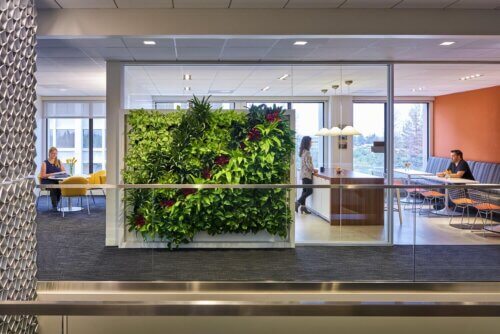
If you were asked to think of an industry that has proven both resilient and flexible in the face of the pandemic, law firms might not be the first thing that comes to mind. In fact, progressive design trends and more equitable practices were beginning to take hold in many law firms well before the advent of COVID-19. Today, as work-from-home (WFH) policies evolve in the corporate space, more law firms are embracing the kinds of outward- and inward-facing changes that are employee-owned. Put another way, they’re opting to implement change by movement, not mandate. The various kinds of changes we explore below touch on layout and programming models, considering design as an instrument of wellness, and the use of new technologies to promote collaboration, among others.
Re-think Space
Lawyers are trained on precedent, and this often translates to their physical workspace as well, where privacy and the physical division of space is the standard. (See floor-to-ceiling walls, glass films, and acoustical insulation.) While typically law firms are slow to embrace change, the pandemic has helped facilitate an accelerated embrace of certain corporate workplace trends, albeit ones that are appropriate in a law firm context, where confidentiality is essential for conducting business. For example, the cloistering effect that is exemplified by big corner offices is gradually becoming a relic. In doing away with such setups, law firms are seeking more equitable solutions, from shared workspace and hoteling to universal-sized offices and moving private offices to the interior and freeing up natural light for open workstations and shared amenity spaces accessible to all. Beyond that, a broad range of flexibility and adaptability measures are challenging established paradigms, obliging law practices to rethink how they allocate and optimize all their space, including the virtual kind. Our recently completed office redesign for Hoge Fenton provides a useful case study.
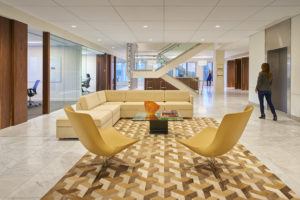
Prior to our coming aboard, Hoge Fenton’s workspace featured a large and centralized library. Over time, this single-use space was being used more as a makeshift common area. In order to capitalize on this organic change, as well as complement their employees’ clear desire for connection and collaboration, we removed the outdated library and converted it into a lounge, which features flexible space for jigsaw puzzles, a favorite activity among Hoge Fenton’s staff. Further, when considering other rightsizing and efficiency measures, we worked with our client to heavily reduce, and in some instances completely purge extraneous filing and storage space. Altogether, these interventions were designed to strike a balance between privacy, productivity, and connection. More efficient use of space results in greater employee efficiency, while simultaneously, the opening up of those spaces and the softening of physical barriers helps foster an employee culture of equity and inclusivity.
Making Connections
Stronger workplace connections are also fostered by the softening of virtual barriers, which is something we have all seen over the last year and a half, and many law firms are heeding the call. As we mentioned, some physical barriers must stay in place in these settings to maintain confidentiality. And yet, those same barriers have already been softened, in a sense, by the ubiquity of Zoom and other web conferencing tools, making WFH an appealing option for many employees on a long-term basis. The challenge facing many law firms, particularly larger practices where they may be a generational divide over wanting WFH vs. a full-scale return to the office, is to keep morale and productivity high by promoting a culture of collaboration and mentoring in both the physical and virtual realms.
Designing for fluidity is key, and that’s where we come in. Hoge Fenton introduced flexible common areas that feature modular glass walls surrounding a cluster of conference rooms. When these walls are moved aside, the clusters transform into one large area that can be used for receptions, presentations, group trainings and more. Meanwhile, the flexibility that comes with virtual conferencing tools is only complemented by the privacy and security features that are designed into the actual software.
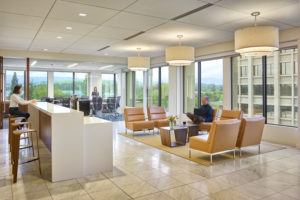
Tools like Zoom and Microsoft Teams aren’t the only examples that illustrate how technology and mobility have evolved the modern workplace. Well before the pandemic, law firms had begun to embrace a variety of comprehensive technologies designed to increase not just employee efficiency but energy efficiency as well. Smart building technology that utilizes IoT sensors; integrated automation systems for HVAC, lighting and shading; and office space utilization software are just some of the measures that law firms have been introducing to their workplaces for some time. Of course, since the pandemic struck, additional needs on the part of many to downsize, optimize space usage, and save on energy costs has only increased the likelihood of law firms embracing all kinds of changes.
Focus on wellbeing
Whether the kinds of changes we’re discussing are pedestrian in nature or on the cutting-edge, the common denominator often concerns a client’s focus on wellbeing. Just within the last decade, clients in the corporate world have developed a sophisticated fluency in the language of sustainable and regenerative design. Many understand that obtaining, for example, a LEED or WELL certification for their building is more than achieving energy efficiency or marketing a progressive corporate culture, it’s about attracting (and retaining) top talent and investing in their employees’ wellbeing. This of course means taking infrastructure-level measures like optimal building location, monitoring air quality, and using on-site renewables. It also means investing in human infrastructure, like instituting flexible scheduling policies, offering reimbursements for not using parking, and providing access to outdoor space, fitness amenities and more. One of the more overlooked facets of wellbeing, however, is aesthetics.
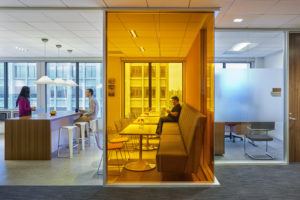
A typical law firm conjures images of mahogany, leather chairs, and darkened hallways with accent lighting. In other words, comfortable but not necessarily hospitable. It was this “traditional” stiff and stuffy aesthetic that Hoge Fenton wished to escape. Their expressed design direction was more along the lines of a Silicon Valley tech firm, with plenty of natural light, biophilia, and contemporary touches that reflected their company’s personality – professional, collaborative, and a bit dressed down.
Elevate Voices
In any corporate office setting, some degree of collaboration will always be organic. But in order to achieve a collaborative culture that is transparent and inclusive, and one that strives for that right balance of privacy, productivity, and connection, it must be an orchestrated process. It also must consider the importance of remote collaboration. All of this, in our humble opinion, can only be accomplished through change by movement.
Many of our clients, including Hoge Fenton, have taken the right steps and elected to use a “bigger table” when making those decisions that will determine the future of their firm. That means more voices were invited to offer their input, and thus more voices were heard, regardless of rank or tenure. And perhaps most important of all, it means that a broad and diverse coalition of voices were not only present but leading the redesign process. (In the case of Hoge Fenton, our entire project team was led by women, as was the client’s, the general contractor’s, and the furniture dealer’s, to name just a few of the stakeholders.) From instituting a company-wide DEI (Diversity, Equity and Inclusivity) framework to performing a complete design overhaul of their workspaces and common areas, the changes deemed necessary to workplace policies and workspace design will have greater impact (and lasting power) if the decision-making process is democratized and with buy-in from the top, as opposed to mandated by a few executives from behind closed doors.
Learn about HGA’s law office portfolio here: https://hga.com/law-offices/