A new YMCA transforms a downtown mall into a community destination.
Following the landmark merger of the YMCA of Metropolitan Minneapolis and the YMCA of Greater St. Paul in 2012, and creation of the YMCA of the Greater Twin Cities, the Minnesota-based, nonprofit organization looked to move its headquarters to a new location. The site, positioned in the heart of downtown Minneapolis, would not only serve to accommodate its larger staff, membership, and programmatic needs, but also reflect its founding mission, enduring identity, and intentional thought of tomorrow.
“We sought to relocate our downtown Minneapolis facility, along with our corporate office, as the next step in our legacy and to gain greater exposure by making sure the Y, [or YMCA], more convenient for people working and living downtown,” said Anita Lancello Bydlon, chief real estate development officer at the YMCA of the Greater Twin Cities.
Innovation Incubator
“The Y is ever-changing to meet human needs and as our evolution happens, we wanted this to be an innovation incubator to start the ball rolling for our organization to evolve into its next iteration,” Lancello Bydlon said.
With the consolidation of the St. Paul and Minneapolis YMCAs, established in 1856 and 1866 respectively, the Minnesota-based non-profit organization became the third largest in the nation and fourth largest in the world. More than a branch location with fitness and wellness amenities, the YMCA of the Greater Twin Cities not only houses association office space and traditional aquatic, health, and fitness equipment; but also space for innovative program development to address critical issues facing communities, such as chronic health, inequity, intolerance, and exclusion.
“The story behind what we are trying to do as one of the larger Ys in the country is impact the entire movement into evolution. You might think about the Ys in the early part of the century where we were a place for young men who came to the city to stay. It was housing and then evolved,” Lancello Bydlon said. “The Y is again ever-changing to meet community need and that was part of the vision that we wanted this facility to be.”
The YMCA was first founded by George Williams in industrialized London in 1844. The organization was eventually brought across the Atlantic to Boston by Thomas Valentine Sullivan, a retired sea captain, in 1851. Though the leading nonprofit organization has since expanded its facility network and offerings throughout its more than 175-year-history, its founding principles of community, connecting people, opportunity, and mobilization to effect meaningful change has remained steadfast. With its three areas of focus—youth development, healthy living, and social responsibility—the Y has sought to strengthen its local communities by working in tandem with its neighbors to ensure men, women, and children of all ages, income, and background have an opportunity to learn, grow, and thrive.
When it came time for the YMCA of the Greater Twin Cities to find a new home, Lancello Bydlon said after putting out an initial request for proposal, or RFP, for architectural services and conducting a pretty extensive interview process, the Y looked to the architecture and planning firm of HGA in Minneapolis to help realize the vision. Lancello Bydlon, in her role as chief real estate officer, oversees the Y’s real estate portfolio and helps to lead new development, as well as project management, of the association’s sites.
Multifunctional Building
From the architect or design perspective, Aaron Mullins, AIA, LEED AP, senior associate and senior project designer at HGA, said throughout the interview process one of the critical items discussed centered on workplace design.
“One of the unique things about this project is that it is not only a fitness facility, which is one of the things people think of when they think of the Y, but also it is offices and a number of other specialty spaces—all in one spot,” Mullins said. “I think the workplace design aspect of it was something that was critical to the initial search for a design firm.”

HGA, which was established in 1953 with a collaborative, integrated approach to modern design, has since grown into a national multidisciplinary design firm rooted in architecture and engineering with more than 850 people in 11 offices across the country. The firm’s expertise ranges from arts and culture, community, and education, to healthcare, corporate, government, and energy; with services in architecture, digital practice, engineering, commissioning, landscape architecture, interior design, lighting, planning, and sustainable design, among others.
Mullins noted when the firm initially became involved, the senior leadership meetings that came together for visioning—fitness facility, workplace, and overall visioning—featured facilitated discussions that included more than 30 people at a time. “This facility wanted to be the Y of the future,” Mullins said. “The new space also really wanted to offer both traditional programming from a fitness facility standpoint, but also offer a number of spaces that were both innovative from the outset, but also were flexible enough to be able to turnover and modify when fitness trends change.”
Central Location
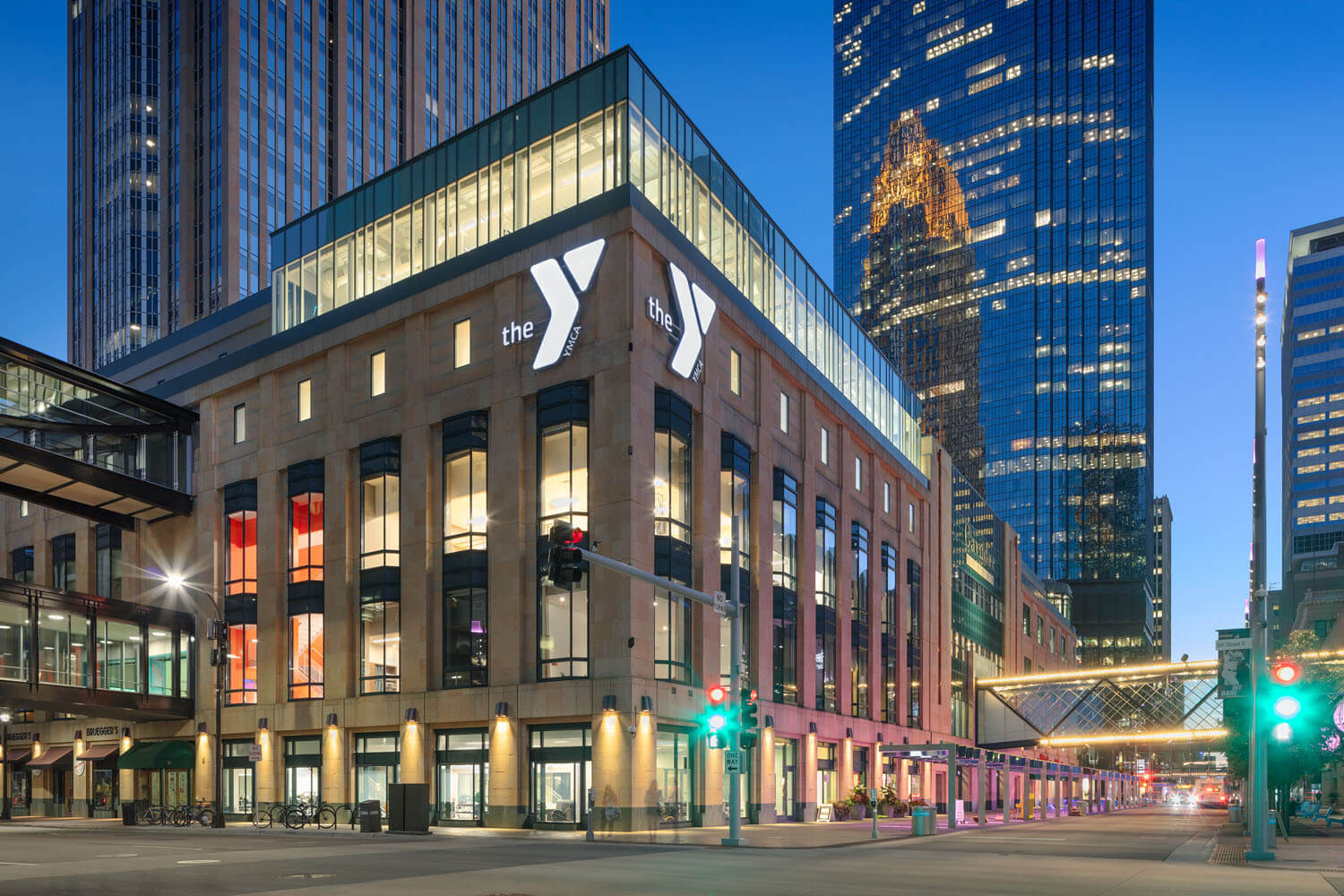
Drawn to its main arterial location along 6th Street and Nicollet Mall—and its iconic design by the late César Pelli in collaboration with Lohan Associates in Chicago—the YMCA of the Greater Twin Cities set its sights on about 104,000 square-feet within the 1989-built Gaviidae Common. Featuring an atrium of pillars and one of the largest barrel-vaulted ceilings in the state, as well as skyways, the mixed-use, retail building offered the organization a chance to tap into the heart of the downtown fibrous network.
“We loved that it was a main-and-main location. It is physically connected to the highest foot traffic in the skyway system with two main arteries feeding in. We really liked that it was a hub and that the Y is at the center of downtown Minneapolis,” Lancello Bydlon said. “This building has this amazing atrium that goes across the building with skylights and just allows so much daylight into the building and provides an open work environment for our team, but also members and participants who are coming into the facility.”
Housed on multiple floors wrapped around the perimeter of the open atrium—and above retail space and skyways—the existing building also presented its own design challenges for the architectural planning team to accommodate the Y’s programmatic needs ranging from office space, rooftop fitness studio, and a four-lane pool, to the George wellbeing Center and YMCA Equity Innovation Center.
Lancello Bydlon said even when considering traditional health and wellness programming, the spaces were more specialized or customized like boutique studios rather than a one-size-fits-all.
“We were really looking for specialized and unique areas and we certainly got that. The other part of our evolution is our work around wellbeing,” Lancello Bydlon said. “Penny George and her husband Bill George put some significant resources behind how we bring wellbeing services to the community, especially to people who can’t afford those types of services—acupuncture, aromatherapy, massage, health coaching, nutrition, and diet—so there is a significant wellness center that exists and we are now working to integrate that into all of our Y facilities.”
The YMCA Equity Innovation Center is another unique program carved out in the space. A “collaborative engine of equity innovation,” the center expands the Mission Impact Council work that began roughly five years ago and seeks innovative ways to solve problems of inequity, exclusion, and intolerance.
“It is the first-of-its-kind in the YMCA network across the country,” Lancello Bydlon said. “We have a partnership with the Science Museum of Minnesota where we designed and implemented an equity innovation lab where you have an opportunity to go in and experience how equity, inclusion, and diversity manifest themselves in a positive or negative way in the Twin Cities, and across the country.”
Embracing the Atrium
Though the main-and-main location presented an ideal opportunity for the Y exposure, ease of access, and the atrium itself offered an architectural element reflective of that connection and exposure, Mullins said Gaviidae Common was designed as a five-story, office-and-retail building with the atrium taking up about one-third of the floor plate. The design solution was to embrace the atrium as an architectural feature, construct bridges that crossed the space, and replace the six existing escalators with stairways that project out into the center. The removal of escalators also was an intentional strategy to encourage movement, which goes back to the Y’s mission.

“It was definitely a plan and volumetric puzzle,” Mullins said. “The atrium was really the heart of how we connected and weaved the floors together. Part of the beauty of the atrium and the way we wove the floors together is that no matter where you are in the building, these different programs don’t sit as islands unto themselves, but they are visually and spatially woven together. You are always in the presence of all the programs.”
The grand staircase leading to a branded wall on the second floor, where the main entrance led to the fitness facility and Equity Innovation Center, was also at the heart of the project, according to Mullins, and while fitting a gymnasium and pool into the building were challenging, it resulted in something beautiful. The team addressed the low floor-to-ceiling heights by taking out a portion of the fifth floor to gain the necessary volume and reduce the structural loads.
“It was a challenge to find a footprint big enough for the pool and the gymnasium to sit, but also challenging to find the volume,” Mullins said. “The pool and the gymnasium actually took away floor space on the fifth floor, so that meant it restricted our avail- able space for the rest of the programming more, but in the end I think it is really part of this project as an insertion into this existing building and speaks beautifully about the holistic nature of programming.”
Though the space now has ample daylighting and views of the surrounding downtown landscape—particularly from the rooftop—Mullins said at the onset, the building was very dark and quiet due to its previous program and as it transitioned to function for the Y, it visually energized and brightened the space.
“With the design we have, we dragged that light all the way down into the second floor skyway level, which is still retail, and so there is a lot of activity and a lot of buzz in the air. The audible nature of the air and the acoustics ramped up a bit, too,” Mullins said.
Stairs and bridges connect areas such as fitness studios, gymnasium, pool, locker rooms, workplace café, conferencing and office spaces, and a rooftop deck with an outdoor training center on the different levels; providing not only a connection between and among space through its circulation paths, but also a relationship between the Y and those at the retail and skyway level. It also serves to break up the large atrium volume, visually.
“How we went from one space to another space, in a way, was a conceptual extension of that city skyway circulation up through the entire project,” Mullins said. “I think the circulation setup across the atrium really serves to weave the different programs together.”
A Public Forum
Known as the Douglas Dayton YMCA at Gaviidae, the nearly $30 million project was completed and opened in early 2018. To Mullins, from a design standpoint, a distinctive element of the project—and part he is most proud of—is the way the stairs and bridges not only cross the atrium, but also pull energy from the skyway up throughout the building.
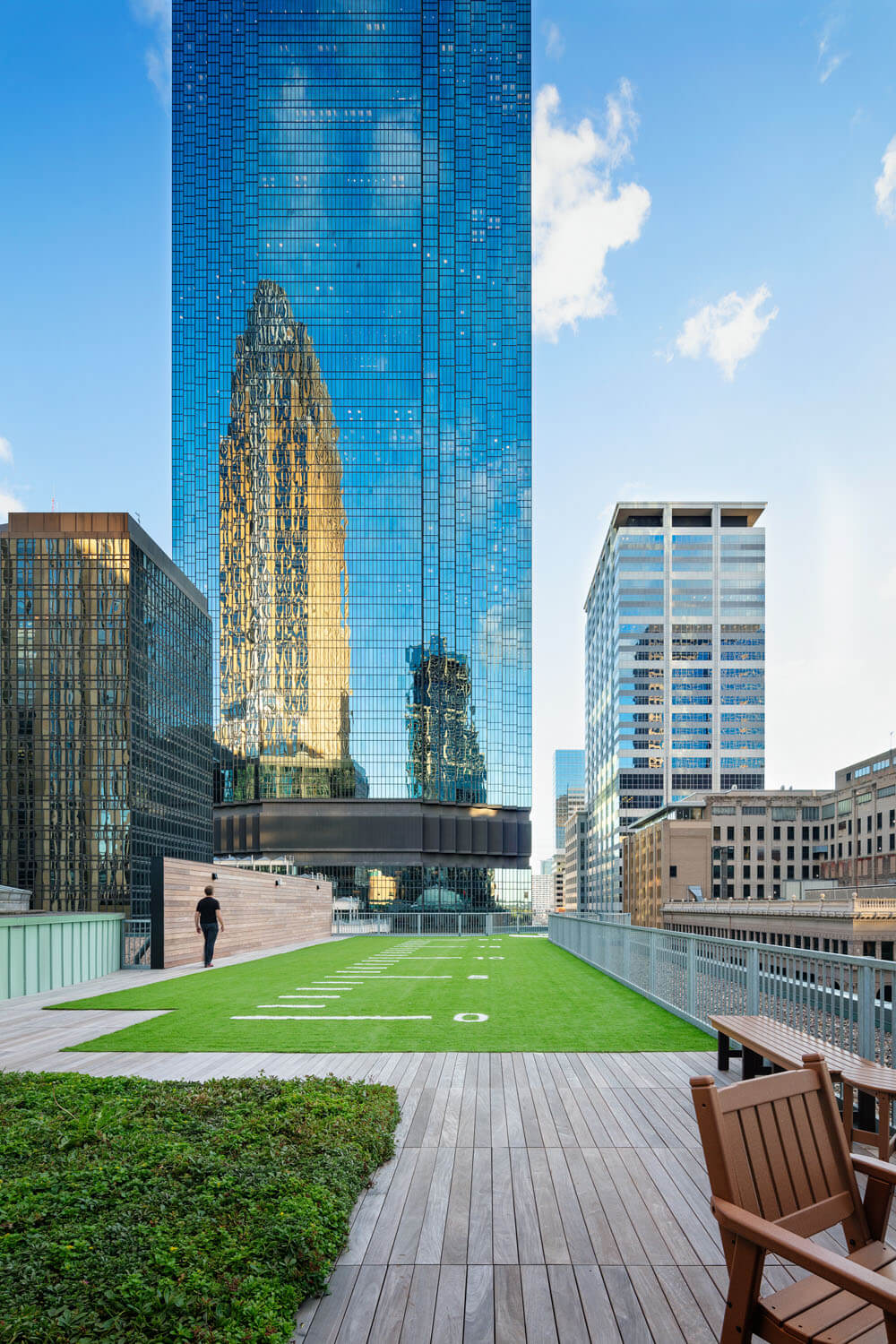
“The atrium feels like it is a natural public forum. There is a connectedness that is real and it is palatable when you are in there,” Mullins said. “It really does pull itself up onto the roof where there is this turf area. The way that this five-story podium building sits in downtown Minneapolis, it is surrounded by extremely tall buildings, so it is almost like another volume, like the pool or gymnasium, where you are nestled in the city and it feels like you are part of the city.”
For Lancello Bydlon, the transformation of Gaviidae Common throughout the process has really served as a catalyst for new and evolving development in downtown Minneapolis.
“It has rejuvenated the whole location and that piece is never-ending for me in terms of the impact as a person who has worked downtown for a long time. Having the Y occupy that space, there is this energy and welcoming environment for people. Even if you are just cutting through, you glance up and see all this activity going on. It is truly a gathering space,” Lancello Bydlon said.
“There was a lot of back-and-forth. As a not-for-profit, we have limited resources that are appropriate to invest in the location and while we want to dream big, we need to be modest and represent who and what we are. We really had a great time and I think that is what matters the most in getting through a process like this. We compromised well and landed on a solution that is just amazing,” Lancello Bydlon added.
Mullins said taking the Y’s programming and inserting it into the shell of the five-story building was very successful and it is a testament to a lot of iteration and discussion with the clients to ensure the design solutions met their vision.
“I think the building was challenging and weaving in the program and the structural requirements of it, but at the same time, those challenges led to a building that really shines in this context. Even though it was a crossroads of two major skyway systems, it was quiet and it was a space you just moved through,” Mullins said. “I think a lot of the greatness wouldn’t have come without the challenges.”
Read More . . .
This article originally was published in Great Lakes by Design.